
Fitzroy Gardens Melbourne: Plan Your Walk
Plan a Fitzroy Gardens walk with the Fairies’ Tree, Cooks’ Cottage, accessible-route checks and the Conservatory closure on 9–13 November 2026.
Fitzroy Gardens suits a Melbourne walk with distinct things to notice: long tree avenues, a carved Fairies' Tree, a miniature village and small historic buildings. Choose it when you want an outdoor break with a few clear stops close to the eastern side of the city centre. You can enjoy the gardens without buying a Cooks' Cottage ticket or completing every numbered point on a map.
Current exception: the Conservatory has a scheduled closure from 9 to 13 November 2026 for a display change. This guide was checked on 12 November 2026, during that closure period. Plan an exterior-and-gardens route for those dates and check the official Conservatory listing before relying on interior access afterwards; the schedule can change.
For the wider choice of museums, neighbourhoods and outings, see our Melbourne guide. This walk is in East Melbourne. The name should not send you to the separate Fitzroy neighbourhood around Brunswick and Gertrude Streets.
Fast facts
| Decision | Practical answer |
|---|---|
| Main purpose | Free garden walk with architecture, trees and small heritage stops |
| Suggested allowance | 60–90 minutes for a selective circuit; longer with cottage entry or activities |
| Useful starting point | Fitzroy Gardens Visitor Centre, Wellington Parade |
| Conservatory | Normally free, 09:00–17:00; scheduled closure 9–13 November 2026 |
| Cooks' Cottage | Separate paid entry; 10:00–16:00, last individual entry 15:45 |
| Cottage adult admission | AUD8.20 on the check date |
| Access | Use a route suited to your needs; some mapped stops have access limitations |
Durations are editorial estimates, excluding your journey and any queue. The garden walk and the buildings inside it have different conditions. An open park does not guarantee entry to every attraction or the operation of every fountain.
Choose Fitzroy Gardens for a compact, varied walk
The strongest reason to come is the changing scale of the experience. You can move from an avenue of mature trees to a small carving, from an English cottage to a fern-lined stream. That variety makes a selective route satisfying without requiring a full afternoon or detailed botanical knowledge.
If you want a visit centred on plant collections and a larger botanical outing, compare our Royal Botanic Gardens Melbourne guide. Fitzroy Gardens is especially useful when a park break should fit around central-city plans and include small cultural landmarks. You do not need both gardens on the same day simply because both are green spaces.
Before setting out, choose one priority: a short tree-and-stream walk, a family route with the Fairies' Tree and model village, or a heritage visit including the cottage. You can add another element if everyone remains interested. This is more flexible than committing to all the stops before seeing how much attention each one deserves.
Start with a map and the story of the land
The Visitor Centre supplies free walking maps and information about the gardens, public transport and children's activities. It is a useful starting point when you want to confirm current paths or choose a suitable route. The city's self-guided walk also provides a sequence of features to select from.
The gardens are on Wurundjeri Woi-wurrung Country. Include the Scarred Tree as a meaningful stop rather than reading the place only through its later European buildings. The city's interpretation explains that bark was removed from trees to make useful objects such as canoes, containers and shields. Follow the interpretation on site for this tree instead of inventing the exact purpose of its scar.
The preserved Scarred Tree and the Fairies' Tree are different things. The former records Aboriginal cultural practice; the latter is a twentieth-century artwork by Ola Cohn. Keeping that distinction clear makes both stops more useful. Read before photographing, stay outside any protective boundary and treat the surviving tree remains as evidence deserving care.
Let the avenues and stream set the pace
Take time on an avenue rather than moving only between labelled attractions. Look at how the trees frame a long view and how the character changes when a path turns toward water or smaller planting. A garden can be appreciated through those transitions even if you do not identify every species.
The city's garden overview describes a stream and fern gully in the southern section near the visitor centre. This offers a different scale from the broad avenues: choose it when you want a closer look at water and planting. Follow the actual open paths; shade does not remove the need to consider weather and footing.
Hotham Walk gives an east-west line through the gardens, with the option of continuing west toward Treasury Gardens and the city centre. Use that connection when your next destination lies in that direction. If you started on Wellington Parade and need to return there, a shorter loop may be more useful than crossing the whole park and retracing your steps.
A family route with two small-scale anchors
The Model Tudor Village and nearby Fairies' Tree make a natural pair. At the village, look for the differences between houses and public buildings rather than trying to count everything. The city explains that the model was given in appreciation of Australian food parcels sent to Britain during the Second World War. Its miniature scale is an invitation to look closely, not to enter the enclosure.
Ola Cohn's Fairies' Tree uses the form of an old red gum for carved figures, animals and birds. Give children one detail to find, then let them choose another. This keeps attention on what is actually there instead of turning the stop into a lecture. The carved tree is an artwork, so avoid touching or climbing it and respect any protection around it.
For a more structured visit, check the current Fitzroy Gardens Outdoor Adventure listing. It describes a free map challenge for primary-school-aged children, requiring adult help, and a simpler Seek and Find activity for younger children. Bring a pen and collect the relevant material at the visitor centre during its opening hours. This is an optional activity, not a reason to force a tired child through every stop.
Decide whether Cooks' Cottage adds enough interest
Cooks' Cottage is a separate paid attraction. The official cottage description makes an important correction: James Cook never lived in this house. His parents built it in Yorkshire in 1755, and it was transported to Melbourne in 1934. Visit for that unusual relocation story and the domestic setting, rather than expecting the explorer's preserved Melbourne home.
The booking and admission page currently lists individual admission at AUD8.20 adult, AUD6.10 concession, AUD4.50 child aged 5–15, and AUD22 for two adults and two children. Individual visitors do not need to book; opening is 10:00–16:00 with last individual entry at 15:45. Recheck the applicable category and date before paying.
Choose entry if a small historic interior and the story of moving it across the world interest you. If your main aim is outdoor time, observing the exterior and continuing through the gardens is a coherent choice. The cottage is not an admission gateway to the whole park, and skipping it does not leave the garden walk incomplete.
Groups and schools have separate booking requirements; the official pages require advance arrangements for groups of eight or more. Do not apply an individual's walk-in conditions to a larger party. Likewise, a guided group product is not evidence that an individual tour departs whenever you arrive.
Treat the Conservatory as a conditional stop
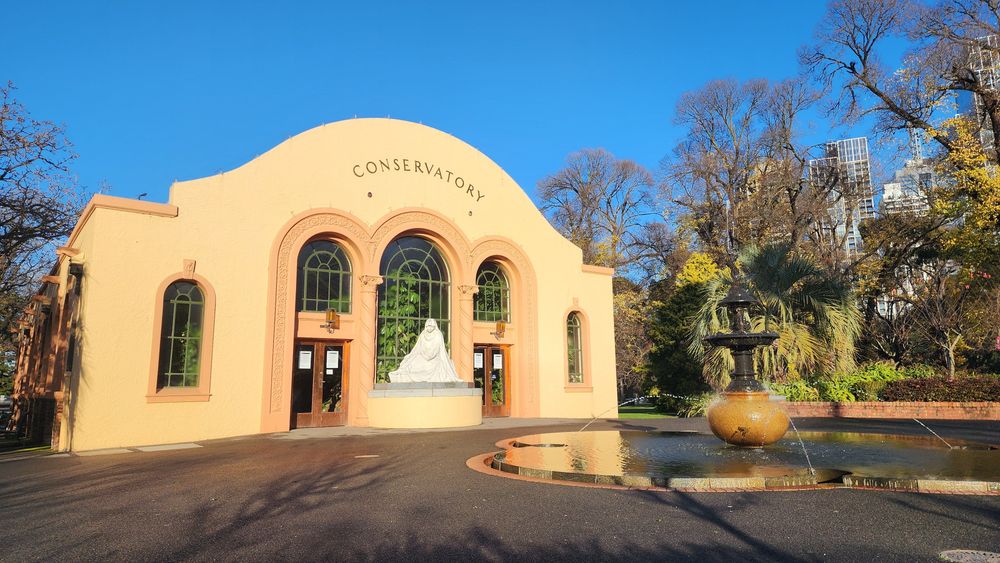
The Conservatory's Spanish mission-style exterior is part of the walk even when the interior is closed. The building opened in 1930, and its indoor floral displays normally change five times a year. This makes it a maintained display space with planned interruptions, rather than a room whose contents and access stay constant.
Normal published hours are 09:00–17:00, with free entry. However, the 9–13 November 2026 display-change closure overrides those hours during this guide's check period. If the flowers are your main reason for coming, verify reopening directly before choosing a date. Do not interpret the end of the scheduled closure as independent confirmation that the doors have reopened.
When the interior is available, use it as a short, concentrated change from the outdoor planting. Notice colour combinations and arrangement rather than expecting a particular plant from a photograph taken in another season. If it is closed, continue to the avenues, carved tree or cottage exterior; there is enough variety for a worthwhile walk without substituting another distant attraction.
Add architecture only while it remains interesting
The Temple of the Winds rotunda and the older band pavilion offer different shapes among the trees. The city guide dates the rotunda to 1873. Compare a building's setting and sightlines with the open paths around it; this gives the architecture a role in the garden rather than treating each structure as a compulsory photograph.
Sinclair's Cottage provides another contrast, with its patterned brickwork and association with the garden's head gardener. Treat it as an exterior stop unless access is explicitly offered. A historic building shown on a walking map is not automatically an interior attraction open to the public.
If you have already enjoyed the stream, a tree avenue and the small-scale artworks, it is reasonable to finish. A selective walk can feel complete without visiting every fountain and statue. Choose the exit that serves the rest of your day, rather than adding distance merely to complete the printed sequence.
Adapt the route for access and current conditions
The city's garden overview describes broad, smooth paths and accessible toilets, and directs visitors with specific access needs to the visitor centre. Use the visitor centre to identify alternatives for your mobility needs instead of assuming that every small bridge, garden feature or building shares the main paths' access.
Cottage access should be checked separately through its own accessibility information. Someone who comfortably uses a garden avenue may still need a different arrangement for a historic interior. Agree on a satisfying outdoor route first, then add buildings only when their practical conditions work for the group.
Weather and temporary works can also change the best circuit. Shorten the route when needed, use current signs, and keep the Conservatory closure separate from the question of enjoying the gardens themselves. Fitzroy Gardens works best as a place to look carefully and move at your own pace, with enough structure to notice what a quick crossing would miss.
Cover photograph: Peach-coloured Conservatory and fountain in Fitzroy Gardens, Melbourne, photographed in 2024 — Archive photograph; no edits to the downloaded file — Shkuru Afshar, CC BY-SA 4.0.
Frequently Asked Questions
Is Fitzroy Gardens free to visit?
The garden walk is free. Cooks' Cottage charges separate admission, while the Conservatory normally has free entry during its opening hours, subject to display-change closures.
Is the Conservatory open in November 2026?
A scheduled closure runs from 9 to 13 November 2026. Check the official listing before planning an indoor visit after those dates; normal hours do not override a closure notice.
Did Captain Cook live in Cooks' Cottage?
No. The official description says his parents built it in Yorkshire in 1755 after he had left home. It was moved to Melbourne in 1934.
Are Fitzroy Gardens in the Fitzroy neighbourhood?
No. The gardens are in East Melbourne near Wellington Parade. The Fitzroy neighbourhood around Brunswick and Gertrude Streets is a separate destination.


Keep Exploring
Royal Botanic Gardens Melbourne: Plan Your Walk
Choose a relaxed lakeside visit or a plant-focused walk at Royal Botanic Gardens Melbourne. Includes free entry, guided experiences, accessibility and the distinction from Cranbourne.
Buenos Aires Botanical Garden: Plan Your Walk
Choose a Carlos Thays Botanical Garden route, with seasonal hours, last entry, weather closures and the greenhouse access to check.
Menara Gardens Marrakech: Plan Your Visit
Plan a Menara Gardens walk around the basin and olive grove, compare pavilion admission and organise transport without relying on unverified garden hours.