
Chinese Garden of Friendship Sydney: Visit Guide
Plan a garden walk, guided introduction or family visit in Darling Harbour, with accessible-route choices, current activities and exhibition limits.
The Chinese Garden of Friendship works best as a deliberate pause in a Darling Harbour day: a place to follow water, stone and changing views rather than hurry between attractions. Choose whether you want a quiet independent walk, a guided introduction or a family visit built around an activity. That decision matters more than trying to photograph every pavilion.
This is a contained, ticketed garden at the southern end of Darling Harbour. It offers a different experience from a long harbourfront walk or a broad botanic-garden visit. For the wider choices, see our guide to things to do in Sydney; here, the focus is how to give this particular garden enough attention without overloading the day.
Checked on 13 November 2026: the garden lists daily opening from 10:00 to 17:00, except Christmas Day and Good Friday. Guided-tour places are limited, and the exhibition “A Garden Through Friendship” is marked unavailable until further notice. Do not confuse that exhibition closure with closure of the whole garden.
Choose the visit you actually want
| Visit style | A useful plan | What to check |
|---|---|---|
| Independent garden walk | Water-level paths, pauses at pavilions, then any suitable higher paths | Your route, footing and available time |
| Cultural introduction | Discovery Tour followed by your own exploration | Places at the front desk on arrival |
| Plant-focused visit | Plants in a Living Landscape Tour | Current daily programme and seasonal focus |
| Family visit | Emperor's Quest and a possible staffed fish-feeding session | Children's interest, activity availability and supervision |
| Wheelchair or pram visit | Lower garden paths and pavilions | Current accessible route; upper steps are a separate issue |
As an editorial allowance, plan about an hour for a focused independent visit, or around 90 minutes to two hours if you want a tour, family activity or longer pauses. A restaurant meal needs its own time. These estimates are for organising your day, not an official minimum or a guarantee that every activity will fit.
The garden suits someone willing to slow down and look from several positions. If your group mainly needs space to run, a picnic lawn or an indoor wet-weather attraction, decide that before paying. The garden's character and visitor rules make those different outings.
Arrival, opening hours and admission
The official garden page places the entrance on Tumbalong Boulevard, at the southern end of Darling Harbour. The street address is Pier Street at Harbour Street. Set your directions to the garden entrance rather than simply to Darling Harbour, which covers a much larger area.
The current opening hours are 10:00–17:00 daily, with closures on Christmas Day and Good Friday. Arrive with enough time to enjoy the paths before closing; do not infer an evening garden visit from a restaurant's later service. Check any date-specific notice before travelling, particularly if the garden is the main reason for your journey.
Admission is paid. Review the current ticket categories before purchasing, including the conditions for children, family tickets and concessions. Australian-card requirements apply to the advertised concession categories; an overseas student or senior should not assume eligibility. A general admission ticket also does not reserve a restaurant table or guarantee a place on a limited tour.
Travel with a manageable bag. A compact garden visit becomes less restful when you are carrying luggage between narrow viewpoints and stepped sections. If you are meeting someone, agree on the entrance rather than a pavilion inside, so a delay does not leave one person searching the paths.
Read the landscape rather than collect landmarks
The official history of the garden explains its role in the friendship between Sydney and Guangzhou and between New South Wales and Guangdong. Opened in 1988, it brings Chinese landscape design into an Australian city setting. The Dragon Wall offers a concrete starting point: its brown dragon represents Guangdong and its blue dragon New South Wales.
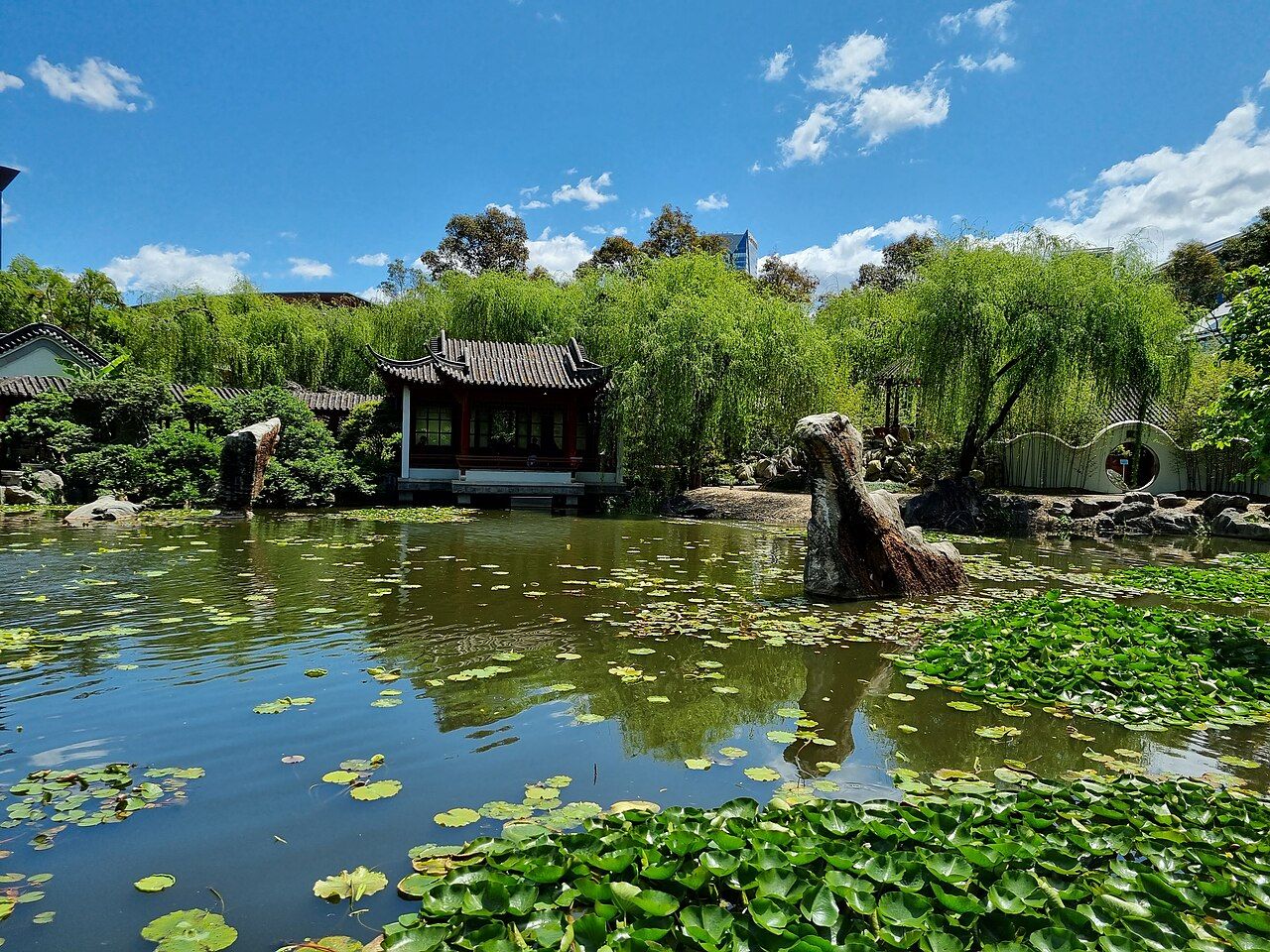
Use that introduction to look at how the garden is composed. Notice where stone frames water, where a building interrupts or reveals a view, and how a turn in the path changes the scene. The pleasure is often in revisiting the same pond from a different angle rather than discovering an entirely new feature at every turn.
Start with a comfortable lower-level circuit and identify places where you would like to stop. If the higher paths suit your mobility and the conditions, add them afterwards. This sequence makes the visit flexible: you can shorten it without feeling that you have abandoned an essential summit or compulsory circuit.
A pavilion can be a place to look outward, not simply an object to photograph. Pause long enough to compare the foreground and the reflected view. Keep paths and doorways clear, especially where several visitors are trying to enjoy the same framing.
Include the newer Meandering Pathway
The garden is not frozen at the layout shown in older photographs. The operator's account of the Meandering Pathway of Tranquillity describes the Friendship Bridge, a bamboo forest walk, Lotus Pavilion and Seven Sages Walk. This addition gives another sequence of views to explore beyond the best-known images of ponds and pavilions.
Ask for orientation at the entrance so you can include the pathway in a sensible order. Do not use an old cover photograph as a complete map of the current garden. If you have limited time, choose this area or a longer pause elsewhere rather than increasing your walking speed simply to include everything.
The route is also a useful reminder that landscape is experienced through movement. Compare the open views with the more enclosed bamboo section, and notice changes in sound near water. Those observations make the visit richer without needing to memorise a catalogue of names.
Guided tours: arrive for a possibility, not a guaranteed seat
The current daily-tour programme advertises the Chinese Garden Discovery Tour at 10:30 and 14:00, lasting 35 minutes. It introduces history, landscape and cultural heritage. The Plants in a Living Landscape Tour is listed at 12:00 and lasts 45 minutes, with a seasonal plant focus.
Tours are included with garden entry, but places are limited; the operator asks visitors to enquire at the front desk on arrival. Reaching the gate at the advertised starting minute is therefore a poor plan if the tour matters to you. Leave time to enter, ask and find the meeting point, while retaining an independent-walk alternative.
Choose the Discovery Tour if you want help interpreting design and cultural context. Choose the plant tour if seasonal planting is your main interest. Attending both may suit an enthusiast, but most short visits benefit from one guided element followed by time to notice things independently.
Visiting with children: a search and a supervised activity
The Emperor's Quest gives children aged five to twelve a search for the twelve animals of the Chinese lunar calendar. The operator describes a map and viewfinder and includes the activity with garden admission. Ask about it when entering rather than discovering it after the children have already walked most of the paths.
Treat the search as a way to look carefully, not a race to finish twelve stops. Let children notice a sculpture and connect it with the clue, then pause by the water or a pavilion. Adults must accompany them. The garden is not a playground: remain on the permitted paths and do not climb rockwork or chase wildlife.
The staffed koi-feeding activity is advertised at 11:30 by Lenient Jade Pavilion, included with entry and without a separate booking. It can be cancelled in colder conditions when the lake water falls below 10°C; the operator recommends checking with the team on the day. Do not promise the activity to a child before confirming it, and do not feed the fish independently.
Accessibility and weather change the route
The operator states that lower-garden paths and pavilions are accessible for wheelchairs, buggies and prams, while steps and rocky paths make the upper area difficult to access. An accessible toilet and baby-changing facilities are available. The closest passenger drop-off is on Harbour Street.
Ask staff to identify the best lower-level route for your needs. “Accessible lower garden” should not be expanded into a claim that every viewpoint is step-free. Equally, choosing the lower route is a meaningful garden visit, not merely waiting while others explore. Agree in advance whether the group wants to stay together or briefly split for stepped sections.
Wear shoes that cope with uneven and potentially wet surfaces. Shelter at a pavilion does not make all the connecting paths an indoor experience. In rain, shorten the route or concentrate on comfortable stopping points; in warmer weather, allow pauses rather than trying to maintain a city-sightseeing pace. Seasonal plants and wildlife are part of a living garden, so a photograph from another month is not a promise of what you will see.
Meals, photographs and the unavailable exhibition
One Dining operates inside the garden, with lunch and dinner advertised separately. Its evening service takes place after the garden closes. A dinner booking should therefore not be interpreted as general evening access to every garden path. Confirm restaurant times, availability and admission arrangements directly when booking.
Picnics are not permitted in the garden. If bringing lunch is central to your day, arrange to eat elsewhere before or after the visit. Keep a meal reservation separate from a tour plan so a full guided session does not leave you rushing away halfway through.
For ordinary personal photographs, avoid blocking pathways or occupying a pavilion for a prolonged session. Professional or arranged shoots have additional approval rules; check the garden's photography conditions before organising one. The best viewpoint is still a shared visitor space.
The “A Garden Through Friendship” exhibition page currently says it is unavailable until further notice, despite retaining older opening-hour text. The closure notice takes precedence for planning. You can still explore the garden and its history, but do not build the visit around entering that exhibition.
Fit it into a Sydney day
Use our three-day Sydney itinerary to give the garden a sensible place among larger outings. It works well as a focused part of a Darling Harbour day, with a meal or an unhurried walk afterwards. Trying to add it between two tightly timed attractions removes much of the reason to go.
Before leaving, check opening notices and decide whether a tour or family activity is your priority. At the entrance, confirm that activity and your preferred route. Then allow some unscheduled time: a garden designed around changing views rewards attention more than a rapid sequence of stops.
Cover photograph: Pond, rock formations and pavilion in Sydney’s Chinese Garden of Friendship — Maksym Kozlenko, CC BY-SA 4.0.
Frequently Asked Questions
How long should you spend at the Chinese Garden of Friendship?
About an hour is a useful allowance for a focused independent walk. Plan around 90 minutes to two hours for a tour, family activity or longer pauses, and add separate time for a restaurant meal.
Is the whole garden accessible by wheelchair or pram?
No. The operator identifies the lower paths and pavilions as accessible, while upper sections have steps and rocky paths. Ask staff for a route suited to your needs rather than assuming every viewpoint is step-free.
Are guided tours guaranteed with admission?
No. They are included with garden entry but have limited places. Enquire at the front desk on arrival and keep an independent walk as an alternative if your preferred session is unavailable.
Is A Garden Through Friendship exhibition open?
At the 13 November 2026 check, it was marked unavailable until further notice. That applies to the exhibition, not the entire garden. Recheck its dedicated page before making it part of your plans.


Keep Exploring
New York Botanical Garden: Plan Your Visit
Choose NYBG tickets, a forest or exhibition route, and the right Bronx arrival, with current tram limits and the 2026 Holiday Train Show dates.
Buenos Aires Japanese Garden: Plan Your Visit
Choose a Japanese Garden walk or guided visit in Palermo, with current resident and visitor prices, rain rules, access and meal arrangements.
Parque Lage Rio: Plan Your Garden Visit
Visit Parque Lage’s free gardens while the palace is closed for restoration, with a focused route, access advice and a separate Corcovado decision.