
Central Park: Choose a Walk That Fits Your Day
Plan a manageable Central Park walk with named landmarks, sensible exits and alternatives for closures, limited mobility or changing weather.
A good Central Park walk has an entrance, a small group of landmarks and an exit that fits the rest of your day. For the familiar skyline-and-lake views, choose the southern route. For a park visit beside the museums, start in the middle. For gardens or woodland, travel directly to the north rather than walking there after a full southern circuit.
The times below are editorial sightseeing allowances, including pauses but excluding travel to the park, meals and museum visits. They are not measured accessible-route durations.
| Walk | Suggested allowance | Main stops | Best fit |
|---|---|---|---|
| Southern landmarks | 90–120 minutes | Pond, Gapstow Bridge, Mall, Bethesda Terrace | First visit from Midtown |
| Middle park | 90–120 minutes | Belvedere, Turtle Pond and nearby paths | A shorter walk before or after a museum |
| Northern garden | 60–90 minutes | Conservatory Garden and a selected Harlem Meer extension | Formal planting and a compact northern visit |
| Northern woodland | 90–150 minutes | North Woods and the Ravine | Walking and nature observation |
Our New York highlights guide helps decide where the park belongs in the wider trip. A route that ends near your next destination is usually more useful than one that collects another distant landmark.
Before setting off: current conditions matter
The Central Park Conservancy help centre lists park opening from 06:00 to 01:00 daily. Gardens, visitor centres, restrooms and attractions have shorter individual schedules. Those broad park hours are not a recommendation to follow a woodland route after dark.
On 26 October 2026, the Conservancy's alerts page listed Bethesda Fountain as switched off for restoration while Bethesda Terrace remained open. It also reported partial Reservoir running-track closures through late fall, selected Concert Ground path and bench closures, and Ramble restroom maintenance from 13–30 October. Great Lawn is closed for the season, with reopening planned for spring 2027.
The NYC Marathon also affects access: West Drive between 67th and 72nd Streets has partial or full closures from 23 October–2 November, and all entrances along Central Park West between West 66th and 81st Streets close on 1 November. The finish-line area near West 67th Street closes from 30 October–2 November; Sheep Meadow closes from 30 October–1 November. On 31 October, Central Park South, the closed East Drive and the southern Park Drive loop are closed until noon. Check the full alert and rerouted paths before choosing an entrance on those dates.
These notices do not close the whole park. Keep Bethesda as an architectural and lake-view stop, avoid depending on a complete Reservoir circuit and use an alternative open restroom before entering the Ramble. Recheck the alerts for your date: a temporary notice is not a permanent description of the place.
Southern walk: the Pond to Bethesda Terrace
Start at the southeast corner near Fifth Avenue and Central Park South. This suits a day arriving from Midtown and puts the Pond close to the beginning. Visit Gapstow Bridge for the contrast between stone bridge, water and the skyline to the south. Move around the Pond's edge to change the view rather than waiting for a single photograph from the bridge itself.
Continue north towards the Mall and Literary Walk. The shift from curved waterside paths to the long tree-lined promenade is part of the experience. Follow open paths around any Concert Ground works instead of assuming every bench and crossing is available. A pause here is worth more than adding a hurried detour into every nearby attraction.
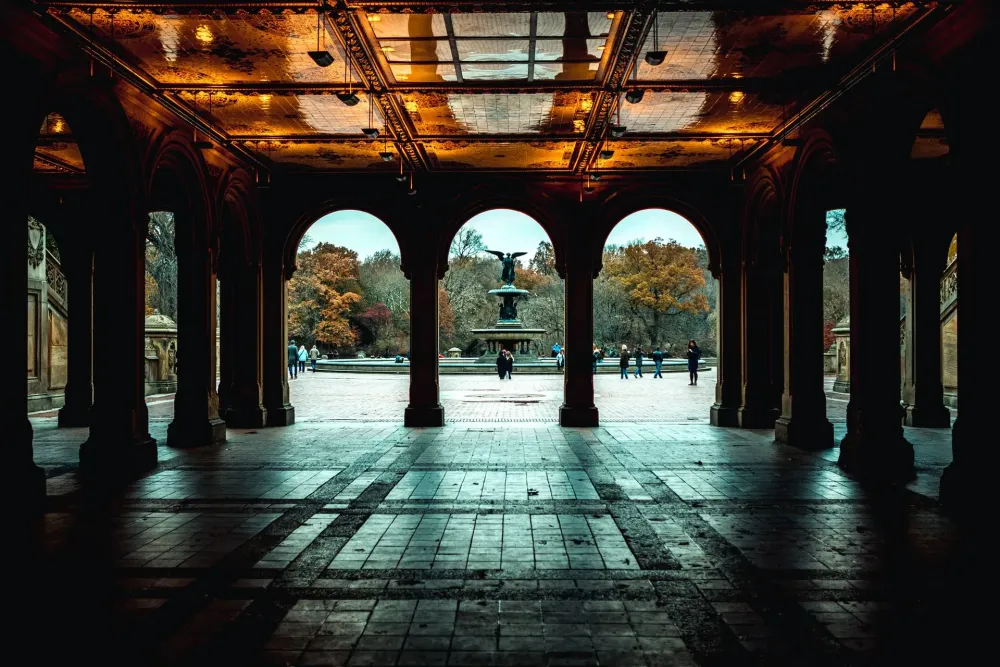
The Mall leads towards Bethesda Terrace, with its upper and lower levels, arcade and fountain setting. Look at the carved architectural details and the view towards the Lake. The fountain restoration changes the water display, not the value of the terrace as a place to stop.
The visible stairways are not the only detail to consider when planning access. If avoiding steps matters, consult the Conservancy's access information before choosing the approach and do not simply follow the shortest line on a navigation app. The published Bethesda restroom listing says that restroom is not wheelchair accessible; choose facilities as part of the route, not after reaching them.
Add Bow Bridge only if time remains
From the Bethesda area, Bow Bridge makes a logical extension towards the Lake and the edge of the Ramble. It connects the lake-side scenery with woodland paths, so crossing it creates another decision: return to your planned exit or continue into a less direct network of paths.
Allow an additional 30–45 minutes as an editorial estimate for the detour and pauses. You do not need to enter deeply into the Ramble to enjoy the bridge. If your next stop is on the east side, avoid wandering west merely because another landmark appears nearby on the map.
For the shortest version, finish after Bethesda and leave towards the side that suits your onward journey. For a longer version, make Bow Bridge the final destination rather than the beginning of an unplanned walk to the northern end of the park.
Middle walk: Belvedere and Turtle Pond
Choose an entrance near the middle of the park when pairing the walk with a museum. An approach from Central Park West around West 81st Street is useful for the Belvedere area; an eastern approach can suit a day already centered on the Met. Check the pedestrian entrance rather than using a cross-park road as though it were the scenic walking route.
Belvedere Castle stands on Vista Rock and overlooks Turtle Pond and the Great Lawn. Its changing levels make it a more demanding destination than a level lakeside pause. As checked for this guide, the building's published hours are 10:00–17:00 daily, with terrace access ending at 16:55; it closes on Thanksgiving, Christmas Day and New Year's Day.
You can build the walk around the landscape without making an upper terrace essential. Look towards the castle from the surrounding paths and Turtle Pond, then decide whether the approach and steps suit your group. The visitor-centre opening window is distinct from the park's overall hours.
Use the pond-side area as the unhurried part of the walk. A museum visit already involves substantial standing and concentration, so this is a good place to reduce the number of additional stops. If you want to continue, choose nearby paths around the Great Lawn before considering the much longer trip north. Stay on open surrounding paths: the Great Lawn itself is seasonally closed until spring 2027.
Do not automatically append a complete Reservoir loop. Current partial track closures can interrupt that plan, and reaching the Reservoir is additional walking before the circuit even begins. When the objective is a pleasant museum-day break, a shorter route around Belvedere and Turtle Pond is often the better use of time.
North option: Conservatory Garden and Harlem Meer
For a garden-focused visit, arrive on the Fifth Avenue side near the Conservatory Garden. The official garden page distinguishes the French-style North Garden, Italianate Center Garden and English-style South Garden. Comparing their layouts gives a purpose to the walk even when your visit does not coincide with a particular flowering display.
The garden has its own seasonal hours. The published October schedule is 08:00–18:00, checked for this guide; use the current month rather than assuming the main park schedule applies. Do not plan a late garden visit simply because other park paths remain open.
Walk through the different garden areas at a pace that leaves time to sit and look. Seasonal planting changes the scene, but no specific bloom or autumn colour is guaranteed on a fixed date. If photography is the priority, allow flexibility for light, weather and other visitors.
Add a selected stretch towards Harlem Meer if the garden visit leaves time and energy. Treat the water-side walk as an extension, not an obligation to loop every northern feature. Any activity or programme around the Meer needs its own current check; seeing the lake does not require booking a recreational activity.
This route is a useful alternative to the southern landmarks, especially when your day already starts uptown. Travelling north specifically for the garden can be sensible; trying to reach it on foot after a full Midtown-to-Bethesda walk changes the scale of the outing considerably.
North option: woodland instead of formal gardens
The North Woods includes the Ravine and a different landscape of woodland paths. Choose it when the main activity is walking and observing nature, rather than when you need a quick passage between appointments.
Use a current map to choose a short outward route and a clear return. The winding paths are part of the appeal, but they make “continue north until the exit” a poor navigation plan. Stay on designated paths and turn back before the route becomes longer than your group's comfortable walking range.
The Conservancy's hiking guide describes the Loch and its cascades between Glen Span Arch and Huddlestone Arch. These are useful named features for choosing a woodland walk. They are not evidence that every connecting path is level, dry or suitable for every mobility aid.
After rain, reduce the route if footing is slippery. For an outing that needs frequent benches, predictable surfaces or a quick exit, choose a shorter garden or perimeter-adjacent version instead. Plan restrooms before entering the woods; the North Woods location page does not list facilities within the woodland itself.
Adapt the walk to weather and the next stop
In hot conditions, shorten exposed stretches and allow more breaks. In persistent rain, choose an indoor visit first and retain only a short park walk if conditions improve. The Met on the east side and the American Museum of Natural History on the west are possible alternatives, but each needs its own opening and ticket check; neither is an automatic free shelter.
During storms or official weather closures, follow park instructions rather than treating an arcade or tree canopy as a reason to continue the full route. In winter, shortened daylight and slippery surfaces can matter more than the number of landmarks on the list.
For wheelchairs, strollers or limited walking stamina, plan the exact entrance, surfaces, gradients, facilities and exit using current accessibility information. A named attraction being accessible does not establish that every route between attractions is accessible. Keep a short version that works without stairs or an extended woodland detour.
Our New York itinerary pairs museum time with a selective park visit. Pick the walk after fixing the museum or evening reservation, so you finish on the useful side of Manhattan with enough time to leave the park comfortably.
Cover photograph: Arches and tiled ceiling of Bethesda Terrace in Central Park. Photo: Carsten Kohler / Pexels.
Frequently Asked Questions
Which Central Park walk is best for a first visit?
The southern route from the Pond and Gapstow Bridge through the Mall to Bethesda Terrace gives a varied introduction. Add Bow Bridge only if the extra walking fits your day.
How long should I allow?
Allow 90–120 minutes for the southern or middle route, 60–90 minutes for a selected northern garden visit, or 90–150 minutes for the woodland option. These are editorial estimates with pauses, excluding travel, meals and museums.
Is Bethesda Terrace closed during fountain restoration?
The notice checked for this guide says the fountain is switched off while the terrace remains open. Check the Conservancy's current alerts before visiting, because work and temporary restrictions can change.
Are these routes guaranteed step-free?
No. Check the exact approach, gradients and facilities against current access information. Shorten the walk around a confirmed suitable entrance rather than assuming every connecting path is accessible.

Keep Exploring
Chapultepec Park: Choose Your Day Out
Plan Chapultepec by geography: choose a castle-and-lake route, a museum day along Reforma or an outing farther west, without confusing park access with attraction tickets.
Bondi to Coogee: Plan Your Coastal Walk
Choose a full coastal outing or a shorter section between Bondi, Tamarama, Bronte and Coogee, accounting for closures, steps and your return journey.
Tijuca Forest: Choose Your Day Out
A first Tijuca Forest visit starts with choosing the right sector and level of walking. Compare a short forest outing with a properly planned hike.