
Brooklyn Bridge and DUMBO: Plan Your Walk
Cross toward the skyline or finish beside the river: choose your Brooklyn Bridge entrance, DUMBO stops and return journey before setting out.
The best direction for a Brooklyn Bridge walk depends on what you want at the end. Walk from Brooklyn toward Manhattan for Lower Manhattan ahead of you. Walk from Manhattan toward Brooklyn if you want to finish with DUMBO's streets, a meal and the waterfront. Both work; crossing twice is optional.
For a first visit, choose one crossing and a compact section of Brooklyn Bridge Park. The bridge, Washington Street and Pebble Beach offer different perspectives, but you do not need to add every pier. Our New York experiences guide helps place this outing among the city's museums, parks and history visits.
Make the main decisions first
| Decision | Practical choice |
|---|---|
| Skyline in front while walking | Start in Brooklyn and finish in Manhattan |
| DUMBO meal or waterfront finish | Start near City Hall in Manhattan |
| Brooklyn access without the DUMBO stairs | Use the longer approach at Tillary Street and Adams Street |
| Closest bridge connection to DUMBO | Washington Street/Cadman Plaza East at Prospect Street; stairs |
| Compact waterfront outing | Washington Street, Main Street and Pebble Beach, then optionally west toward Fulton Ferry |
| Planning allowance | 45–60 minutes for a relaxed crossing; 2–3 hours for crossing plus a compact DUMBO visit |
| Cost | No walking admission for the bridge; park entry free; transport and attractions separate |
Information checked 21 October 2026. Durations are editorial planning estimates, not guaranteed journey times. They exclude travel from your accommodation and a substantial restaurant meal. Check weather, transport and park alerts before leaving.
Choose the direction by your final destination
Starting in Brooklyn places the Manhattan skyline ahead through much of the crossing. It suits visitors who want their main photographs on the bridge and a Lower Manhattan activity afterwards. Explore DUMBO first, then walk inland to your chosen bridge entrance. Do not arrive at the waterfront expecting to step directly onto the elevated promenade.
Starting in Manhattan gives the walk a natural neighbourhood finish. The towers and cables remain the central experience; look back when you stop safely to appreciate Manhattan. After descending in Brooklyn, you can decide how much more walking to do based on your actual energy. This is the easier sequence when a DUMBO meal or a long waterfront pause is the point of the afternoon.
For a sunset outing, distinguish the view you want from the direction you want to walk. A riverside bench and the moving stream of people on the bridge create different experiences. Choose a waterfront finish if lingering matters more than crossing at a precise moment. Neither a particular start time nor a favourable forecast guarantees an empty walkway or dramatic light.
A return crossing makes sense if the bridge itself is your priority. Otherwise, use public transport for one leg. Turning a pleasant one-way walk into an obligatory out-and-back can consume the energy you meant to spend exploring Brooklyn.
Find the pedestrian entrance, not a bridge pin
In Manhattan, approach the pedestrian route by Centre Street near City Hall and Park Row. Use street-level signs for the promenade. A generic map pin for the bridge may point to the structure, a road approach or an unsuitable access point. Select the pedestrian entrance as the destination and review the walking route before setting off.
On the Brooklyn side there are two useful choices. Tillary Street and Adams Street provides the longer ramped approach. It is the option to plan around when avoiding the DUMBO stairs, with additional walking between the ramp and the waterfront. Washington Street/Cadman Plaza East at Prospect Street connects by stairs beneath the bridge approach. It is more convenient for DUMBO when stairs are manageable.
The official Brooklyn Bridge Park bridge guide distinguishes the Washington and Prospect Street stairs from the Tillary Street approach and identifies Centre Street on the Manhattan side. The NYC DOT bridge overview distinguishes the pedestrian promenade from the protected bicycle path, which opened in 2021.
Do not follow cyclists as a shortcut to the walking route. NYC DOT also announced Brooklyn-side cycling access works in October 2026. That announcement does not establish a pedestrian closure, but it is a reason to obey current signs around Adams Street rather than rely on an old photograph of the junction.
Give the crossing enough space in the day
Allow 45–60 minutes for a relaxed one-way crossing with photographs. A purposeful walker may move faster, while crowds, mobility needs and frequent stops can extend it. The approach ramps are part of the effort: the river crossing visible on a map is not the whole pedestrian journey.
Pause where there is room to move out of the main flow. Keep children close, do not stop a group across the path, and put away the camera while navigating congested sections. A photograph becomes less enjoyable if it requires blocking people who are trying to get somewhere.
Think of the crossing as an exposed outdoor walk. Carry water, choose shoes you can comfortably use on the approaches and neighbourhood streets, and bring a layer when wind or cool weather is forecast. In uncomfortable heat, rain or strong wind, reduce the outing rather than treating a completed crossing as a requirement. There is no need to make the bridge your only chance to see the skyline.
A wheelchair or stroller changes the entrance decision, but avoiding stairs does not remove gradients, distance or crowding. Plan both ends, including the onward street route and transport. If that combined journey is too demanding, a shorter waterfront visit retains the central view without the bridge commitment.
Follow a compact DUMBO route
After the Prospect Street stairs, continue along Washington Street toward the waterfront. The famous view framed by brick buildings is of the Manhattan Bridge, not the Brooklyn Bridge. The local DUMBO Improvement District explains the Washington Street public space and its bridge view. Use the pavements and signed pedestrian areas; a familiar photograph does not mean every surrounding intersection is closed to vehicles.
Give the view a few minutes, then continue toward Main Street and the river. This prevents the visit becoming a queue for one photograph. Look at how the warehouses, overhead bridges and waterfront fit together. If the street is busy, the park offers another way to enjoy the setting without competing for the exact same position.
The park's Main Street page identifies Pebble Beach, lawns, a playground and the terrace. Choose somewhere to pause before adding distance. Pebble Beach is a waterfront viewing stop; its name should not be read as an invitation to swim. Stay on permitted paths and respect barriers at the shoreline.
From this area, continue west through the waterfront toward the Brooklyn Bridge, Empire Fulton Ferry and Fulton Ferry Landing if you want a longer finish. Alternatively, stop after Main Street and return to transport. Pier 1 is a possible extension beyond the landing, while the southern piers make a much longer park outing. Having more park available is a reason to choose deliberately, not an obligation to cover it all.
Separate park access from optional attractions
Brooklyn Bridge Park is free to enter. A carousel ride, food or another operated attraction is a separate decision with its own conditions. Keep the basic walk workable without booking or buying anything, then add an activity because it interests your group.
The park's accessibility information states that its entrances and pathways are accessible and describes accessible restrooms and seating. That statement concerns the park; it does not certify the whole journey from a subway platform, across the bridge and through DUMBO. Check those links individually. A cobbled street, stair shortcut or unavailable station elevator can change an otherwise suitable route.
For families, make the waterfront pause part of the plan rather than a reward available only after more walking. Choose the playground or a seated break before deciding on Pier 1. Our New York family guide helps balance this outdoor outing with the rest of the day.
Plan the return before your feet make the decision
The park's transport guide lists bus, subway and ferry access and warns that nearby parking is limited. Use your actual finishing point when choosing the return. A station convenient for the bridge ramp may be less useful from the riverside, and a ferry landing is not the same destination as a subway entrance.
If considering the ferry, select DUMBO/Fulton Ferry and verify the current route, departure time and fare with the operator. Do not confuse it with the park's southern Pier 6 landing. Allow space for a wait, and keep a land-based alternative if conditions or service change. A ferry can add another view of the city, but it should not turn your return into an anxious connection.
For step-free travel, check the MTA's accessibility resources and elevator status for the stations in your actual route. Nearby on a map is not enough. Decide on one crossing, one compact waterfront section and one realistic way home: that gives the outing room for the views you came to enjoy.
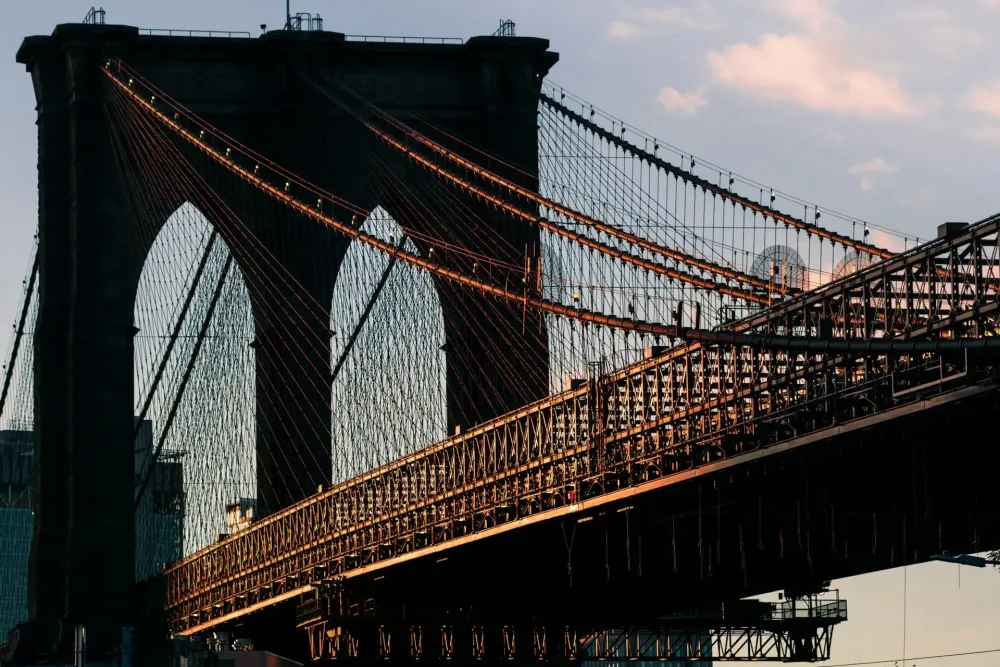
Cover photograph: Brooklyn Bridge from DUMBO. Photo: jurien huggins / Unsplash. Source · License.
Frequently Asked Questions
Which direction is best for walking the Brooklyn Bridge?
Walk from Brooklyn toward Manhattan for the skyline ahead. Walk from Manhattan toward Brooklyn if you want to finish in DUMBO or beside the river. The better choice depends on your next activity.
Which Brooklyn entrance avoids stairs?
Plan the ramped approach at Tillary Street and Adams Street. The Washington Street/Cadman Plaza East connection at Prospect Street uses stairs. The ramp adds walking from DUMBO, and gradients and crowds still matter.
How long should I allow for the bridge and DUMBO?
Allow 45–60 minutes for a relaxed crossing and 2–3 hours for the crossing plus a compact DUMBO visit. These are editorial estimates excluding accommodation travel and a substantial meal.
Is the bridge in the Washington Street photograph the Brooklyn Bridge?
No. The bridge framed by the buildings on Washington Street is the Manhattan Bridge. Continue to the waterfront for other perspectives, including the Brooklyn Bridge.
Can I visit DUMBO without crossing the bridge?
Yes. Arrive by public transport and focus on Washington Street, Main Street and the waterfront. Park entry is free; transport, food and separately operated attractions have their own costs.

Keep Exploring
Bondi to Coogee: Plan Your Coastal Walk
Choose a full coastal outing or a shorter section between Bondi, Tamarama, Bronte and Coogee, accounting for closures, steps and your return journey.
High Line and Chelsea: Plan Your Walk
Walk a focused section of the High Line, finish at Chelsea Market and decide whether to add the Whitney. Includes access checks and clear free-versus-paid distinctions.
Singapore Botanic Gardens: Plan Your Visit
Choose your entrance, orchid visit or family route at Singapore Botanic Gardens, with current access rules and practical ways to plan a shorter outing.