
Usina del Arte Buenos Aires: Choose Your Visit
Choose Usina del Arte for architecture, a concert or family activities, with careful checks for dated programmes, reservations and access.
Usina del Arte is most rewarding when you give the visit a purpose: hearing a concert, understanding an industrial building's transformation or joining an activity designed for your children's age. The red-brick complex in La Boca has a striking exterior, but its cultural life depends on the programme. An attractive building and an available performance are separate reasons to go.
Choose the activity first and build the southern-city outing around it. Our Buenos Aires cultural guide helps compare this with museums and neighbourhoods elsewhere. For architecture and an available exhibition, allow an estimated 90 minutes–2 hours, excluding transport; a concert or workshop needs its own advertised duration and arrival allowance.
Fast facts
| Decision | What to know |
|---|---|
| Address | Agustín R. Caffarena 1, La Boca |
| Building | Former electrical plant, transformed into a cultural centre |
| Main choices | Concert, architecture visit, visual arts or an age-appropriate family activity |
| Cost | Many activities are free; the selected listing determines ticket collection or reservation |
| Opening | Use the dated programme; historical timetables are not a reliable current schedule |
| Family distinction | iUpiiiii is designed for ages 0–3; other children's activities have their own conditions |
Read the building before entering
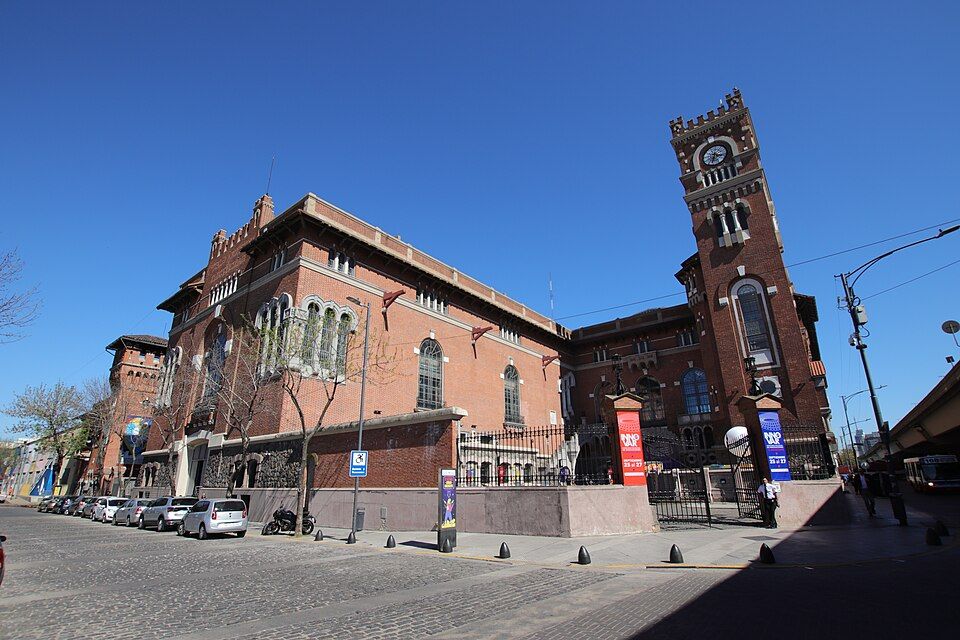
The city tourism overview identifies a former Ítalo Argentina de Electricidad power station, built in 1916 under architect Juan, or Giovanni, Chiogna and restored for cultural use in 2012. Its exposed brick and Florentine-inspired architecture make the industrial function less immediately obvious than a plain factory shed would.
Stand where you can take in the long building and clock tower together. Notice the contrast between tall openings, repeated windows and the more ceremonial entrance composition. The useful question is why an electricity company chose such an imposing public face. You do not need to identify every architectural detail to see that the building was designed to communicate authority as well as house machinery.
The city's historical building account explains that the former boiler hall became the symphonic auditorium and describes the courtyard and clock-tower additions dating to 1926. These relationships give an interior visit a theme: look for how a large technical volume can be adapted for listening, circulation and gathering. They do not mean every historic space is freely accessible whenever the doors open.
A concert and an architecture tour are different visits
Choose a concert if the music is your main interest. The Auditorio accommodates symphonic-scale performance, while the Sala de Cámara is intended for chamber music. Compare the actual ensemble and repertoire before selecting a hall. A chamber programme can be a more satisfying introduction for someone who wants to listen closely to a small group, while a larger performance offers a different balance of sound and spectacle.
A performance ticket should not be treated as a building tour. Access follows the event's route, and rooms used for another activity may be closed to you. Similarly, an architectural visit does not include a concert simply because the auditorium is part of the building. If both matter, find two compatible activities and leave time between them.
The city's guided-visit description explains an approach combining architectural history and visual-art exhibitions. That page is in the historical section: use it to understand the format, not to rely on its old daily timetable. Confirm the current tour, language, meeting point and capacity before crossing the city for it.
Free admission does not always mean walk straight in
A useful dated example is the official listing for Víctor Torres and seventeenth-century Italian and German music. Checked on 24 November 2026, it advertises a performance on Sunday 29 November 2026 at 11:30, with free tickets collected at the venue from 11:00, subject to capacity. The repertoire includes composers such as Cavalli, Pachelbel and Buxtehude.
That example shows why “free” is only the first part of the decision. There may still be a collection time, a limited number of seats and a separate start time. It is not a standing rule that every Usina event releases tickets half an hour beforehand. For a later date, choose a new dated listing rather than reusing these instructions.
For any activity, check whether entry is described as unrestricted access, online reservation or collection on site. Save the confirmation where you can retrieve it without a reliable mobile connection. If your group cannot tolerate the possibility of missing a capacity-limited event, choose a confirmed reservation where offered or keep a nearby alternative. Arriving early improves your preparation; it does not create an entitlement to a seat.
Visual art: use the architecture as part of the experience
Exhibitions at Usina can make particular use of the building's scale. The official November listing for Habitantes de lo invisible by Tadeo Muleiro describes large suspended sculptures in the Salón Mayor, connecting imagined childhood creatures with the surrounding architecture. Its listed dates ran from 20 to 23 November 2026; at this guide's check they had already passed.
Treat that as an example of the kind of visual-art encounter to look for, not a promise that those works will be there when you arrive. Before choosing an exhibition-led outing, establish the current title and dates. Then read enough about the work to know whether you want to look closely, attend an accompanying activity or simply combine a shorter gallery visit with architecture.
Inside an available exhibition, look at the relationship between work and room: how far away can you see a sculpture, what changes beneath it, and which industrial details remain visible? This approach gives you more to do than taking a single wide-angle photograph. Respect barriers and staff instructions; a playful visual language does not automatically make an artwork something children may touch.
iUpiiiii and Ludo-Espacio suit different ages
The city's iUpiiiii introduction describes a sensory space for babies and toddlers up to age 3, with features such as pushchair storage, feeding and changing facilities. It also describes reservation-based access. The page's old opening hours should not be used as confirmation of a current session: verify that the space is operating and that a suitable slot is available.
For a baby or toddler, choose this kind of age-specific session as the main event. Build the journey around feeding, changing and a manageable period of play rather than adding several adult galleries. Confirm how accompanying adults are counted and whether an older sibling can enter. A broad “family activities” label does not answer those practical questions.
The recent official Ludo-Espacio listing describes puzzles, memory games, construction games and board games. Its displayed sessions were dated 20–23 November 2026, so check the next dates before travelling. This is a different proposition from a room specifically designed for ages 0–3: choose by the actual activity and your child's interests, not just the presence of the word “children”.
A mixed-age family may need to divide time or choose one activity everyone can join. Agree that before reserving. These are cultural activities with accompanying adults, not a childcare service that allows the rest of the group to leave for a concert.
Arrival and accessibility need a precise destination
Use Agustín R. Caffarena 1 as the location, then check the meeting instructions for your event. Do not substitute Caminito, a football stadium or another La Boca attraction as though they were the same arrival point. Map the actual journey from your accommodation and decide how you will return, especially after an evening performance.
The official venue information lists ramps, a lift, accessible toilets, rest areas, audio guides and access for assistance dogs. These are useful facilities, but they do not establish the exact route or support available for every activity. If you need step-free access to a particular hall, confirm the entrance, lift operation and seating arrangements for that event.
Avoid choosing transport from an old list of bus numbers without checking the current route. This guide does not promise a nearby metro entrance or a fixed transfer time. A direct arrival may be preferable when a booked session is the reason for coming; a wider walk can be planned separately during daylight if it fits your interests.
Combine with La Boca without overfilling the day
Our La Boca and Caminito guide compares the street attraction with other cultural stops. Use it to choose one addition, rather than assuming the entire neighbourhood is a compact circuit around Usina. The two outings can complement each other, but each has its own address, opening arrangements and reason to visit.
For a daytime architecture visit, a sensible order is the confirmed Usina activity first, then a meal and an optional neighbourhood stop. For a concert, protect the collection or check-in time and keep earlier sightseeing modest. An event with an uncertain finishing time is a poor anchor for a tightly booked onward appointment.
Do not assume that a food court shown in a festival programme operates during every visit. The city's special-event programme includes food, outdoor music and late-night activities for a particular occasion; it is not a daily service timetable. Decide where to eat independently unless your selected event confirms food service.
Cover photograph: Brick buildings and clock tower of Usina del Arte in Buenos Aires — Archive photograph Image adapted for publication. — Andrzej Otrębski, CC BY-SA 4.0.
Frequently Asked Questions
Is Usina del Arte a museum or a concert venue?
It is a cultural centre in a former electrical plant, with concert halls, exhibitions and family activities. Choose the specific programme or an architectural visit rather than expecting one fixed museum route.
Are all visits free and without booking?
Many activities are free, but reservations, on-site ticket collection and capacity limits vary. Follow the dated listing for the chosen activity; free admission does not guarantee a seat.
Can I rely on the daily guided-tour times found online?
Check whether the page is historical. The archived city tour page explains the format but is not reliable evidence of today's timetable. Confirm the current language, meeting point and reservation method.
Is iUpiiiii suitable for older children?
The city's description is for ages 0–3. Check current sessions and accompanying-person rules. Other programmes, such as Ludo-Espacio, offer different activities and should be assessed separately.
How long should I plan for Usina del Arte?
An editorial estimate is 90 minutes–2 hours for architecture and an available exhibition, excluding transport. Add the actual duration and arrival requirements of a concert, tour or workshop, rather than assuming everything fits that allowance.


Keep Exploring
Palacio Paz Buenos Aires: Choose a Guided Visit
Plan a Palacio Paz guided visit: reservation, language and access questions, the separate Museo de Armas and a practical Retiro pairing.
Palacio Barolo Buenos Aires: Choose Your Tour
Visit Palacio Barolo: choose a daytime or evening tour, check prices, understand the stairs and lighthouse access, and plan Avenida de Mayo.
Bellas Artes Buenos Aires: Plan Your Museum Visit
Choose a focused route through Buenos Aires’ Museo Nacional de Bellas Artes, with admission guidance, Argentine art, temporary exhibitions and Recoleta planning.