
Tangier Kasbah: Museums and a Neighbourhood Walk
Choose Tangier’s palace museum, contemporary art space or Borj sites, with verified weekly hours and time for a kasbah and medina walk.
Tangier’s kasbah is best approached as a neighbourhood with several different cultural stops, rather than a single attraction called “the Kasbah Museum”. Choose one museum that matches your interests, leave room for the streets and sea-facing views, then descend through the medina for a café or meal. That makes a more coherent first visit than trying to complete every museum on a short afternoon.
The essential distinction is between the Musée la Kasbah des cultures méditerranéennes, in the former palace, and the nearby Musée la Kasbah, espace d’art contemporain, in a former prison. Their similar names make them easy to confuse. The first is the stronger starting point for Tangier’s history and palace architecture; the second is a choice guided by the exhibition programme.
Choose your main stop
| Your main interest | Start with | Then consider |
|---|---|---|
| Tangier’s history and Mediterranean connections | Museum of Mediterranean Cultures | A slow look through the kasbah streets |
| Contemporary art | Kasbah contemporary art space | A second museum only if energy and time remain |
| Ibn Battouta and travel history | Borj En-Naam | The nearby kasbah neighbourhood |
| Fortifications and the port | Borj Dar El Baroud | A medina walk linked to the waterfront |
| A short first impression | One museum and a café | Leave the other interiors for another day |
Allow 3–4 hours for a focused outing with one main museum, walking and a pause. This is an editorial planning allowance, not an official tour duration. A second substantial interior can turn it into most of a day, especially if you enjoy reading displays. Our seven-day Morocco itinerary guide helps decide whether Tangier has enough room in the wider route before you add more stops.
Understand the kasbah and medina relationship
The Port Tanger Ville description places the kasbah high above the port and identifies Bab El Assa as an access point. It also describes Grand Socco at the entrance to the medina and the cafés of Petit Socco. These are useful orientation anchors, not a guarantee that every route between them is equally easy.
For a first visit, decide whether to start near the kasbah and work downwards or approach through the medina and climb first. If travelling with someone who finds slopes difficult, ask a driver or accommodation host for a practical upper drop-off and check the walking segment that remains. A vehicle getting close to the district does not establish step-free access to a museum.
Save the full name of your chosen museum and its entrance on a map. “Kasbah” can mean the neighbourhood, the palace museum or the art space in a conversation. Showing the exact name avoids arriving at the wrong doorway or paying for a different visit than intended. Carry the accommodation location separately so you can choose a sensible return rather than retracing every turn.
The palace museum: architecture and city history
The Fondation Nationale des Musées page for the Museum of Mediterranean Cultures identifies its home as Dar Al-Makhzen, the former sultan’s palace, on Place de la Kasbah. Its archaeological and ethnographic collections explore Tangier and its relationship with the Mediterranean. This is a useful anchor when the rest of the walk risks becoming only attractive façades and sea views.
Look at the building as well as the cases: the courtyard, tilework, carved plaster and woodwork offer different reasons to pause. Instead of attempting to memorise every historical period, follow one question through the visit: how did Tangier’s position connect it to other places? The display sequence can give the streets outside a clearer context.
Start with 60–90 minutes as a flexible allowance, not a promised complete-tour time. If you mainly want the architecture, you may move differently from someone reading every panel. Ask staff which areas are open and whether any route involves stairs before buying a ticket if access is important. Do not assume a photograph of a garden or upper room confirms access on your day.
The art space: check the exhibition, not just the name
The separate Kasbah contemporary art space occupies the former kasbah prison and presents temporary exhibitions, with a programme particularly connected to northern Morocco. The change of building use is part of its interest, but the decision to visit should depend on what is currently showing.
Read the exhibition title, dates and description before adding it automatically to the palace museum. An exhibition may be exactly what you want even if it does not offer a general introduction to Tangier. Conversely, if your only free hour is for city history, the palace collection is a more direct fit. The two venues complement one another without being interchangeable.
Check current photography rules and any room closures on arrival. A temporary exhibition mentioned in an older itinerary may have ended, and installation periods can affect what is available. This guide deliberately does not promise a named show for a future visit. Choose the programme on your date, then give it enough time to be more than a quick second doorway.
Hours, tickets and the Tuesday distinction
At the source check on 13 November 2026, both FNM kasbah museum pages listed 10:00–18:00, closed Tuesday. Each also displayed a standard adult price of 30 DH. These are published reference details, not a booking confirmation: recheck the pages for your date, special arrangements and the applicable visitor category before travelling.
Do not assume that a ticket for one museum admits you to the other. Ask about the exact coverage of the ticket sold that day and any combined arrangement actually offered. Reduced-price categories and eligibility should be checked directly rather than inferred from an adult price. Keep the ticket until you have finished the visit.
The Tuesday closure is especially useful when planning the week: an open neighbourhood does not mean the two FNM interiors are open. The municipal sites described below publish a different weekly pattern. A Tuesday can still support a cultural walk, but select the alternative deliberately and verify it instead of discovering the museum closure at the door.
Borj En-Naam or Borj Dar El Baroud?
The municipality’s cultural-sites page identifies Borj En-Naam, northwest of the kasbah, as an exhibition space devoted to the memory of Ibn Battouta. It gives the address as 61 Rue Riad Sultan. Choose this for a travel-history theme rather than expecting the palace’s collection in another building.
The same municipal source describes Borj Dar El Baroud, on the northeastern medina defences, as a fortifications interpretation centre using models, maps, photographs and military objects. This is the more direct choice if you want to understand the defended city and its relationship to the port. For both sites, the municipality publishes Tuesday–Sunday, 10:00–18:00; confirm any exceptional changes before relying on them.
Pick the subject that interests your group. Seeing both is optional, and the route to one may fit your onward plans better than the other. Avoid treating the two names as adjacent rooms of one museum. Locate the actual entrance, allow for the walk and check the current admission arrangements separately.
Make the streets part of the visit
After the main museum, take a modest loop through the kasbah before continuing into the medina. Allow time for a view where public access permits, but keep passages and entrances clear. The neighbourhood contains homes and everyday activity; a photogenic doorway does not make a courtyard public.
Use Petit Socco as a possible café stop and Grand Socco as a larger orientation point rather than insisting on one exact sequence of lanes. If you stop to shop, ask about an object’s materials and origin. Buying something you understand is more satisfying than rushing a purchase simply because a guide or driver has brought you to a particular shop.
If hiring a guide, agree the length, language, museum visits and shopping expectations first. Clarify whether admission and transport are included. A useful guide can connect the buildings and streets through a theme, but a general walking tour may not include extended time inside the museum you most want to see. State that priority before booking.
Adjust the outing to your group
For families, choose one interior and one clear question to explore, then leave room for a snack or rest. The fortification models or a story about long-distance travel may engage different children than a gallery visit, but no museum is automatically suitable for every age. Check the actual display and your family’s interests.
For limited mobility, ask about the entrance, steps, seating and accessible toilets at the exact venue. The hill, street surfaces and historic buildings make broad assurances unhelpful. A shorter route with a confirmed drop-off and one suitable interior can be a better visit than a nominally comprehensive circuit.
If you have only a short interval before a train or ferry, protect the departure connection first. Confirm the actual station or terminal, transfer time for your circumstances and required check-in margin. Do not use a photograph of the port below the kasbah as evidence that your own departure point is a quick walk away.
Give Tangier its own place in the trip
A kasbah visit can stand on its own as a focused cultural half-day. It does not need a long excursion outside Tangier added afterwards to feel worthwhile. If you are comparing northern and Atlantic-coast stops, our Kasbah of the Udayas guide in Rabat offers a separate neighbourhood visit to consider within the route you actually have time for.
Before leaving the kasbah, settle the next step: lunch in the medina, return to the accommodation or onward transport. Keep that final decision simple. One well-chosen collection, a few streets understood in context and time to sit with the view are enough for a meaningful first encounter.
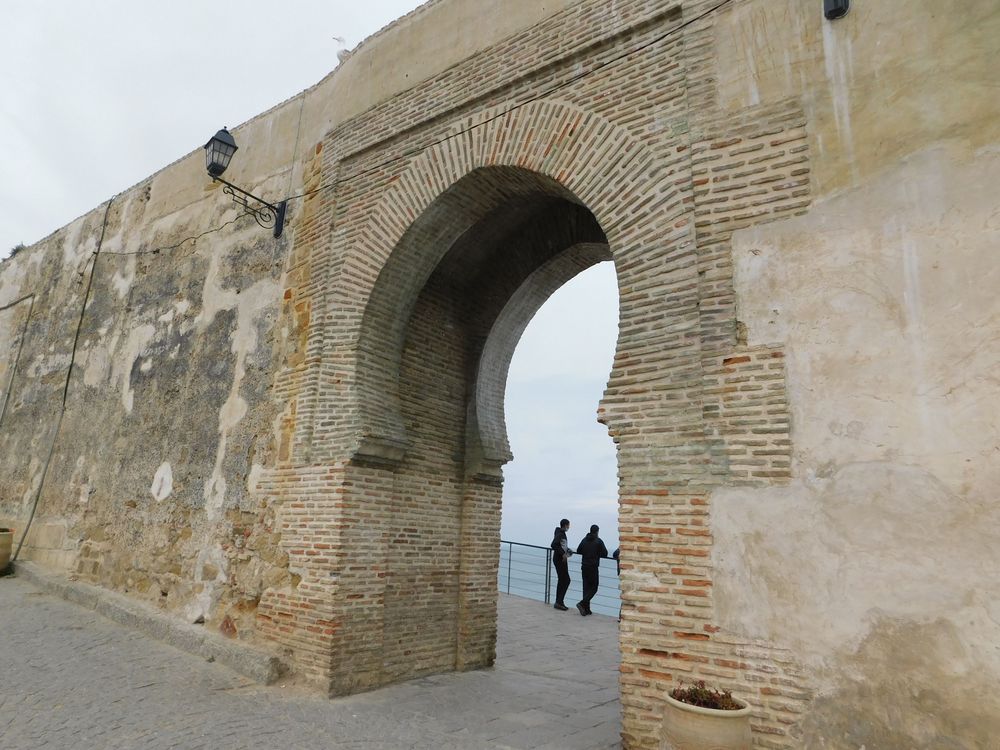
Cover photograph: Brick arch in Tangier’s kasbah opening towards a sea-facing terrace — Ideophagous, CC BY-SA 4.0.
Frequently Asked Questions
Are the two Kasbah museums the same place?
No. The Museum of Mediterranean Cultures occupies the former palace and focuses on history and collections. The nearby contemporary art space occupies the former prison and has an exhibition-led programme.
How much time should I allow for the kasbah?
Use 3–4 hours as a planning allowance for one main museum, a neighbourhood walk and a pause. Add time for a second interior rather than rushing both.
Can I visit the museums on Tuesday?
The two FNM kasbah museums publish Tuesday closure. The municipality lists Borj En-Naam and Borj Dar El Baroud as open Tuesday–Sunday, 10:00–18:00; verify current exceptions before visiting.
Does one ticket cover every cultural site?
Do not assume so. Confirm the venue and areas covered by the ticket offered that day, including any genuine combined option. Museum admission, a guide and transport may be separate costs.


Keep Exploring
Recoleta: Cemetery, Museums and a Neighbourhood Walk
Choose a cemetery visit, a substantial art stop and a manageable Recoleta walk, with admission distinctions and alternatives for rain or limited time.
Joo Chiat and Katong: A Singapore Neighbourhood Walk
Walk East Coast Road, Joo Chiat Road and Koon Seng Road, choose a food stop and decide whether to book The Intan's private home collection.
San Ángel Mexico City: Art and a Neighbourhood Walk
Plan San Ángel around Plaza San Jacinto, Saturday crafts and one museum, with El Carmen timetable warnings and the separate Rivera–Kahlo studio.