
São Bento Monastery Rio: Plan a Respectful Visit
Plan São Bento in Rio: church art or Gregorian liturgy, free entry, service times, access limits and a manageable Centro pairing.
Visit São Bento in Rio for the abbey church's gilded woodwork, or come to attend its liturgy: those are two different ways to plan the same place. For an art-focused stop, choose a period between services. For Gregorian chant, attend a published service respectfully rather than expecting a concert that pauses for photographs.
The Mosteiro de São Bento is an active Benedictine community on Morro de São Bento in Centro. Public church access does not mean a tour of the monks' living quarters or unrestricted entry to the cloister. Our Rio highlights guide helps fit this focused cultural visit into a wider city stay.
Fast facts
| Detail | What to plan |
|---|---|
| Address | Rua Dom Gerardo 68, Centro, Rio de Janeiro |
| Public focus | Abbey church of Nossa Senhora do Monserrate |
| Published church opening | Daily 06:30–18:30, subject to worship and special arrangements |
| Admission | Riotur lists the church visit as free |
| Sunday conventual Mass | 10:00; check exceptions for solemnities |
| Monday–Saturday Mass | 07:15 |
| Vespers | Sunday 17:30; Monday–Saturday 18:00; changes can apply |
| Art-only allowance | Editorial estimate of 30–45 minutes inside, plus arrival and ascent |
Information was checked on 23 November 2026. The monastery's own liturgical timetable is the reference for services; an opening interval is not an uninterrupted sightseeing slot. Do not use information for the monastery of the same name in São Paulo.
Church visit or service: choose before arriving
For architecture, the advantage of a quieter interval is freedom to look without moving through a congregation. Allow an estimated 30–45 minutes inside if you want to examine the nave, side altars and main chapel. This is a suggested visitor allowance, not a guided-tour duration or a guarantee of uninterrupted access.
For worship, build the visit around the actual service and leave room to remain for it. The official conventual timetable lists Sunday Mass at 10:00 and Monday–Saturday Mass at 07:15. Gregorian chant is used at conventual Mass and Vespers, with greater solemnity on Sundays.
Vespers are listed at 17:30 on Sunday and 18:00 Monday–Saturday. The monastery notes changes for weddings and major solemnities such as Christmas and Easter. Vigils and Compline are closed to the external public. A time on the monks' full daily schedule is therefore not automatically an invitation for visitors.
If you arrive during worship but only wanted to look at the art, sit quietly or return later. Do not treat the nave as a museum corridor while the service continues. You can appreciate the building without being Catholic; the essential adjustment is to respect the purpose of the gathering and the boundaries indicated on site.
What the public can actually visit
The monastery's visitor page welcomes the faithful to the abbey church daily from 06:30 to 18:30. Its invitation centres on the church, prayer and services. It does not advertise unrestricted wandering through the residential monastery.
Riotur's religious heritage guide identifies the visit as free and distinguishes the cloister from ordinary access. Do not build a holiday plan around an assumed special opening of the cloister. If an exceptional religious occasion permits access, follow the community's arrangements; it is not automatically a tourist tour or photography session.
The same distinction applies to Casa de Emaús, the monastery's hospitality facility. A place offering retreats or lodging is not another gallery included with a church visit. Use its separate contact arrangements if that is your purpose, rather than trying doors while sightseeing.
For a group, a professional guide or any organised activity, contact the monastery first. The fact that individual visitors enter the church without an admission charge does not establish permission for a group commentary during worship.
A simple way to read the interior
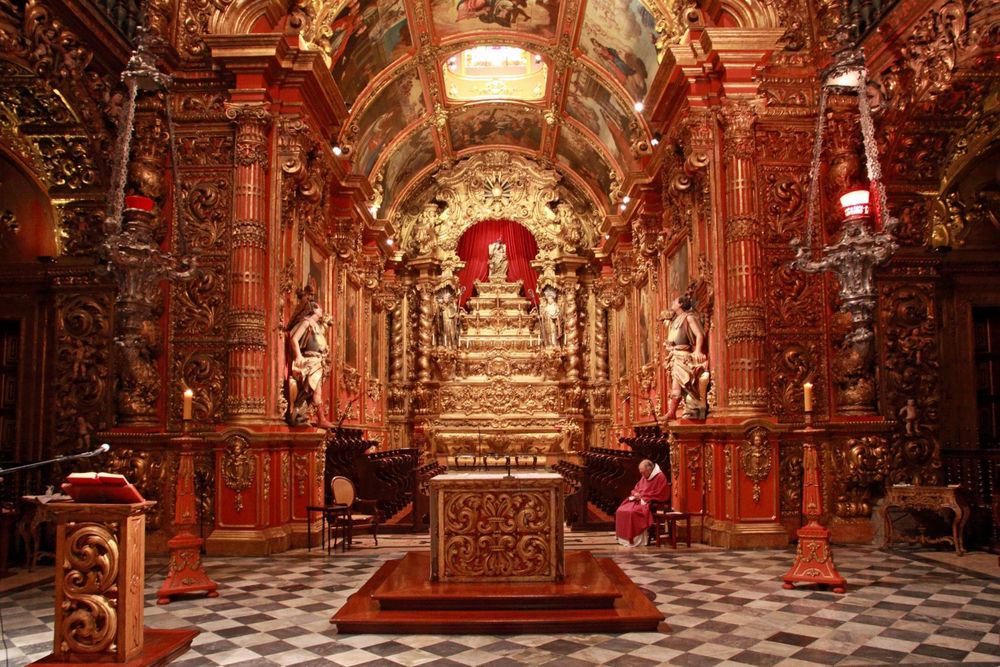
Start by comparing the restrained exterior with the density of carving inside. The contrast is part of the experience: the church does not announce every detail of its interior from the street. Once inside, pause long enough to see the overall arrangement before concentrating on individual decoration.
The abbey's account of its church identifies a central nave leading towards the main chapel, altar, monastic choir and the image of Nossa Senhora do Monserrate. Looking along that axis helps explain why movement near the sanctuary is different from browsing a museum room.
Then choose a few details rather than attempting to identify every figure. Look at how carved wood creates depth around an altar, how gilding catches the available light and how painted surfaces work with the architecture. Stay in the areas open to visitors; a better angle is not a reason to cross a barrier or enter the choir.
The abbey names the sculptor Frei Domingos da Conceição da Silva, painter Frei Ricardo do Pilar and later carver Inácio Ferreira Pinto among the makers. That makes a useful question for further reading: the interior is the work of people and successive campaigns, not a single anonymous layer of gold. Read the official description before arriving if you prefer to keep your phone away inside.
For a short visit, prioritise the nave's overall view and one side altar. For a longer look, compare the side chapels with the main chapel without turning the visit into a hunt for every named object. Restricted areas and the day's religious use take precedence over completing a checklist.
Getting to the correct São Bento
Use Rua Dom Gerardo 68, Centro, Rio de Janeiro in your route planner. A generic search for São Bento can return the São Paulo monastery, other churches or a transport stop rather than the visitor entrance. Save the actual address before leaving your accommodation.
The monastery's official arrival page identifies the São Bento VLT stop and Uruguaiana metro station as useful approaches. It estimates about 900 metres and 15 minutes on foot from Uruguaiana, and about 950 metres and 15 minutes from the Praça XV ferry terminal. Those are the venue's approximate walking figures, not guaranteed personal journey times.
Allow for the hill and your own pace. The existence of a nearby tram stop does not certify a flat, step-free route from platform to church. If mobility, a wheelchair or a pushchair affects your plans, contact the monastery about the current accessible arrival, drop-off point and any lift or ramp arrangement rather than relying on an unverified shortcut.
Choose your transport for the actual start and finish of the outing. A Centro museum visit can combine well with the church, but it does not make every attraction across Rio walkable from here. Keep a separate return plan to your accommodation and check current transport operation before travelling.
Build one manageable Centro pairing
For art followed by a different kind of cultural interpretation, pair São Bento with a selected exhibition at CCBB. Our CCBB Rio visitor guide explains that venue's tickets and programme, which must be checked independently. A free church visit does not imply that every exhibition or performance nearby can be entered without a reservation.
Decide which stop is the anchor. If you have a timed exhibition entry, visit the church in an appropriate interval beforehand or afterwards. If Sunday worship is the reason for the outing, let the service determine the timing and keep the museum optional. This avoids leaving a service halfway through merely to preserve an overfull schedule.
An editorial allowance of 2–3 hours for the church, a selected second stop and movement between them can be a starting point, but a substantial exhibition or full service may require longer. Add meals and travel from your hotel separately. Do not squeeze São Bento, both Praça Mauá museums and a mountain attraction into the same short block simply because the church itself is compact.
If you only have time for one cultural stop, choose by purpose. São Bento offers sacred architecture in use. A museum provides a more explicitly curated exhibition setting. Neither is a substitute for the other, and choosing one well is preferable to hurrying through both.
Respectful behaviour without guessing a formal dress code
Choose clothing appropriate to a working church and follow any instructions at the entrance. The sources consulted do not establish a complete published tourist dress code, so do not rely on an invented list of permitted garments. If you are unsure, ask before entering rather than turning a disagreement into part of the visit.
Silence your phone and avoid commentary, calls or audio playback. Ask about photography, especially during services; do not assume that older visitor photographs establish today's permission. Flash, tripods and close images of worshippers need particular consideration, and an instruction to stop should settle the matter immediately.
With children, explain beforehand that this is a place where people pray. A shorter, quiet visit can be more successful than expecting them to sustain a long art-history session. If they need to move or talk, step outside and resume only if that suits the setting.
Skip any offer promising unrestricted monastery access unless the community itself confirms what is included. Also skip a plan based on a supposed daily Gregorian “show.” The church's art and the liturgy are rewarding for different reasons; neither requires pretending the monastery operates as a performance venue.
Cover photograph: Gilded main chapel and altar of São Bento abbey church in Rio de Janeiro — Archive photograph Resized for publication. — Halley Pacheco de Oliveira, CC BY-SA 3.0.
Frequently Asked Questions
Is São Bento Monastery in Rio free to visit?
Riotur lists the church visit as free. This refers to ordinary church access, not a paid external tour, retreat stay or unrestricted entry to monastic areas. Services and local instructions can affect sightseeing.
When can I hear Gregorian chant?
The monastery says it uses Gregorian chant at conventual Mass and Vespers. Sunday Mass is listed at 10:00 and Monday–Saturday Mass at 07:15; Vespers are Sunday 17:30 and Monday–Saturday 18:00. Check the official timetable for exceptions and attend as worship, not a concert.
Can tourists visit the cloister and monks' rooms?
Do not assume so. Public visiting information centres on the abbey church. Any exceptional access must follow the community's specific arrangements and does not amount to a general tourist route through residential areas.
How long should I allow for the church?
An estimated 30–45 minutes inside suits an art-focused visit between services. Add arrival and the hill approach separately. If attending worship, allow for the service rather than trying to fit it into that sightseeing estimate.
Is there a guaranteed step-free route from the VLT?
A complete current step-free route was not verified. Contact the monastery about your arrival point and mobility needs. A nearby tram stop or vehicle drop-off does not establish access through every part of the church approach.


Keep Exploring
Immigration Museum Melbourne: Plan Your Visit
Choose Melbourne’s Immigration Museum galleries, current exhibitions or a guided tour, with ticket eligibility, access and a thoughtful visiting plan.
Hyde Park Barracks Sydney: Plan Your Museum Visit
Plan Hyde Park Barracks in Sydney: free entry, audio sessions, languages, access options and the history behind the museum.
Biblioteca Vasconcelos: Plan Your Mexico City Visit
Visit Biblioteca Vasconcelos for architecture and books. Check hours, photography rules, group tours and the difference between entry and library services.