
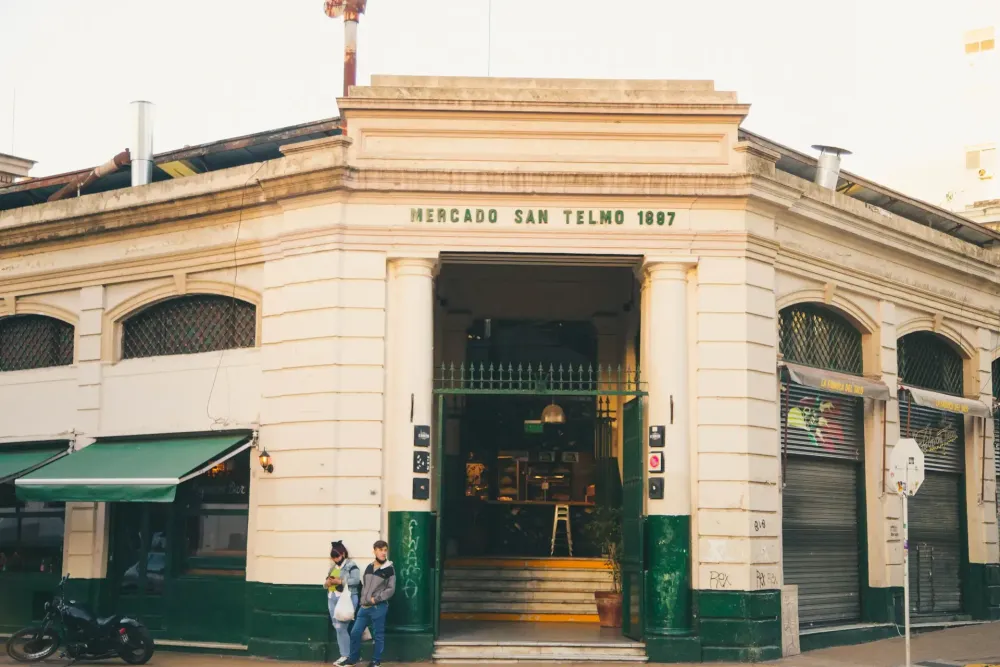
Choose a San Telmo visit: covered market, Sunday antiques fair, neighbourhood walks and Museo Moderno, with practical planning advice.
San Telmo is worth visiting on more than one kind of day. Choose Sunday if the outdoor fair is your main reason to come; choose another day if you would rather concentrate on the covered market, architecture and a museum. Those experiences overlap geographically, but they do not share one timetable or one atmosphere.
The most useful starting distinction is simple: Mercado San Telmo is a building; the San Telmo fair is an outdoor event around Plaza Dorrego and neighbouring streets. Searching for “San Telmo market” can return information about either. Decide which you mean before choosing your day.
For the wider choice between San Telmo, Recoleta and other districts, see our Buenos Aires culture and neighbourhood guide. Here, the focus is a manageable visit within San Telmo itself.
Choose your version of San Telmo
Information was checked on 20 October 2026. Visit durations are editorial estimates, not official tour lengths.
| Your priority | Best starting point | Planning implication |
|---|---|---|
| Food and the historic market building | Mercado San Telmo, Defensa and Carlos Calvo | Verify a particular stall's schedule separately |
| Antiques and outdoor browsing | Plaza Dorrego and the Sunday fair | Give the fair a substantial part of your day |
| Contemporary visual art | Museo Moderno, Avenida San Juan 350 | Check the exhibition and museum opening day |
| Buildings and a less event-led walk | Market, nearby streets and a café | Sunday is optional |
| A first overview with a meal | Covered market plus Plaza Dorrego | Allow roughly 3–4 hours, including pauses |
A shorter visit can still work, but choose one anchor. Trying to fit a long meal, serious shopping and a full museum visit into two hours leaves little time for any of them.
The covered market: more than a food stop
The city's Spanish-language Mercado San Telmo listing places the market at Defensa and Carlos Calvo. It opened in 1897 and combines food businesses with antiques and other browsing. Look above the counters: its metal structure and central dome make the building itself part of the visit.
A useful first lap is simply to orient yourself. Look at what is being sold, compare menus and decide whether you want a snack, coffee or a seated meal. Ordering at the first counter you see can be perfectly enjoyable, but it makes less sense if your group has different appetites or dietary requirements.
Ask about ingredients and preparation directly when they matter. A dish's familiar name does not establish whether it suits an allergy or a specific diet. If you want to eat together, check where everyone can sit and whether separate purchases are practical before ordering.
The current Spanish city listing gives building hours of 09:00–20:00 daily. An English city page still presents a different schedule, so treat published hours cautiously and confirm directly for your date, especially if making a special trip. Building opening does not guarantee every counter or antiques stall is trading throughout the same hours.
There is no need to invent a fixed “best lunch” inside. Choose what appeals on the day, inspect the displayed prices and ask how payment works before ordering. If the queues or seating do not suit you, a meal elsewhere in the neighbourhood can preserve the visit's relaxed pace.
The Sunday fair is a separate experience
The city's fair information distinguishes the antiques fair at Plaza Dorrego from the nearby arts fair on Humberto 1º. The municipal organizer's page identifies Sunday as the principal outdoor fair day. Do not transfer the covered market's daily schedule to these outdoor stalls.
Choose Sunday because you want to browse and be part of an event, rather than because you assume the neighbourhood has nothing to offer at other times. Walking and decision-making take longer when you repeatedly stop at stalls. Leave space for that instead of treating the fair as a corridor to cross on the way to lunch.
For antiques, ask about the object, its condition and what is known about its age or origin. Decorative appeal and documented provenance are different reasons to buy. If a purchase is expensive or difficult to transport, take time to think and ask for a receipt; you do not have to decide because a stall is busy.
For art and craft, talk with the seller about the work and how to carry it safely. Consider luggage space before choosing fragile or large pieces. A small object you understand and can bring home comfortably is often a better travel purchase than a dramatic one that becomes a logistical problem.
Check the organizer's current notice for operating hours and any changes. Do not assume every stall on every nearby street follows the same schedule, or that an outdoor event will operate unchanged in poor weather.
A simple walking structure
Use the covered market and Plaza Dorrego as two anchors, then allow the streets between and around them to fill the gaps. This is an editorial approach, not a prescribed route with guaranteed walking times. Save both locations on your map so that browsing does not turn every next step into a navigation decision.
If food is your priority, begin with the market and decide on a meal before widening your walk. If antiques are your priority on Sunday, begin with the square and keep lunch flexible. If an exhibition is the main reason for coming, start with the museum's requirements and let the street walk fit around them.
Look at the neighbourhood above shop level as well as through windows. Doorways, balconies and the changing scale of buildings offer a different subject from the merchandise. Avoid entering residential courtyards simply because an open door looks inviting; public access and a picturesque view are different things.
A short walk repeated slowly can be more rewarding than extending the outing until you are tired. Give yourself permission to return to a stall or café that interested you. There is no benefit in completing an imagined neighbourhood checklist at the expense of looking properly.
Adding Museo Moderno
Museo Moderno's visitor page gives its address as Avenida San Juan 350 and lists Tuesday closure except on public holidays. Check the current exhibitions and ticket conditions before deciding to include it. The museum is a substantial cultural stop, rather than a place to fill a spare fifteen minutes.
Allow roughly 90 minutes to two hours for a selective museum visit if art is important to you; that is an editorial estimate, and a particular exhibition may merit longer. Combining it with a leisurely fair visit and lunch is a larger outing than the basic 3–4-hour market-and-streets suggestion.
The practical choice is where to put your attention. A museum-first day gives you context and a defined indoor anchor, with the market serving as a break. A browsing-first day leaves the museum optional. Either works; booking additional activities simply because they are nearby can remove the flexibility that makes San Telmo enjoyable.
Tango without relying on a chance performance
The city describes a Sunday “Patio de Tango” at Plaza Dorrego. Treat the current programme as something to check, not a guaranteed performance at the exact moment you arrive. A passing encounter with street tango is different from buying a seat for a scheduled show or attending a dance event.
If tango is the main purpose of your day, choose and verify a specific event separately. Confirm its start time, whether you are watching or participating, the venue and any booking requirement. A general promise of “tango in San Telmo” is too vague to organize an evening around.
When performers are present, leave their working space clear. Ask before making close portraits and check expectations around photographs or posed interactions. Enjoy the performance without assuming that another person's work is simply part of the street furniture.
Money, bags and purchases
Carry a payment method that works for your chosen businesses and ask before committing to a purchase. Do not assume all stalls accept the same cards or use identical payment conditions. Keep a modest amount of accessible cash if you plan to buy small items, while avoiding handling your full travel budget at a crowded stall.
Use ordinary busy-city awareness: keep your bag closed, avoid leaving a phone on a table and step aside to check directions. This is practical advice for a crowded browsing environment, not a guarantee about safety or a reason to treat every interaction with suspicion.
If you buy several things, think about whether a museum cloakroom will accept your bags before making the museum your next stop. Storage conditions belong to the venue. A photograph of an interesting object, taken with permission, can also be a useful reminder when you do not want to carry more.
Rain, mobility and travelling with children
The covered market gives you an indoor component, but it does not turn the entire neighbourhood outing into a sheltered route. In sustained rain, shorten the outdoor walk and check the fair's arrangements. An indoor meal and a museum may be a more comfortable version of the day.
Historic paving, curb transitions, crowded aisles and entrance steps can affect the experience for wheelchair users, people with limited mobility or families with pushchairs. Check a specific entrance and any venue assistance directly. This guide does not establish an uninterrupted step-free route through the market, square and surrounding streets.
With children, alternate browsing with an actual seated break. Let them choose a small observation task—find an unfamiliar object, spot a building detail or compare two kinds of packaging—without turning every stall into a lesson. Agree a clear meeting point with older children before anyone splits off.
Fitting San Telmo into a short stay
San Telmo works best when it has a clear place in your trip. If you are here for a weekend and care about the outdoor fair, give it the Sunday slot and move other flexible activities. If you cannot visit on Sunday, build the outing around the covered market, streets and an open cultural venue.
Our three-day Buenos Aires itinerary helps arrange the wider stay. Keep its timing flexible around your chosen anchors. A neighbourhood visit is successful when you have time to notice things and enjoy a meal, even if you leave several famous names for another trip.
Cover photograph: The entrance to Mercado San Telmo in Buenos Aires. Photo by Gustavo Sánchez — Unsplash.
Frequently Asked Questions
Is San Telmo Market only open on Sunday?
No. The covered Mercado San Telmo and the outdoor Sunday fair are separate. The Spanish city listing currently gives daily building hours, but individual stalls can differ and official language versions conflict, so confirm for your date.
What is the difference between the market and the fair?
The market is the permanent building at Defensa and Carlos Calvo. The outdoor fair centres on Plaza Dorrego and nearby streets, with antiques and arts areas described separately by the city.
How long should I spend in San Telmo?
Allow roughly 3–4 hours for the market, a walk and a meal. That is an editorial estimate; a substantial museum visit or extensive Sunday browsing needs more time.
Is San Telmo still worth visiting on a weekday?
Yes, if your priority is the covered market, buildings, cafés or an open museum. You should not expect the same outdoor event as on Sunday, and you should check individual opening schedules.
Can I count on seeing tango in Plaza Dorrego?
The city advertises Sunday Patio de Tango, but check the current programme rather than assuming a performance at your arrival time. Book a specific event separately if tango is your main priority.

Keep Exploring
NGV Melbourne: Which Gallery Should You Visit?
Choose between NGV International and NGV Australia, with free-entry details, exhibition planning, access advice and realistic visit times.
Nijo Castle: Tickets and Visit Planning
Choose the right Nijo Castle ticket, understand the two palaces and their different calendars, and plan a visit with enough time for the gardens.
Coyoacán and Frida Kahlo: Plan Your Visit
Choose a museum-led or neighbourhood-led Coyoacán outing, with Casa Azul booking advice, a practical walking sequence and clear limits on extra stops.