
Peranakan Museum Singapore: Choose Your Visit
Choose a focused Peranakan Museum visit through identity, home and style, with gallery priorities, ticket checks and practical access advice.
Choose the Peranakan Museum if you want to understand the people, households and creative traditions behind the word Peranakan. Its strongest visit moves from identity to domestic life and finally to clothing and adornment. Allow about two hours for that sequence, or choose one upper-floor theme after the introductory gallery if your attention or time is limited.
This is a collection-focused visit in the former Tao Nan School on Armenian Street, not a preserved family house. It suits visitors interested in textiles, ceramics, design and social history, including those who would like a closer cultural explanation after exploring Singapore's streets. Use our Singapore highlights guide to decide where it fits alongside neighbourhoods, gardens and larger attractions.
Choose your version of the visit
These time allowances are editorial suggestions, not museum estimates or guaranteed tour lengths. They exclude travel, ticket queues and a substantial temporary exhibition.
| Your interest | Best focus | Suggested time | What to leave optional |
|---|---|---|---|
| First introduction | Origins, selected Home displays, selected Style displays | About 2 hours | Reading every object label |
| Textiles and fashion | Origins, then the third-floor Style galleries | 90 minutes–2 hours | A comprehensive second-floor visit |
| Family and food culture | Origins, then the second-floor Home galleries | 90 minutes–2 hours | Every fashion and jewellery case |
| A short cultural stop | Origins and one chosen upper-floor section | About 60–75 minutes | The full museum and a special exhibition |
| A deeper museum afternoon | All three themes plus breaks | 2–3 hours | Another major museum immediately afterwards |
The distinction matters because the collection is not simply a sequence of spectacular rooms. Its detail rewards looking closely. A visitor who wants to compare embroidered surfaces will use time differently from someone reading family stories. Decide what you most want to understand before assuming that a small building requires only a quick look.
Start with Origins: who is represented?
The ground-floor Origins gallery introduces trade, migration and community identities through objects, photographs and interviews. Start here even if fashion is your main reason for coming. It establishes that Peranakan heritage has multiple expressions, rather than one fixed appearance or a single family story.
A useful way to approach this room is to compare what a portrait tells you with what an interview adds. Clothing, setting and pose are visible; a person's account can introduce identity, belonging and change. You do not need to read every label to notice that the museum is presenting living communities as well as historical material.
Avoid carrying a restaurant-menu definition into every gallery. Food is an accessible starting point, but it cannot explain every community or object. Equally, an ornate garment does not stand for everyone's everyday life. Treat individual labels as the evidence for the person, place and period represented.
For a family visit, begin with a simple question: what can you learn about someone from a photograph, and what can you only learn by listening? That gives children a concrete task without turning the museum into a hunt for the most expensive or decorative object. It also creates a reason to slow down before moving upstairs.
Home: look beyond the colourful tableware
The second floor's Home theme brings ceramics and food culture together with family and community life. The official gallery directory separates these sections, making this a useful floor for visitors more interested in how people lived than in a chronological art survey.
Begin with one group of vessels rather than trying to remember every shape. Ask what each object was for, how it might have been used with others, and what its decoration contributes. Then move towards furniture and household material with the same question: how does an object organise a meal, a room or a social occasion?
This is an interpretive suggestion, not an instruction to identify ritual meanings from colour alone. Where an object carries a particular significance, let its label provide that connection. Attractive ceramics can otherwise become an undifferentiated succession of photographs, with their domestic context lost.
The floor is particularly worthwhile before or after a meal that has made you curious about Peranakan food. Keep the two experiences distinct: the museum explains cultural material, while a restaurant offers its own menu and interpretation. There is no need to claim that a particular dish represents every Peranakan household.
If you have only an hour, choose one Home section after Origins and spend your remaining time there. A concentrated comparison of objects is more satisfying than crossing all three floors with no opportunity to read. You can leave Style for another visit without having missed the point of the museum.
Style: give textiles the time they need
On the third floor, Style includes batik, decorative textiles, fashion and jewellery. The museum map is the most practical way to see how these sections relate before you arrive. Visitors interested in making, dressing and design should reserve the largest share of their visit for this floor.
Rather than looking only for the most elaborate piece, compare two objects closely. Consider pattern scale, surface, fastenings or silhouette, then read what the labels say about their place and date. A jewellery case offers a different kind of looking from a textile display; alternating between them can help avoid the feeling that every detail is merging together.
Use the distinction between an object and its presentation. A museum display lets you see a garment in a particular arrangement, but the label may explain how and when it was worn. Photographs or other contextual material can change your understanding of the same object. Give those connections time.
This floor is the strongest reason to extend a visit if you sew, work with textiles or enjoy fashion history. If those subjects leave you cold, there is no obligation to spend equal time in every section. An introduction across the floor followed by a return to Home is a perfectly coherent visit.
Tickets and opening times: check the exhibition combination
The official visitor page lists daily opening from 10:00 to 19:00, extended to 21:00 on Fridays, with gallery admission ending 30 minutes before closing. Checked on 10 November 2026, these are planning references; consult the page again for your date.
Ticket categories distinguish Singapore citizens and permanent residents from other visitors, and temporary exhibitions can affect what an all-access ticket includes. Do not assume an old permanent-gallery price is the price of the currently promoted package. Open the official ticket link, check the visitor category, the named exhibition and the final amount before paying.
Friday evening can make sense when you want to preserve daylight for a neighbourhood walk. It is not a guarantee of a quieter museum. Arrive early enough for your chosen route: a last-admission deadline leaves little time for a two-hour introduction. Similarly, a late afternoon visit needs a clear priority if your dinner plans are fixed.
If a temporary exhibition is the main reason for coming, verify its own dates and admission terms. A banner visible in an older exterior photograph does not establish what is showing now. The permanent themes remain a separate reason to visit, so decide whether they would still justify the outing if that exhibition were unavailable.
Arrival, access and guided tours
The museum is at 39 Armenian Street. Its visitor information describes an approximately ten-minute walk from City Hall, Bras Basah or Bencoolen MRT. Choose the station that fits your actual starting point; the shortest rail journey can matter more than saving a small amount of walking at the end.
For step-free planning, the museum lists ramp access beside the front entrance and lift access to all galleries. It also describes benches, portable stools, accessible toilets and a loan wheelchair. These facilities make it worth planning a seated pause between themes rather than treating the visit as one uninterrupted standing session. Contact the museum directly if you need to confirm a particular mobility aid or assistance arrangement.
The museum FAQ explains that public guided tours use same-day registration at Visitor Services and have limited capacity. Check the current tour schedule and language before choosing a time. A general admission ticket does not by itself promise a place on the tour.
A guided introduction is useful if your main question is how the objects connect. An independent visit works better when you want to linger over one craft or move at a child's pace. You can make either choice without turning the other into a necessary extra.
Pair it with one contrasting experience
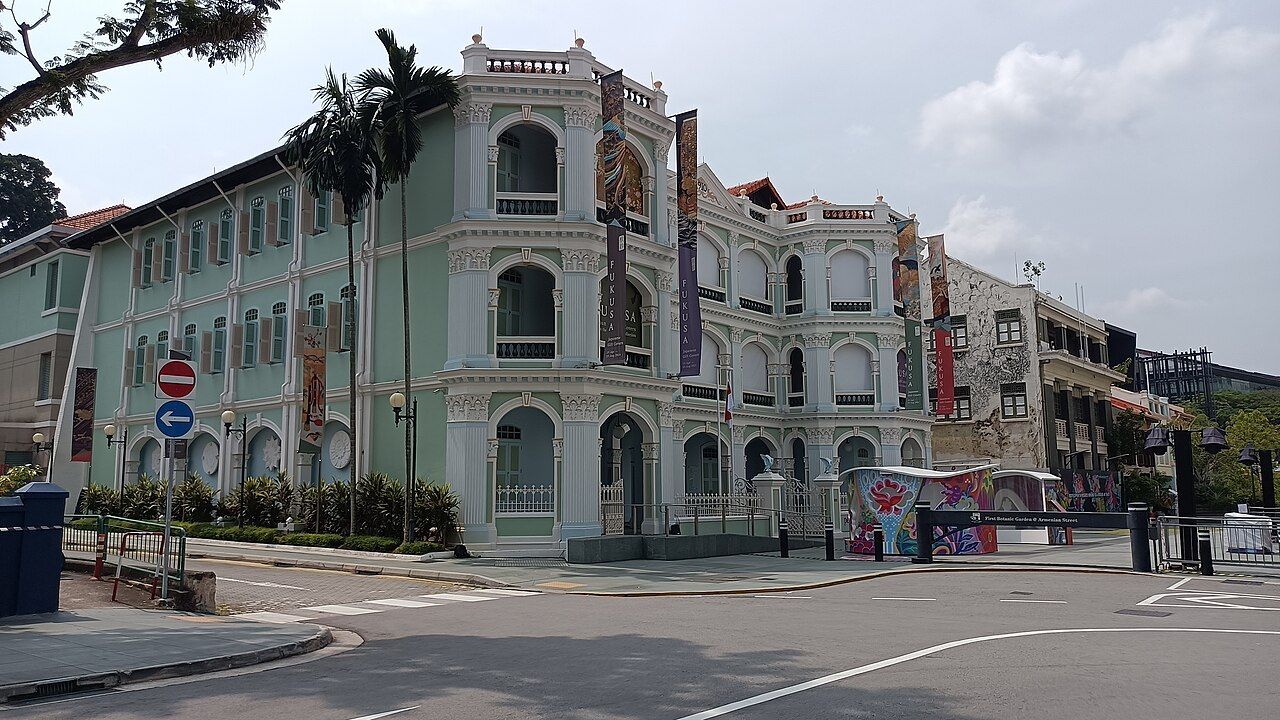
The former school's exterior deserves a look before or after the galleries. The museum's building history identifies the 1912 Tao Nan School as the museum's home. Notice the symmetrical façade and balconies, then distinguish the historic building from the modern exhibition design inside.
For most first visits, a meal or short street walk is a useful next step. If you want another collection, compare the premise carefully: our Asian Civilisations Museum guide focuses on a broader encounter with Asian art and connections across regions. Peranakan Museum offers a more concentrated route through identity, home and style.
Choose both only if museum time is a real priority. Otherwise, let the Peranakan visit stand on its own and leave space to discuss what you noticed. The best outcome is a clearer understanding of a few objects and communities, not a claim to have absorbed every culture represented in one afternoon.
Cover photograph: Pale green façade of the Peranakan Museum on Armenian Street — Archive photograph resized by Wikimedia Commons; exhibition banners are historical. — GoAheadFan95, CC BY-SA 4.0.
Frequently Asked Questions
How long should I spend at the Peranakan Museum?
About two hours is a useful editorial allowance for Origins and selected Home and Style displays. A focused visit can take around 60–75 minutes; a detailed visit or special exhibition needs more time.
Is the Peranakan Museum the same as the Asian Civilisations Museum?
No. The Peranakan Museum is on Armenian Street and concentrates on Peranakan communities, domestic life and style. The Asian Civilisations Museum offers a broader collection at Empress Place. Choose by interest rather than treating them as interchangeable.
Can wheelchair users visit all the galleries?
The museum lists ramp access and lifts serving all galleries, plus accessible toilets and a loan wheelchair. Check directly about the dimensions of a particular mobility aid or any assistance you need.
Do I need to book a guided tour separately?
The museum's FAQ describes same-day registration at Visitor Services, subject to capacity. Check the published tour schedule and language; an admission ticket does not guarantee a tour place.


Keep Exploring
ArtScience Museum Singapore: Choose Your Visit
Choose an ArtScience Museum exhibition, understand Future World tickets and plan a manageable Marina Bay visit.

Intrepid Museum New York: Choose Your Visit
Choose the carrier, Enterprise, Growler or a Concorde tour, with access checks, digital tickets and dated closures.
Australian Museum Sydney: Choose Your Visit
Plan a free Australian Museum visit around dinosaurs, wildlife or cultures, with gallery routes, access advice and current closure notices.