
Choose MAR exhibitions, architecture and educational visits on Praça Mauá, with current opening days, tickets and the library’s separate calendar.
The Museu de Arte do Rio, usually called MAR, is a strong choice when you want to understand Rio through art and the stories people tell about the city. Its location on Praça Mauá makes it convenient for a waterfront outing, but the exhibitions deserve more than a quick stop for the roof photograph. Plan around an exhibition that interests you, then use the building and the square to put the visit in context.
The most useful practical detail is the weekly calendar: MAR closes on Wednesdays, not Mondays. Its exhibition pavilion normally opens 11:00–18:00, with last entry at 17:00. Tuesday admission is free. The library follows a different calendar, and a scheduled educational visit is different again. Choose the part of MAR you actually want before fixing the day.
Choose the visit that fits your interests
| Interest | Where to focus | What to check |
|---|---|---|
| Art connected with Rio and Brazil | Current exhibitions | Subjects and closing dates |
| Architecture and the waterfront | The paired buildings and available viewpoint | Access on the day, including events |
| An introduction with an educator | Conheça o MAR | Session time and language |
| Books and research | Library and documentation centre | Its separate opening days |
| A family visit | A small selection of galleries | Age suitability and breaks |
Allow 2–3 hours for a selective exhibition visit and time looking at the building. This is an editorial planning estimate, not a museum requirement or a queue forecast. If you add a guided introduction or extensive reading, leave longer. Our Rio experience guide helps place MAR alongside the city's landscapes and neighbourhoods without turning the day into a race between attractions.
Opening hours, tickets and the Tuesday option
Use the museum's hours and tickets page before setting out. The ticket office and self-service machines operate 10:30–17:00; exhibition access begins at 11:00 and continues until 18:00, with last admission at 17:00. A ticket-office opening time is not permission to enter the galleries earlier. Wednesday is the regular closure day; check holiday notices for your date.
Published admission is R$20 full price and R$10 reduced. Tuesdays are free. The museum lists several other free or reduced categories, including free admission for children through age 5 and people aged 60 or above, with supporting documentation required for eligibility. Read the current list for your group rather than assuming that a foreign student card or a particular professional status automatically qualifies.
The official page directs visitors to online sales and on-site machines and specifies card payment, with no cash ticket sales. Take a working payment method even if you expect to qualify for a discount. A free day can be attractive, but it is not a promise of immediate entry or an empty gallery. Pick Tuesday if the saving suits your plans, not because it guarantees a quieter visit.
Understand the two buildings before entering
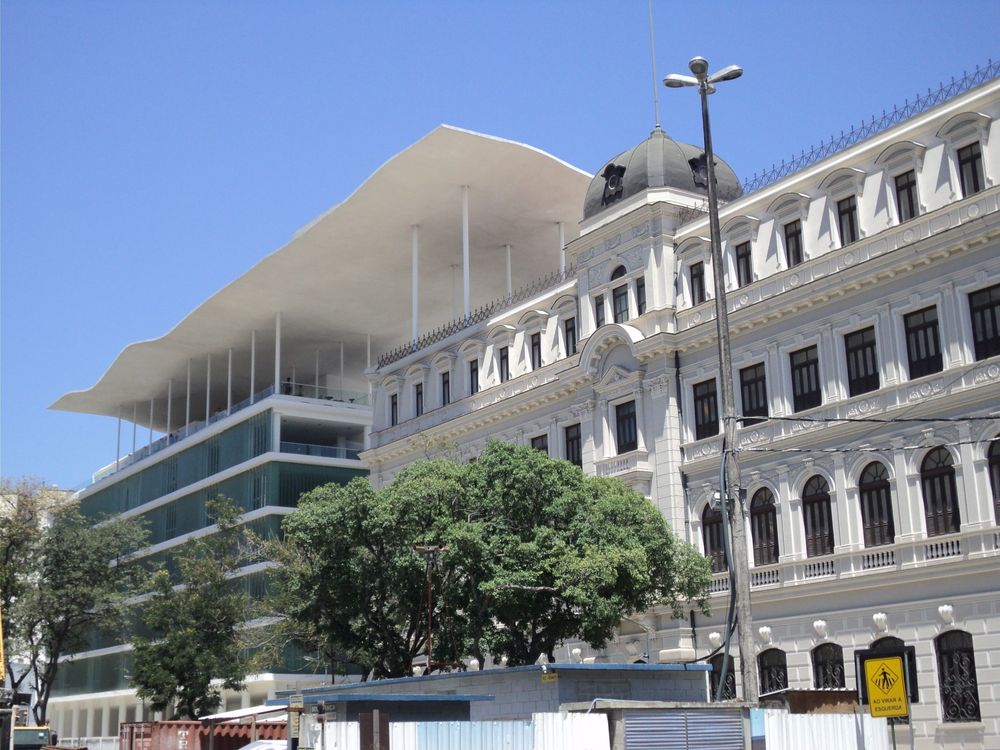
MAR joins two visibly different structures: the ornate Dom João VI building, containing exhibition rooms, and the modernist building housing Escola do Olhar, its educational programme. Their connection and wave-shaped canopy are part of what makes the ensemble recognizable. The museum's institutional introduction explains how art and education belong together here.
Before going inside, take a moment to look at the contrast between the façades. It gives you a useful question to carry through the visit: how can an institution hold different versions of a city's history together? You do not need architectural training to notice the contrast, and you do not need to reduce it to a single ideal camera angle.
Inside, follow the route indicated by staff rather than assuming an old blog's sequence still applies. If the viewpoint is available, include it as a pause within the visit. Ask about access when you arrive, particularly if an event is taking place. Do not buy admission solely on the assumption that every terrace or event space is always open to general visitors.
Choose exhibitions by subject, not by a fixed masterpiece list
MAR uses historical and contemporary art to explore the city and wider Brazilian society. That makes the current exhibition programme more useful than a permanent checklist of famous objects. Read the short introductions to the shows before travelling and choose the one you would most regret missing. A work appearing in an online collection does not establish that it is on display.
Once inside, begin with that priority while your attention is fresh. Read its introductory text, look slowly at a few works, and notice how objects, photographs or other media are placed in conversation. You can see more afterwards without having to give every room equal time. If you do not read Portuguese confidently, check available language support before relying on a guided visit or extensive text panels.
For companions with different interests, agree on a meeting point and a flexible amount of gallery time. One person may want to read every label while another prefers the visual sequence. A selective visit can be more rewarding than hurriedly crossing every room because a guide told you that completion was the goal.
Consider the Conheça o MAR introduction
The official Conheça o MAR programme lists sessions on Tuesdays at 11:00 and 14:00, Saturdays at 14:00, and holidays at 14:00. The introduction connects the museum's spaces and exhibitions with the port area and Pequena África, lasts up to one hour, and meets beside the ticket office. Confirm the session and language for your date.
This can be a useful starting point if the waterfront's history is new to you. It gives a framework for looking rather than simply adding another attraction to the itinerary. Arrive with time to arrange admission and find the meeting point; do not plan to join halfway through because your journey ran late.
Do not confuse this public programme with a prearranged school or institutional group visit. If you are organising a group, use the museum's dedicated booking process and explain the group's needs. A published public-session timetable does not reserve places for a large party.
The library is a separate reason to visit
The library and documentation centre focuses on art, education, social sciences and Rio's history. Its published public hours are 11:00–17:00, with closure on Wednesdays and Sundays, and visits are free. Sunday can therefore work for exhibitions while being the wrong day for a library-led outing.
If you want to consult particular material, check the catalogue and ask about access before travelling. A collection containing books, archives and artists' publications does not mean every item is available for casual handling. For a first leisure visit, treat the library as an optional extension if its subject genuinely interests you, rather than another room to tick off.
This distinction is especially useful for a return trip. You might choose a new exhibition on one visit and a more focused reading or research purpose on another. The museum's different functions need not all fit into the same afternoon.
Accessibility, children and time to pause
MAR's accessibility information states that the exhibition pavilion and Escola do Olhar are adapted for wheelchair users and visitors with reduced mobility. The entrance-level orientation area includes tactile models and a map. Friday 11:00–12:00 is listed as an adapted visiting period for people with intellectual and mental disabilities, with changes to sound, lighting and communication. Contact the team about your particular needs and the current arrangements.
For a family visit, choose a small number of things to notice together: a contrast in materials, a city scene, or an object that raises a question. Let the exhibition's subject guide the conversation instead of promising that every show is designed for children. Build in a break before attention runs out, especially if the morning already included another museum.
The museum's visitor FAQ describes seating on exhibition floors and wheelchairs and pushchairs available on request. Availability is limited, so make enquiries if an item is essential. It also explains that photography is generally permitted without flash but that individual works or areas can be restricted. Follow the signs and staff guidance, and use lockers for belongings that cannot enter the galleries.
Arriving at Praça Mauá and planning the rest of the day
The museum's arrival information places the Parada dos Museus VLT stop in front of MAR and identifies Uruguaiana as a metro option followed by a walk. Compare the whole journey from your accommodation, including the final approach and return. Do not confuse a useful transit connection with a guaranteed travel time, and check current service before leaving.
Keep the museum as the main commitment, then decide whether to add the square, a meal or another cultural stop. The nearby Museu do Amanhã has a different subject and a separate admission process; proximity alone is not a reason to book both. If you would prefer another exhibition-led visit in the centre, our CCBB Rio guide helps compare its programme and practical arrangements.
A good MAR day has room to absorb what you saw. After the galleries, discuss one work or question over a break before moving on. You will remember more from a chosen exhibition and an unhurried look at the waterfront than from collecting several museum entrances without time inside them.
Cover photograph: Historic and modern buildings beneath the wave-shaped roof of Museu de Arte do Rio — Mwaldeck, CC BY-SA 3.0.
Frequently Asked Questions
Which day is MAR closed?
Wednesday is the regular closure day. Exhibitions normally open 11:00–18:00 on other days, with last admission at 17:00. Check any date-specific notices.
Is MAR free on Tuesdays?
Yes, the current admission page lists Tuesdays as free. On other days it publishes R$20 full price and R$10 reduced, with documented eligibility for concessions.
Can I visit the library on Sunday?
No. Its published schedule is 11:00–17:00, closed Wednesdays and Sundays. It does not follow the exhibition pavilion's full weekly calendar.
How long should I allow?
About 2–3 hours is a useful editorial allowance for a selective exhibition visit and the building. Allow more for an educational session, detailed reading or a longer break.


Keep Exploring
Museo de Arte Popular: Plan Your Mexico City Visit
Plan Mexico City’s Museo de Arte Popular: craft collections, admission, Sunday access and a focused visit near the Alameda.
Academy Museum Los Angeles: Plan Your Visit
Plan an Academy Museum visit with gallery tickets, separate screenings and Oscars Experience, current closures and a realistic afternoon route.
Oaxaca Textile Museum: Plan Your Visit
Plan a thoughtful textile museum visit, with current hours, guided tours, workshop checks and a useful link to Oaxaca’s weaving communities.