
Plan a visit to Fes’s reopened Batha Museum: Islamic arts, ceramics, manuscripts, garden, current published fees and a focused route.
Visit Al Batha when you want to understand the objects, materials and decorative traditions behind Fes’s architecture. The restored palace reopened in February 2025 as the Museum of Islamic Arts. Give it a dedicated visit for the collection and garden, rather than treating it only as a place to rest after an exhausting medina walk.
The strongest first plan is around ninety minutes to two hours, with ceramics, manuscripts or textiles as your main interest and time outside in the garden. That is an editorial allowance, not an official tour duration. If you have only one substantial interior visit available in Fes, Batha is particularly useful for comparing different materials in a museum setting. Our Fes medina guide covers the wider walking visit separately.
Practical details at a glance
| Question | Planning answer |
|---|---|
| Current identity | Musée Al Batha des arts de l’Islam |
| Address | 5 Place Batha, Oued Fejjaline, Fes |
| Published opening | 10:00–18:00; closed Tuesday |
| Published admission | Foreign visitors MAD 60; Moroccans MAD 30; children MAD 15 |
| Suggested allowance | Around 90 minutes–2 hours, according to your interest |
| Best reason to choose it | Collection, palace architecture and garden in one focused visit |
| Confirm separately | Last admission, concessions, accessibility and photography arrangements |
Hours and tariffs come from the Fondation Nationale des Musées visitor page, checked on 12 November 2026. They are published rates, not a dated booking quote. The page does not establish the child age band or every exemption, so ask before assuming which category applies. A closing time of 18:00 also does not confirm that entry is possible until that minute.
Reopened, with a different museum identity
Older accounts often describe Batha as closed for restoration or as a museum primarily of local arts and traditions. The foundation’s reopening announcement records the public reopening on 26 February 2025 and the new Islamic-arts focus. Use the present operator page when deciding whether to visit, rather than a closure notice copied into an older itinerary.
The same announcement explains that the late nineteenth-century palace was built under Moulay Hassan I and completed under Moulay Abdelaziz. It became a museum in 1915. Those dates help separate three things you will encounter: the age of the palace, the age of individual objects and the modern presentation of the collection. They are not necessarily the same period.
This distinction is useful in Fes, where different historical layers are close together. UNESCO’s account of the medina places much of its major monumental development in the medieval Marinid period. Batha’s palace belongs to a later chapter. Reading a label’s date before connecting an object to a building outside helps avoid turning everything decorative into one undifferentiated “old Fes”.
Start with a question, then follow the displayed route
At reception, establish which areas are open and whether any temporary arrangement changes the visit. Ask about photographs, bags and available interpretation in your preferred language. These practical points have not been verified as uniform services, so do not rely on an assumed audio guide, locker or translation.
Choose one question to carry through the rooms. You might ask how a ceramic object’s shape relates to its use, how writing becomes decoration, or how a woven surface differs from a carved one. This gives you a reason to stop at particular objects without requiring prior knowledge of every dynasty.
Follow the museum’s current circulation rather than an imagined room-by-room route from an old review. When an object catches your attention, look before reading the label, then read the date, material and origin, and look again. That second look often reveals details you missed: an uneven rhythm, a handle’s shape, or a border that changes the composition.
Ceramics: begin with form, then decoration
The operator identifies ceramics among the collection’s main materials. They provide a useful entry point for visitors who have been looking at tiled surfaces and pottery around Fes. Start with the shape of a vessel: its opening, base, handles and the balance between its parts. Then consider the decoration in relation to that shape.
Compare two displayed pieces rather than trying to memorise a cabinet. Is the pattern arranged around a centre, in bands or across the whole surface? Does it emphasise the rim or the body? Read the labels before concluding that similar colours mean the same workshop, town or date. A museum comparison is valuable precisely because it can complicate what initially looks similar.
Keep this separate from shopping advice. A historic object in a case is not a certificate for a modern item sold elsewhere. If the museum makes you interested in buying pottery later, ask the seller about that actual piece’s material, production and intended use. The museum visit can improve your questions without authenticating a purchase.
Manuscripts, textiles and metalwork: change how you look
Manuscripts, carpets, textiles and metal objects are also listed by the museum. With manuscripts, start at the scale of the page. Notice margins, the relationship between writing and empty space, and how different elements direct the eye. Reading the script is not necessary to appreciate a page’s organisation, but the label remains important for understanding its purpose.
For textiles, step back enough to see the overall arrangement before approaching the permitted viewing distance. Look for repeated units, borders and changes in colour. Then compare the texture and pattern with a ceramic or metal object you have already seen. Similar visual ideas can behave differently on a flexible surface and a rigid one.
With metalwork, consider the relationship between the object’s volume and its surface treatment. Look for how a handle, lid or edge participates in the design. These are suggested ways to observe whatever is displayed, not a promise of specific masterpieces or a fixed cabinet arrangement. The museum’s published overview also mentions contemporary work; use current labels to understand any such pieces you encounter rather than assuming every object is historical.
If your group has mixed interests, each person can choose one object to explain to the others. A brief conversation about why it stood out often creates a better shared visit than trying to read every label together at the same speed.
Treat the palace and garden as part of the visit
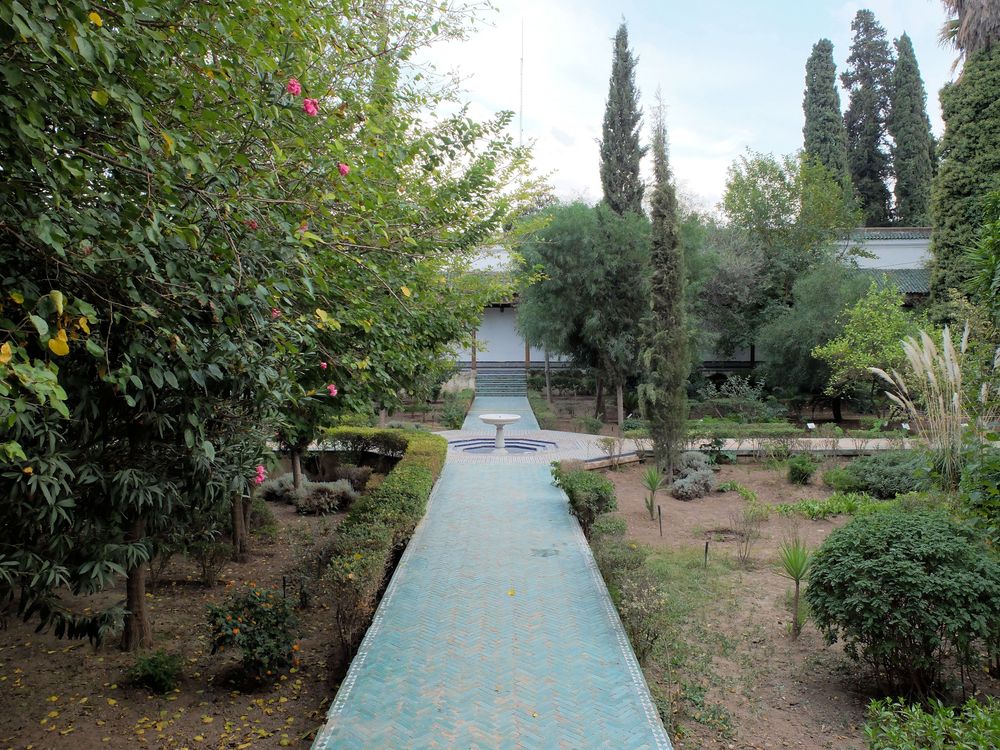
The garden is central to the palace’s design, not simply an outdoor waiting area. The foundation’s reopening material describes a Moroccan-Andalusian garden occupying more than half the site. Give it time alongside the objects, while recognising that weather and temporary access can affect how long you want to remain outside.
Look at how planted space, paths and surrounding architecture frame one another. From an allowed position, compare the view across the garden with a closer view of a doorway or arcade. The shift in scale is part of the appeal: an individual object, a room and a whole garden require different kinds of attention.
The cover photograph is an archival image from 2014, before the recent restoration. It depicts the actual Batha palace setting, but it is not evidence of today’s planting, furniture, access route or exhibition layout. For a visit focused on a particular restored feature, ask the museum whether that area is currently accessible.
A garden pause may help after time in the galleries, but do not build the day around an unverified café or guaranteed seating. Ask staff what facilities are available when you arrive. Food and drink rules, like photography rules, should come from the museum’s current arrangements.
Fit Batha into a Fes day
For a museum-first morning, arrive after opening, concentrate on the collection, then spend time in the garden before lunch. This works well if you want to look closely while your attention is fresh. A short neighbourhood walk afterwards can connect what you have seen with the city without requiring another long indoor visit.
For a medina-first day, keep the morning walk compact and leave a real museum block after lunch. The risk is arriving too late or too tired to enjoy the objects. If your walk expands into several interiors and shopping stops, move Batha to another day rather than preserving a nominal museum stop just before closing.
The national tourism office’s Fes page helps orient the wider city visit. Use Place Batha as the destination to discuss with your accommodation or driver, then confirm the museum entrance. Do not assume that a vehicle can collect you at an arbitrary pin deep inside the medina. Agree a recognisable meeting point and the walking approach.
If choosing how many days Fes deserves within the wider journey, our seven-day Morocco itinerary comparison explains the larger route decision. Museum time is easier to protect when the city has a full visiting day instead of only the hours between transport connections.
Families, mobility and a final check
For children, a short material-based game can make the collection approachable: choose an object made from clay, one from metal and one from textile, then compare their shapes. Keep it observational and follow staff instructions; museum objects are not handling exhibits unless explicitly presented that way.
For reduced mobility, contact the museum about the exact approach, thresholds, gallery access, garden surfaces and toilets. A restored historic building should not be assumed fully step-free simply because it reopened recently. State the assistance or equipment you use so the answer concerns your actual visit.
Before travelling, recheck the Tuesday closure, holiday changes and your ticket category. If you plan to arrive late, ask about last admission and the time needed to see the open areas. The visit is most rewarding when there is room to compare a few objects and understand the setting, rather than when its only goal is to enter the building.
Cover photograph: Tiled garden path and fountain at Dar Batha palace in Fes — Garden of Dar Batha, archival photograph from 2014, before the recent restoration. — R Prazeres, CC BY-SA 4.0.
Frequently Asked Questions
Is Batha Museum still closed for restoration?
No. The foundation records its reopening on 26 February 2025 as the Museum of Islamic Arts. Check the current museum page for exceptional closures before travelling.
What are the published hours and admission prices?
On 12 November 2026, the operator listed 10:00–18:00, closed Tuesday, with MAD 60 for foreign visitors, MAD 30 for Moroccans and MAD 15 for children. Confirm concessions and the child age band directly.
How long should I allow for a visit?
Around ninety minutes to two hours is a useful editorial allowance for the collection and garden. Your interest in the displays and the open areas will determine the actual duration.
Should I visit Batha before or after the medina?
Choose a museum-first morning for concentrated looking, or a separate afternoon after a short walk. If your medina visit becomes long and tiring, Batha is better saved for another day than squeezed in before closing.


Keep Exploring
Academy Museum Los Angeles: Plan Your Visit
Plan an Academy Museum visit with gallery tickets, separate screenings and Oscars Experience, current closures and a realistic afternoon route.
Oaxaca Textile Museum: Plan Your Visit
Plan a thoughtful textile museum visit, with current hours, guided tours, workshop checks and a useful link to Oaxaca’s weaving communities.
Niterói Contemporary Art Museum: Plan Your Visit
Plan a MAC Niterói visit from Rio: Niemeyer architecture, galleries, tickets, Wednesday admission, ferry connections and a realistic half-day outing.