
Look closely at Bahia’s painted ceilings, carved plaster and courtyards, then decide whether to add El Badi, the Mellah or a nearby food museum.
Bahia Palace is a strong Marrakech choice if you enjoy decorative architecture: painted ceilings, carved plaster, tile patterns and the transition between enclosed rooms and open courtyards. Give those details your attention before adding another attraction. A visit followed by lunch and a short southern-medina walk can make a satisfying morning without becoming a race between palaces.
Allow 60–90 minutes inside, as an editorial estimate excluding entry queues and travel. Add more time if you book detailed interpretation or want to sketch. The attraction is the architecture itself; choose a guide for explanation, not because you expect an admission ticket to include a narrated tour.
| Decision | Useful starting point | What to confirm |
|---|---|---|
| Admission | Official Ministry ticket portal | Correct nationality, residence and age category |
| Timing | Published visiting window 09:00–17:00 | Date-specific access and last admission |
| Main focus | Ceilings, plaster, tilework and courtyard sequence | Which areas form the current visitor route |
| After the palace | El Badi for ruins or a food-focused museum | Separate admission and enough time for a break |
| Mobility | Describe your actual requirements before arrival | Thresholds, route changes and accessible facilities |
Tickets: use the official categories
The Ministry of Culture’s Bahia ticket page lists 100 Dh for a foreign adult and 50 Dh for a foreign child aged 7–13. It lists 30 Dh for a Moroccan or resident adult and 10 Dh for a Moroccan or resident child aged 7–13. These were the published categories on 16 October 2026; check the current offer before paying and bring evidence for any category you claim.
Do not substitute the price of a guided package for the monument’s admission price. A commercial offer may include a guide, transport, other monuments or a service charge. Read the inclusions and meeting point, and establish whether you receive a valid entry ticket or still have to buy one separately.
The Ministry’s terms explain the admission exemptions: reduced-mobility visitors are exempt, while the Friday and first-day-of-holiday exemption applies to Moroccan nationals. Do not read this as free Friday admission for every visitor. Confirm the evidence and practical procedure for any exemption before arriving.
Save a purchased ticket where you can open it without depending on mobile reception. Check its conditions and the official order confirmation before making another purchase if delivery is delayed. The existence of a checkout page does not promise priority entry past every queue or a place on a guided tour.
Opening time and the current visitor route
The Ministry portal publishes visiting hours of 09:00–17:00. Treat that window as the starting point, then verify the day’s entrance arrangements and last admission before a late visit. Closing time is not a sensible arrival target when you want to examine the palace properly.
An early visit is our preferred planning choice when Bahia is the main sight of the morning: it leaves room for a slower circuit and lunch afterward. This is an itinerary recommendation, not a guarantee of empty rooms. If you arrive with a large group, let it move ahead where the route permits rather than trying to photograph through everyone at once.
UNESCO’s conservation update discusses restoration work involving Bahia and other medina monuments after the earthquake. That is a reason to respect the current visitor circuit, not to assume that the entire palace is closed. Before buying, ask about any section particularly important to you; follow barriers and staff directions instead of using an old online floor plan as an access entitlement.
Getting to the right entrance
The regional tourism board’s Bahia listing places the palace on Avenue Imam El Ghazali. Save the monument location and confirm the visitor entrance with your accommodation, especially if your map shows several adjoining buildings or lanes. A drop-off at the edge of the medina may still leave a walk.
If you are walking from the Jemaa el-Fna area, give the approach its own time rather than subtracting it from the palace visit. If you arrange a vehicle, agree a usable meeting point and the final walking section. For a group, choose a place to gather that leaves the entrance clear.
Keep a light day bag and wear shoes that work on historic paving. Arrange luggage storage with your accommodation before setting off if you are between rooms or leaving Marrakech later. Do not assume a palace visit includes a staffed luggage service simply because a tour can collect you from a hotel.
Understand the palace through its changing spaces
Bahia developed as the residence of Si Moussa and was expanded by his son Ba Ahmed. Think of it as an ensemble of rooms, garden courts and connecting passages rather than a single symmetrical building to inspect from one viewpoint. The useful historical idea is expansion: different spaces serve different scales of reception and domestic life.
You do not need to memorise every room name to follow that idea. On the visitor route, compare an intimate garden court with a larger, more open courtyard. Notice how a doorway limits your view, then how the next space opens it. Look at the relationship between the decorated rooms and the outdoor space they face.
UNESCO includes Bahia among the medina’s architectural landmarks. The palace also belongs to a living urban setting of houses, lanes and traditional crafts. That context makes the walk outside worthwhile, but it does not turn neighbouring homes or workshops into extensions of the paid monument.
Look up: painted wood and the frame around it
The regional tourism board identifies cedar in the painted ceilings. Begin by stepping back enough to see an entire ceiling composition from a permitted standing place. Then look at a smaller section: a border, repeated motif or the transition between ceiling and wall. Wide view first, detail second is more revealing than collecting close-ups without knowing where they sit.
Compare painted wood with carved plaster. Paint changes colour across a flat or shaped wooden surface; plasterwork creates depth through relief and shadow. Look for where one material gives way to another around a doorway or upper wall. You are reading how a room is assembled, not trying to decide that every decorative mark has a hidden symbolic meaning.
If you have a guide, ask how the materials were worked and which surfaces have been conserved or restored. A useful explanation distinguishes observed detail from a story about former occupants. There is no need to repeat an elaborate anecdote simply because it makes a room sound more dramatic.
Look down and outward: tilework, marble and courtyards
At floor and lower-wall level, follow the geometry of the zellij tilework. Choose a pattern and trace how it repeats, then look at how its border meets a doorway, column or corner. Keep your eyes on your footing when moving; stop clear of the main path before examining a detail closely.
In the courtyards, use the marble surfaces, fountains and surrounding openings to understand scale. A photograph of a single carved doorway can conceal the size of the space around it. Take a wider view that includes the relationship between the court and the rooms, then return to a detail that caught your eye.
The planted courts offer another comparison: greenery and shade change the experience of the surrounding architecture. Do not expect every fountain to be operating or every garden section to be accessible. A closed portion need not erase the value of the open route; spend longer comparing the materials and spaces that are available.
For children, make the visit a simple observation game: find a repeated shape, compare a painted and a carved surface, and choose a favourite doorway. This gives the palace a clear subject without inventing royal legends or requiring a long history lesson at every stop.
Independent visit or a guide?
Visit independently if you mainly want to look, photograph within the rules and set your own pace. A guide is more useful when you want the building’s social history, explanation of craft techniques or help understanding how the different spaces relate. Agree language, duration and scope before booking.
Ask whether the guide meets you at the palace or elsewhere, whether entry is included and whether the itinerary contains shopping stops. If Bahia is your priority, say so explicitly: a multi-stop city walk may leave less time here than you expect. Also establish what happens if part of the palace route is unavailable.
For photographs, follow current notices and staff instructions, particularly for professional equipment or staged shoots. Do not block a doorway while waiting for an empty frame. Keep hands and bags away from decorated walls; looking closely does not require touching fragile surfaces.
Choose one nearby continuation
El Badi is the clearest architectural contrast. The tourism board’s El Badi page describes the surviving open space, pools and palace remains. Choose it for scale and ruins after Bahia’s detailed decoration. It is a separate visit, with additional admission and outdoor exposure; stop for a drink or meal between the palaces rather than assuming they make one continuous interior tour.
The Mellah adds neighbourhood context. Walk through the public streets if you want to remain in the southern medina. The Salat Al-Azama listing places the synagogue within the Mellah. If interested, confirm its visitor arrangements separately and respect its religious setting. A palace ticket does not include it, and a neighbourhood walk does not imply permission to enter homes or private courtyards.
The Moroccan Culinary Art Museum changes the subject. Its own website lists a museum visit, tea salon, rooftop restaurant and cooking classes on Rue Riad Zitoun el Jdid. Choose the museum for food history or reserve a class if you want participation; a meal or tea stop is a separate purchase. Confirm the specific activity and duration rather than treating every service in the building as one ticket.
Put Bahia into your wider stay
If Bahia is your only paid cultural stop that day, pair it with a short medina walk and a proper meal. If you add El Badi, leave the northern medina and distant gardens for another outing. Our Marrakech itinerary handles the wider sequence; this visit works best when you protect time to observe the palace itself.
For a lower-cost continuation, our free Marrakech activities guide distinguishes public spaces from paid interiors. Keep the same distinction here: buying Bahia admission gives you the current palace visitor route, while guides, transport, neighbouring attractions and refreshments remain separate decisions.
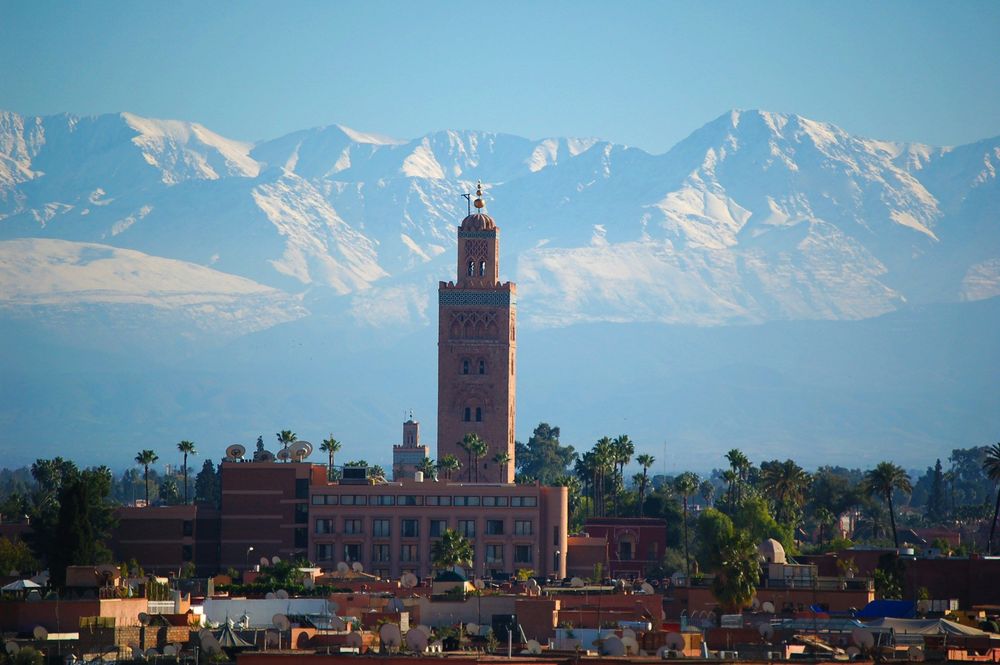
Cover photograph: Destination overview — Marrakech rooftops and a minaret with snowy mountains behind. Photo by Paul Macallan on Unsplash.
Frequently Asked Questions
How long should you allow for Bahia Palace?
Allow 60–90 minutes inside as an editorial estimate, plus travel and entry queues. A detailed guided visit, sketching or a slower pace may need longer. Check last admission before planning an afternoon arrival.
Is Bahia Palace the same as El Badi?
No. Bahia is the stronger choice for decorative rooms and courtyards; El Badi offers palace remains and open scale. They have separate entry arrangements, and visiting both deserves a break between them.
Is Bahia Palace free on Fridays?
The Ministry’s Friday exemption applies to Moroccan nationals, not every visitor. Its terms also identify an exemption for people with reduced mobility. Confirm your eligibility and the procedure before the visit.
Can you assume the whole palace is accessible?
No. Follow the current visitor route and ask about sections or mobility requirements that matter to you before buying. Restoration, thresholds and entrance arrangements should be checked for your date; an admission exemption is not proof of a fully step-free route.

Keep Exploring
Mexico City Anthropology Museum: Plan Your Visit
A focused Anthropology Museum visit: compare Mexica, Maya and regional galleries, make room for living cultures and understand practical admission choices.
Marrakech Souks: A First-Visit Guide
Explore Marrakech's souks with a clear starting point, a small craft shortlist and time to compare purchases, without turning your first visit into a shopping marathon.
Things to Do in Marrakech: A First-Visit Guide
Plan a first visit around the Marrakech experiences you actually want: decorative palaces, garden walks, photography, souks and Moroccan cooking.