
Teotihuacan from Mexico City: Plan Your Visit
Plan a day among Teotihuacan's plazas, pyramids and museums, with a route that works without a summit climb and a clear separation between ground visits and balloon packages.
Teotihuacan deserves a day with room to walk, look closely and return without rushing. The practical choice is how much of the ancient city to cover: a focused circuit around the Sun and Moon pyramids, a longer route including the Ciudadela, or a visit that gives the museums proper time. A balloon flight is a separate activity and needs its own ground-visit arrangements.
The allowances below are editorial estimates for sightseeing, excluding travel from Mexico City, entrance formalities and lunch. They assume a route at ground level; none depends on permission to climb a pyramid.
| Visit style | Suggested allowance | What to prioritize |
|---|---|---|
| Monument-focused | 2–3 hours | Pyramid of the Sun, Avenue of the Dead, Moon plaza |
| Broader archaeological visit | 4–5 hours | Ciudadela, main avenue, northern monuments and a museum |
| Art and archaeology | Most of the day | A shorter outdoor route plus selected museum galleries |
| Balloon and ruins | Separate flight and site blocks | Written transfer, admission and ground-visit inclusions |
For the wider trip, use our Mexico City highlights guide. Teotihuacan is an excursion outside the city; it should replace a substantial sightseeing block rather than follow an already full museum morning.
Hours and admission: plan the museum first
As checked on 16 October 2026, INAH's visitor listing gives daily archaeological-site hours of 08:00–17:00, with last admission at 16:30. The Ministry of Culture museum listing confirms the combined museum and archaeological-zone ticket at MXN 105 for Mexican nationals and foreign residents, or MXN 210 general admission. Sunday free admission is listed for Mexican citizens, so foreign tourists should not assume Sunday is free for them. Residents should confirm Sunday eligibility and the required proof directly with the site.
Last admission is a cutoff, not a recommended arrival time. Arriving near it leaves little time even for a focused outdoor visit. Keep the site ticket accessible during the day, particularly when moving between museum spaces and archaeological entrances.
The museum pages below list shorter opening hours and admission included in the archaeological-zone ticket. That distinction changes the order of an afternoon visit: do the museum first, then the outdoor section that fits the time remaining. Official listings differ on some museum closing times. Use the earlier Lugares INAH times below for planning and confirm the selected museum’s current hours before departure.
Read the site from south to north
The UNESCO description identifies the north–south Avenue of the Dead as the city's main axis. Its geometry is part of the attraction: the plazas and buildings make more sense when you look along the avenue as well as at individual pyramids. The visible ceremonial area was part of a much larger city.
A practical extended route begins with the Ciudadela and Temple of the Feathered Serpent, follows the avenue towards the Pyramid of the Sun and finishes around the Moon plaza and Quetzalpapalotl complex. Agree your exit and pickup point before starting; a one-way walk can save retracing the route, but only if your transport arrangement supports it.
Ciudadela and Temple of the Feathered Serpent
Include this southern group if carved architectural detail interests you as much as the pyramids' scale. It provides a different opening to the day from going directly to the Sun pyramid. Look for the relationship between the large enclosure and the temple rather than treating the whole stop as a single photograph.
Do not promise yourself a particular raised viewpoint or close approach to every carved surface. Use the open visitor route and follow barriers. If arrival is late, choose deliberately between this southern extension and a museum instead of hurrying through both.
Pyramid of the Sun and the main avenue
This is the natural anchor for a shorter visit. Walk between viewpoints at the base and along the avenue; changing position helps reveal the monument's proportions. Allow time to stop, because continuously crossing the exposed site can feel very different from strolling through a shaded city park.
INAH's archaeological overview also describes palaces and residential compounds beyond the best-known pyramids. Do not add every named compound to a first visit. A guided visit focused on painting or urban life can justify a detour; an already long circuit with a fixed return pickup usually cannot.
Moon plaza and Quetzalpapalotl
The northern end makes a useful conclusion to the main outdoor route. Look back along the avenue before leaving: the alignment and surrounding platforms give context to the monuments you have just passed. Add the Quetzalpapalotl area if its visitor route is open and you still have energy for architectural detail.
The itinerary works without any ascent. Access to individual structures can change, so old photographs of people on stairways are not evidence that those stairways will be available during your visit. If a climb is essential to your expectations, confirm the specific structure's current access before purchasing a tour that advertises it.
Choose a museum for a particular purpose
Trying to see every museum after walking the whole site is an easy way to run out of attention and opening time. Pick the collection that answers the question the outdoor ruins leave you with.
Museo de la Cultura Teotihuacana: how the city worked
The Museum of Teotihuacan Culture, south of the Pyramid of the Sun, presents objects and themes relating to society, technology and belief. It is a logical choice when you want the monumental setting connected to people's lives. Its published hours are daily 09:00–16:00, and entry is included in the archaeological-zone ticket.
Allow roughly 45–60 minutes as an editorial starting point. Concentrate on the social and economic material if you have already spent a long time discussing ceremonial architecture outside. Conversely, choose religious imagery if the temples raised questions you want to pursue. A selective museum visit is more useful than reading every label while watching the clock.
Museo de Murales: painting and interpretation
The Beatriz de la Fuente mural museum focuses on mural fragments, painting techniques and their interpretation. INAH identifies access via Gate 3 and lists daily 09:00–16:00 hours, with admission included in the site ticket.
This is the stronger choice for an art-focused visit. Reserve approximately 45–60 minutes, as an editorial allowance, and prioritize the explanations of technique and imagery. The displays help you imagine coloured surfaces where the outdoor monuments now read largely as stone. Fit the museum into the northern part of your route, with the actual access path confirmed on arrival.
Museo de la Grandeza Teotihuacana: another option
INAH also lists the Museo de la Grandeza Teotihuacana, with material on social organization, religion and daily life. Its published hours are daily 09:00–16:00 and admission is included in the archaeological-zone ticket.
Treat it as an alternative collection to consider when planning, rather than an automatic extra. Ask which route connects it most conveniently with your chosen monuments. If you already selected Cultura for a broad introduction, adding another general collection may be less valuable than spending longer with the mural museum or shortening the walking day.
Decide how you will get there and back
Independent bus travel, a booked driver and a guided excursion solve different problems. Compare the complete journey from your accommodation, including the return, rather than only the advertised outbound fare.
For the bus option, Central del Norte is the departure point to investigate. Ask for the archaeological zone or “Pirámides,” making the destination explicit rather than buying for a town with a similar name. Consult Autobuses Teotihuacan for current service information and confirm the day's departure, fare, drop-off and return boarding point before travelling. Do not base the afternoon on an assumed fixed frequency or the last bus time from an old blog.
A prearranged driver can make a route with different entry and exit points easier. Specify the pickup gate, waiting arrangement, return destination and what happens if the visit runs late. Include tolls and parking in the price discussion. An outbound ride booked through an app should not be treated as a confirmed return reservation.
A guided excursion is useful when interpretation matters as much as transport. Compare actual time inside the archaeological zone, guide language, group size, museum stops and extra shopping or meal stops. A long tour duration does not necessarily mean a long archaeological visit. If the mural museum is essential, request an itinerary that names it.
Balloon flights and ground admission are different decisions
A balloon product may combine a flight with breakfast, transfers or a guided visit, but the word “Teotihuacan” in the title does not establish those inclusions. Before paying, identify the departure meeting point, hotel transfer coverage, archaeological admission, time at the ruins and return transport in writing.
Ask how weather cancellation affects each component and whether a cancelled flight still leaves you with a ground visit or a different refund arrangement. Also check the operator's passenger restrictions and boarding requirements. These are product-specific conditions, not something a general site ticket resolves.
If the ruins are your priority, book a day that protects time on the ground. If the flight is the priority, allow for its early departure and the fatigue of continuing across an exposed archaeological site afterwards. Avoid attaching a tightly timed evening reservation in Mexico City to either plan.
Practical preparation and a workable day
Wear shoes suited to uneven surfaces and carry sun protection and water appropriate to the conditions. Plan your meal outside the archaeological visit: INAH lists no food entry, no smoking and no pets. Museum listings also prohibit flash photography. If you require step-free movement, ask about the exact entrance, paths and museum access; “ground-level itinerary” does not mean an entirely smooth or accessible route.
For a balanced day, start with the southern monuments, continue towards the Sun pyramid, take the selected museum break while it is open and finish at the northern end only if energy and transport allow. For a shorter day, keep the Sun–Moon core and drop the southern extension. Shortening the route is preferable to reaching a museum after closing.
Our Mexico City itinerary helps decide which city day to replace. Keep the return evening flexible for dinner near your accommodation rather than another cross-city commitment.
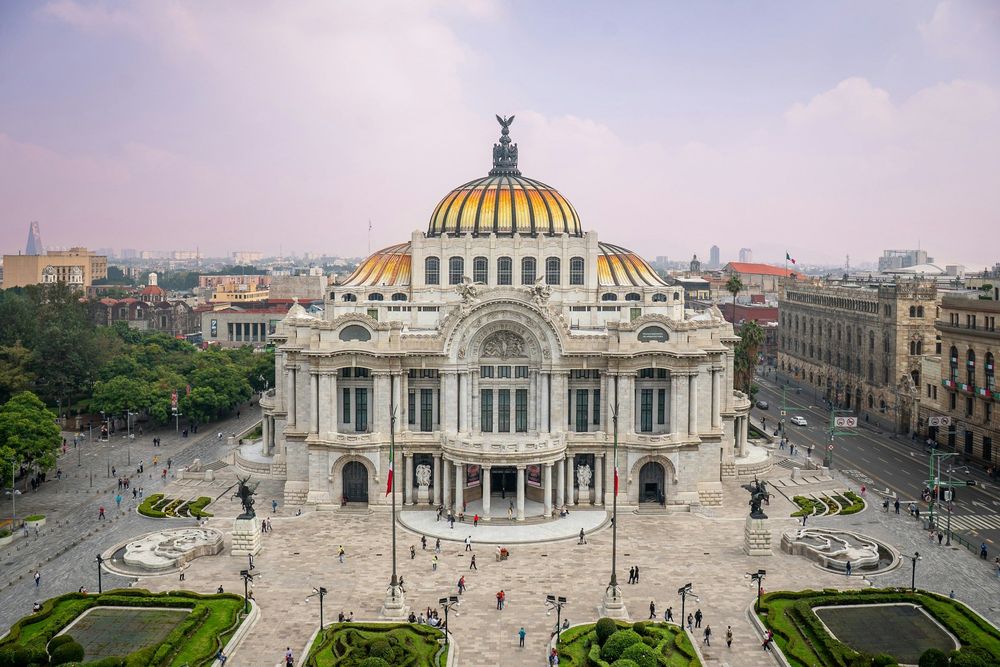
Cover photograph: Destination overview — Palacio de Bellas Artes and its forecourt in Mexico City. Photo by Alexandra Tran on Unsplash.
Frequently Asked Questions
How much time should I allow at Teotihuacan?
Allow 2–3 hours for a focused monument visit or 4–5 hours for a broader route with a museum. These are editorial estimates excluding travel, entrance formalities and lunch.
Does the archaeological ticket include the museums?
The INAH pages for Cultura Teotihuacana, Beatriz de la Fuente and Grandeza Teotihuacana list admission as included in the archaeological-zone ticket. Official listings differ on some museum closing times, so confirm your chosen museum’s hours and plan it before the end of the day.
Can I assume I will climb a pyramid?
No. Build a route that works at ground level and confirm current access to the specific structure. Old photographs and generic tour descriptions do not establish permission for your visit.
Does a balloon booking include visiting the ruins?
Only if the package explicitly includes it. Confirm ground admission, transfer arrangements, time inside the site and cancellation terms before booking.

Keep Exploring
Malé Stopover: Plan a Short City Visit
Decide whether to leave the airport or stay overnight, then build a manageable Malé walk around the historic centre and your onward connection.
Mexico City with Kids: Museums, Play and Easy Days
Plan manageable family days in Mexico City, choosing between interactive museums, an artist's house and flexible park time without crossing the city repeatedly.
Ait Ben Haddou from Marrakech: Day Trip or Overnight?
A practical choice between a long day from Marrakech and a night near the ksar, with architectural highlights, access limits and realistic time tradeoffs.