
Taronga Zoo Sydney: Ferry, Tickets and Visit Plan
Choose an upper- or lower-entrance route at Taronga Zoo Sydney, plan the ferry and focus on selected habitats. Includes the current Sky Safari closure and ticket distinctions.
Give Taronga Zoo Sydney a substantial part of the day, choose a few animal areas and decide which entrance suits your transport before you buy. The harbour crossing can be part of the pleasure, but arriving by ferry does not put you at the top of the zoo. A good route accounts for the hillside rather than assuming that every exhibit lies on a flat circuit.
Sky Safari is closed. Taronga's current project page says the former cable car retired on 31 January 2023 and the replacement is expected in late 2027. Do not plan a 2026 visit around riding it up from the wharf or using it to return to the upper entrance.
Our Sydney sightseeing guide compares harbour, museum and coastal outings. Taronga earns its own block of time when animals and their care interest you; the harbour view alone is not a reason to rush through a full zoo ticket.
Choose a manageable version of the day
| Plan | Best for | Editorial allowance | Main decision |
|---|---|---|---|
| Selected habitats and one talk | Visitors who want a focused introduction | 4–5 hours inside | Which animals matter most? |
| Longer zoo day | People who enjoy observing and reading | Most of the opening day | Where to pause rather than adding every area |
| Ferry plus upper-entrance start | Those wanting the harbour journey and a downhill bias | Zoo time plus crossings and bus connection | Check the 238 connection from the wharf |
| Lower-entrance start | Arriving by ferry without an initial bus | Zoo time plus crossings | Plan for uphill sections and the final exit |
These are planning allowances, not promised durations or a guarantee that every habitat will be visible. Information was checked on 20 October 2026. Check opening hours, construction notices, ferry departures and the daily map before setting out.
Buy zoo admission and transport deliberately
The official ticket page distinguishes adult, concession, child and infant entry, as well as family products. On the check date, child entry covers ages 4–15, while children under four enter free. Confirm the applicable category and documents before paying; a family product may not match your group's actual composition.
Compare the live total for your date rather than treating an online “from” price as a fixed quote. Read whether your selected product has a date requirement and how changes work. Save the confirmation somewhere accessible before travelling, especially if several people will enter together using one purchase.
A zoo admission purchase should not be assumed to pay for the ferry, public bus or parking. Some third-party packages combine transport and entry, but their inclusions must be explicit. Compare the same components when deciding whether a package is useful; a boat operator's ticket and an ordinary public ferry journey are not automatically interchangeable.
Optional encounters and guided experiences are another decision. Read age limits, meeting point, animal-contact conditions and whether zoo admission is included in that exact product. General admission is not a promise of touching or holding animals. Choose an extra because it adds something you want, not because it appears during checkout.
Decide between the lower and upper entrances
Taronga's arrival page places the zoo on Bradleys Head Road, Mosman. Ferry passengers arrive near the Lower Zoo Entrance. The zoo's Sky Safari guidance gives two practical choices: enter there, or take the 238 public bus from the ferry terminal to the Top Main Entrance.
An upper start can reduce some initial climbing and lets you plan a route with an overall downhill direction. It does not make every connecting path downhill. Choose the actual habitats first, then use the map to avoid repeatedly crossing the slope for attractions at opposite ends of your list.
A lower start avoids waiting for the initial bus, but means accepting more uphill movement if your priorities are above you. It may still be sensible for a shorter route built around lower areas. The right entrance is the one that fits your selected visit, not necessarily the one used by another traveller in an old itinerary.
Taronga advertises additional shuttles during holiday and peak periods. Its arrival page includes a dated school-holiday service; do not turn that into a guarantee of a free daily shuttle throughout the year. For an ordinary visit, check current public transport and ask about any additional service actually operating on your date.
Treat the ferry as a real connection
Transport for NSW's F2 Taronga Zoo route identifies the public ferry service and accepts Opal and contactless payment. Check the current departure, stop pattern and service alerts through the trip planner. The route page notes that variations occur, so a generic journey time is not a complete plan.
At Circular Quay, use the displayed departure information for the sailing you need. Allow time to reach the wharf and board rather than arriving at the published departure minute. If you need assistance, review the service's accessibility information as part of that journey, not only the zoo's facilities.
For the return, choose an intended sailing with another reasonable option behind it. Finishing at the lower exit is useful for a ferry return; finishing at the upper entrance may require an additional connection. Decide this before the last hour, when it is harder to judge a hillside walk with tired legs.
If you mainly want a boat ride and a harbour stroll, compare that wish with a different harbour outing before buying zoo entry. If the animals are the priority, protect their viewing time and treat the crossing as transport with a pleasant setting, not another attraction that must be extended.
Choose animal areas by interest
For Australian wildlife, Nura Diya Australia brings together habitats associated with kangaroos, koalas, dingoes and nocturnal species. Taronga describes a 400-metre trail and an approximate 45-minute exploration allowance. That is the operator's guide for this area, not the duration of the whole zoo visit or a promise of every animal being active.
Use it as a coherent starting theme if this is your first close look at Australian fauna. Pause to observe behaviour and read how habitats support the animals. A sleeping animal is not a failed visit; quiet observation can be more informative than moving on immediately because nothing is performing for the camera.
Then choose one contrasting area from the current map. Someone keen on giraffes may give that habitat more time; another visitor may prefer primates, birds or marine animals. Agree on two or three priorities for the group rather than collecting a separate long list from each person.
Keep a replacement interest in mind if an animal is out of view or an area is unavailable. Staff instructions and the day's signage take precedence over an itinerary. Do not promise a child a specific encounter that depends on animal behaviour or a separately booked experience.
Use one presentation to structure the visit
The keeper-talks page states that its talks and presentations are included with zoo entry. At the check date, it lists Free Flight Birds at 12:00 and 15:00, weather permitting, and Seals for the Wild at 11:00 and 14:00. Confirm the day's programme rather than treating these as permanent times.
Choose one session that genuinely interests you and organise nearby viewing around it. Trying to reach every talk can create repeated hillside crossings and make the day feel more rushed than a self-guided visit. Arrive with time to find the location and follow staff guidance about seating and access.
A presentation can also be a moment to listen rather than only look. Pay attention to what the keepers explain about behaviour and care, then carry that question into the next habitat. This gives the visit a thread that is more memorable than a count of species photographed.
If the session changes because of weather or operations, return to your selected habitats rather than treating the whole day as spoiled. Included programming is valuable, but it should not be the sole reason your visit works.
Account for slopes, sensory needs and breaks
The zoo's accessibility page provides a map, an accessibility toolkit and a visual story. Use these to plan your own route and discuss assistance with the zoo. Taronga's Sky Safari page specifically recommends its accessibility map for avoiding steeper slopes.
Nura Diya's page lists wheelchair-accessible ramps but also flags steeper terrain on the Blue Mountains Bushwalk. This is a useful example of why a generally accessible attraction still needs route-level planning. Ask about the paths and equipment you intend to use, rather than relying on a single accessibility label.
Build a proper food and rest pause into the plan. Check the current map for toilets and services before moving into the next area. With children, a small number of animal priorities and a reliable break can be more successful than a route that uses every available minute.
The zoo remains an outdoor outing even when some viewing is sheltered. Bring weather-appropriate clothing and shorten the route if heat, rain or wind make it unpleasant. For broader family choices, our Sydney with kids guide helps compare this commitment with other days. The three-day Sydney itinerary helps make room for it without squeezing in a second major excursion afterwards.
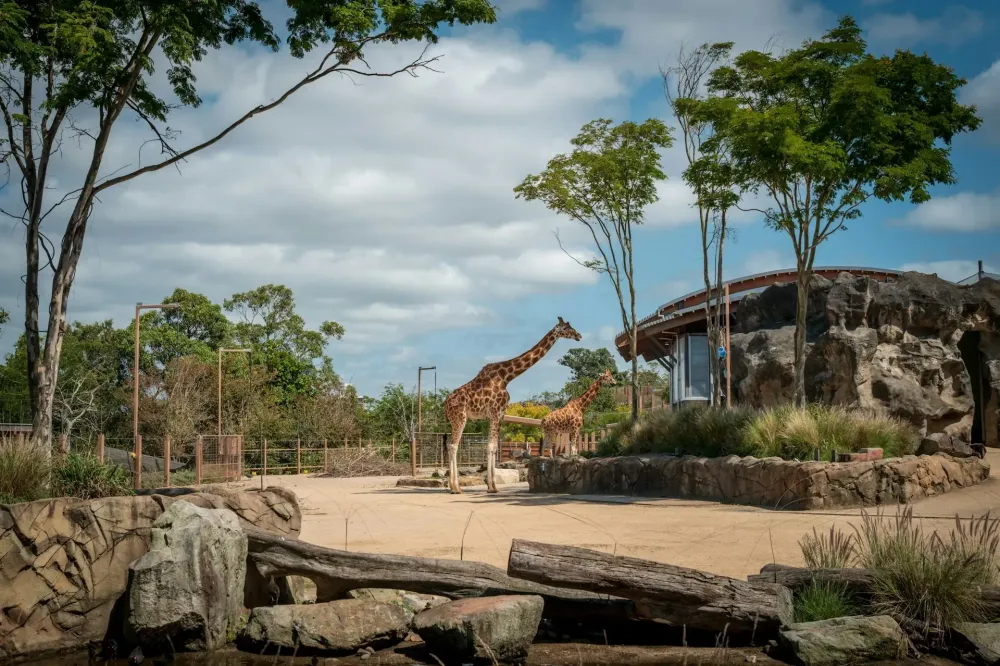
Cover photograph: Two giraffes in their enclosure at Taronga Zoo Sydney. Photo: Sung Jin Cho / Unsplash. Source · License.
Frequently Asked Questions
Is Sky Safari operating at Taronga Zoo?
No. The previous cable car retired in January 2023. Taronga currently expects its replacement in late 2027; that is a project target, not a service available for a 2026 visit.
How do I reach the upper entrance from the ferry?
Taronga identifies public bus 238 from the ferry terminal to the Top Main Entrance. Alternatively, enter at the Lower Entrance and plan for the hillside. Check current departures and any date-specific shuttles.
Does the zoo ticket include the ferry and animal encounters?
Do not assume so. Check the exact product's inclusions. Public transport and optional experiences require their own planning; the advertised keeper talks and presentations are included with zoo entry.
How long should I spend inside Taronga?
Allow about 4–5 hours for selected habitats and a presentation, or most of the day for a slower visit. These are editorial allowances excluding the journey, not a promise to see everything.
Can I avoid all hills by starting at the top?
No. An upper start can favour a broadly downhill route, but connecting paths still vary. Use the accessibility map and confirm the route and assistance that suit your needs.

Keep Exploring
Sugarloaf Mountain: Plan Your Cable-Car Visit
Plan the two-stage Sugarloaf cable-car visit, compare standard and priority tickets, and understand why walking to Morro da Urca is a different outing.
Oaxaca Ethnobotanical Garden: Plan Your Visit
Plan Oaxaca’s garden with clear access uncertainties, tour-language checks, official contacts and ways to connect plants with local culture.
ANIMA Garden from Marrakech: Plan Your Visit
Plan ANIMA as a garden outing from Marrakech, with the official shuttle, ticket categories, café time and clear limits on access and onward travel.