
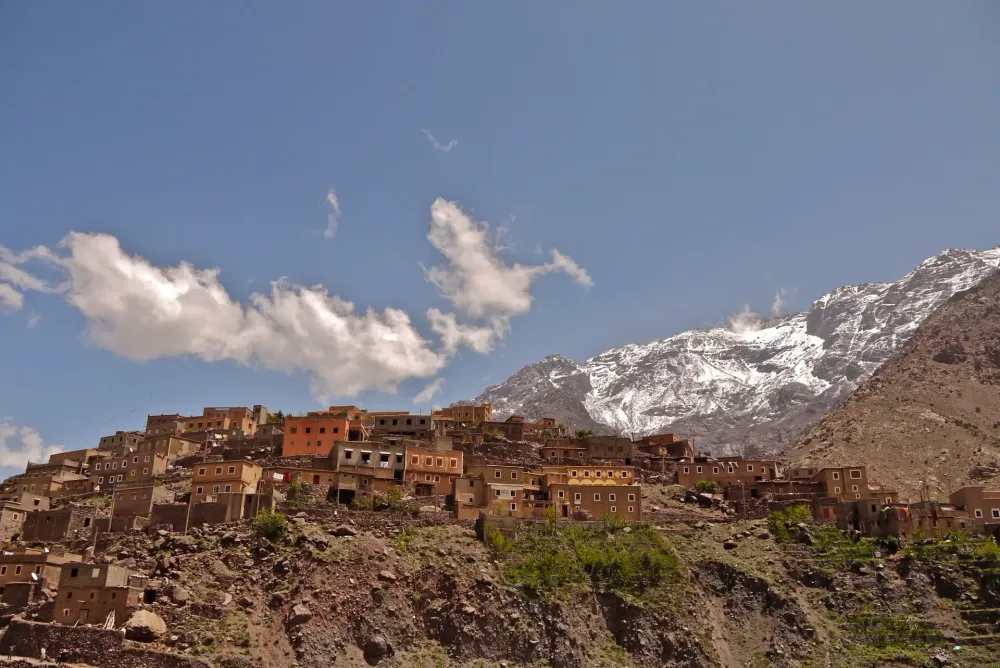
Imlil from Marrakech: Plan a Valley Day Trip
Choose a village visit, a guided valley walk or an overnight stay in Imlil, with practical questions about transport, terrain, meals and mountain conditions.
Imlil works best as a full day devoted to the High Atlas: a journey from Marrakech, a walk suited to your group, lunch and time to understand the valley. The useful decision is how much walking you want. Booking an excursion labelled “Atlas Mountains” without a route or an agreed return plan leaves too much of that decision until arrival.
The village is a gateway to Toubkal, but a lower-valley outing and a summit expedition are different trips. You can enjoy Imlil without climbing a major mountain. Equally, a photograph of snowy peaks does not tell you whether a particular path will be comfortable or suitable on your travel date.
Use this guide alongside our Marrakech cultural guide when deciding whether to exchange a city day for the mountains. The plan below is an editorial framework, not a fixed guided route or a promise about road and trail conditions.
Choose the kind of Imlil visit first
| Choice | Best suited to | What to arrange |
|---|---|---|
| Village visit and lunch | Travellers who want mountain scenery with limited walking | Exact vehicle drop-off and access to the lunch venue |
| Guided lower-valley walk | Visitors comfortable with uneven paths who want time outdoors | Route, ascent, walking duration and a shorter alternative |
| Longer guided day walk | Active travellers making walking the main activity | A route matched to fitness, weather and daylight |
| Overnight in the valley | Those who want a quieter pace and less driving in one day | Accommodation access, meals and onward transport |
| Toubkal summit expedition | Travellers specifically preparing for a mountain ascent | A separate, properly planned mountain itinerary |
The regional tourism board describes Imlil as an Atlas village with terraces and Amazigh communities. Its appeal is not confined to a summit: settlement, agriculture and the shape of the valley give a shorter visit its own purpose.
“Imlil” should appear explicitly in the booking. Ourika Valley and the Agafay landscape are other destinations; a tour using the broad Atlas label may take a different route. Ask for the destination, included stops and expected time in the valley before comparing prices.
Getting there: book the return as carefully as the outward trip
For a day from Marrakech, an arranged vehicle with a clearly agreed return is a practical option. Confirm whether collection means your riad door or a road-accessible meeting point outside the medina. The same distinction matters when you return tired in the evening.
The directions published by Kasbah du Toubkal describe the approach via Asni. They are useful for understanding the journey, but a property's indicative driving time is not a reliable door-to-door guarantee for every departure point, traffic situation or season. Give the driver your actual accommodation and ask what timing is realistic for that day.
For orientation, Kasbah du Toubkal places its Imlil base about 60 km from Marrakech; its transfer pages give roughly 75–90 minutes of driving. For planning, allow around two hours each way including collection and local delays, then reconfirm with the driver. This is a working allowance, not a maximum. The Moroccan National Tourist Office places Imlil at approximately 1,740 metres above sea level.
Agree whether the driver waits in Imlil, where you will meet again and how a delayed walk affects the return. Keep the driver's contact and the meeting point available offline. If your guide and driver are supplied by different businesses, make sure they share the same plan rather than assuming one will coordinate the other.
Do not attach a tightly timed flight, long-distance departure or prepaid dinner to the end of this outing. On a short Marrakech break, keeping the evening flexible makes the excursion easier to enjoy.
A balanced day in the lower valley
Start with an early departure that your driver considers sensible. On arrival, meet the guide before setting off and review the actual walk: where it goes, what the surfaces are like, how much climbing is involved and where it can be shortened. “Easy” is a subjective description; concrete answers are more useful.
For a first visit, a modest walk followed by an unhurried lunch is often a better fit than pursuing the longest circuit available. You might use roughly two hours of walking as an initial planning request, then adjust it with the guide. That is a suggested starting point, not the measured duration of a named trail.
Keep time for ordinary details: terraces, irrigation, the relationship between houses and cultivated land, and the guide's explanation of local life. Aroumd is a name you may encounter when discussing valley walks; ask whether reaching it fits your group and conditions instead of treating it as a compulsory checkpoint.
For a concrete route discussion, the operator’s local walking suggestions include Targa Imoula through orchards and walnut groves, returning via Imlil, and a longer option following the Reraya river past Aroumd, also written Aremd, toward the other side of the Aït Mizane valley. These start from the Kasbah, not your Marrakech hotel or necessarily the village car park. Use them to discuss a suitable valley route with your guide, not as turn-by-turn instructions or a guaranteed same-length walk.
Book lunch with a clear understanding of the location and menu. A terrace with a mountain view can still require a steep approach. Ask about dietary requirements ahead of time, whether drinks are included and whether the meal is at a restaurant, guesthouse or an explicitly arranged hosted visit.
After lunch, retain a margin for returning to the vehicle. Add another short stroll only if everyone is comfortable and the return timing allows it. A day whose main purpose is walking does not need a sequence of shopping stops unless you want them; settle that preference when booking.
What to ask a local guide
The UK government's Morocco travel advice recommends professional guides for mountain hiking and choosing routes appropriate to your experience. For this trip, the guide's value is both practical and cultural: adapting the walk, explaining the landscape and helping visitors move respectfully through lived-in places.
Ask about total walking time as well as total outing time. A four-hour excursion can contain very different amounts of walking, climbing, waiting and lunch. Explain your usual activity level honestly, including anyone who struggles with descents, uneven stones or sustained uphill sections.
Request the proposed route, approximate ascent, terrain, available breaks and a clear turnaround option. Check which language the guide will use and whether you are booking privately or joining a group whose pace may differ from yours. Confirm professional credentials with the provider rather than relying on the word “local” alone.
The Kasbah du Toubkal FAQ illustrates how a local operator distinguishes day walks from summit programmes and tailors walking to guests. It is an example of one provider's arrangements, not a rule that every village walk includes the same services or follows the same route.
Agree the whole price, not just the transfer
Ask for a written description of what the quote includes. Useful distinctions are the vehicle, driver waiting time, guide, lunch, drinks and any optional stops. Establish whether a price is per person, per group or per vehicle, and whether adding travellers changes the guide or transport arrangement.
There is no universal package price for the version of Imlil described here. A direct transfer and a private guided day with a meal are different products. Comparing only the headline total can hide the very service you wanted, such as a guide throughout the walk or a comfortable return time.
Clarify cancellation or route-change arrangements if weather makes the planned walk unsuitable. Ask what a lower-walking alternative would contain, rather than accepting a vague promise that the day will proceed somehow. Keep optional purchases genuinely optional and agree any paid activity before it starts.
Visiting a lived-in valley respectfully
The villages are places where people work, farm, study and receive visitors. Avoid treating houses or residents as scenery available on demand. Ask before photographing people, especially at close range, and accept a refusal without negotiation.
A locally published visitor code stresses respect for residents and permission for photographs. Apply that principle to doorways, workshops and cultivated plots too. Stay on the agreed route, avoid trampling crops and carry your rubbish back to an appropriate disposal point.
A home visit should be an invitation or a transparently arranged activity, not an assumption that a guide can open any door. If a meal or demonstration is paid, knowing that in advance allows everyone to participate on clear terms. Ask your guide how residents describe their own community and traditions; “authentic” should not mean expecting daily life to remain unchanged for visitors.
Weather, equipment and accessibility
Check the mountain forecast and the provider's local assessment shortly before departure. Conditions in Marrakech do not establish conditions on a higher path. Rain, snow, heat and visibility can change what is sensible, while mountain roads may also be affected by poor weather.
For a walking day, bring supportive footwear appropriate to the agreed terrain, water, sun protection and layers, including protection against rain or wind when forecast. Carry a charged phone and any personal essentials. Check that your insurance covers the activity you actually book, particularly if you move beyond a simple village visit into a more demanding hike.
A village-only plan still needs an access check. Vehicle access to Imlil does not mean a particular hotel or restaurant has step-free access. Kasbah du Toubkal, for example, describes an uphill walk from the vehicle stopping point. Ask your own venue about gradients, steps, surfaces, toilets and the distance from the car before making a reservation.
For children or mixed-ability groups, describe the needs of the least comfortable walker and build the day around them. Do not assume a mule ride solves an access difficulty or is included. If walking is unsuitable, a carefully chosen accessible meeting and meal venue may make more sense than buying a walking tour and hoping to opt out later.
When an overnight stay is worth it
Stay overnight if the quieter evening and a less compressed walking day are important to you. Confirm how luggage reaches the accommodation, what meals are available, heating arrangements when relevant and how you will leave the following day. Accommodation farther uphill can change the effort involved even before the planned walk begins.
An overnight stay is not a commitment to climb Toubkal. It can simply separate the drive from the valley visit and allow more time with a guide. Conversely, a summit objective needs its own preparation, equipment and itinerary; adding one hotel night does not automatically make it suitable.
If you have only a few days in the city, compare the excursion with our three-day Marrakech itinerary. Replace a planned city day or add time to the trip. Trying to fit palaces, gardens and the Atlas into the same day leaves little room for the things that make either destination worthwhile.
Cover photograph: Aroumd in the Imlil valley, High Atlas. Photo: Kitetraveller.com, CC BY-SA 2.0. Resized and converted to WebP; CC BY-SA 2.0. Source · License.
Frequently Asked Questions
Can you visit Imlil on a day trip from Marrakech?
Yes. Treat it as a full-day outing with arranged outward and return transport, a walk matched to your group and time for lunch. Confirm driving conditions and the return plan with your provider.
Is an Imlil day trip the same as climbing Toubkal?
No. A village visit or lower-valley walk is distinct from a summit expedition. A Toubkal ascent requires a separate mountain itinerary, suitable preparation and equipment.
Do you need a guide for a valley walk?
A professional local guide is a sensible choice for adapting a mountain walk to your ability and conditions. Government travel advice recommends guides for mountain hiking; confirm the proposed route and credentials with your provider.
Can you visit Imlil without a long hike?
Yes, if you arrange a village-focused visit and a suitable meal venue. Check the exact walk from the car, steps and gradients, because road access does not guarantee easy access to every property.
Should you stay overnight in Imlil?
An overnight stay suits travellers who want a slower visit and less driving in one day. Check accommodation access, meals and return transport; staying overnight does not require attempting the summit.


Keep Exploring
ANIMA Garden from Marrakech: Plan Your Visit
Plan ANIMA as a garden outing from Marrakech, with the official shuttle, ticket categories, café time and clear limits on access and onward travel.
Pulau Ubin: Plan a Nature Day from Singapore
Plan Pulau Ubin with on-demand boats, walking or cycling choices, Chek Jawa boardwalk access and a flexible return to Singapore.
Hierve el Agua from Oaxaca: Plan a Day Trip
Plan a Hierve el Agua day trip around current community access, transport, mineral formations and optional pools, with a realistic alternative if plans change.