
Fort Canning Park: Choose a History and Garden Walk
Choose a focused Fort Canning walk through historical gardens or military landmarks, with MRT choices, gallery hours and practical advice for the hill.
Fort Canning Park works best as a short hill walk with a clear theme: the gardens that interpret early Singapore, or the buildings and surviving traces of its later military history. Choose one as your main thread and leave space for shade, reading and a drink afterwards. Trying to collect every garden and photograph turns a compact central outing into a surprisingly tiring climb.
This guide helps you choose that walk. For the wider decision about which attractions deserve time during your stay, start with our Singapore highlights guide. Fort Canning suits someone who wants landscape and history together; it is less useful as a substitute for a substantial botanical collection.
The essentials before you climb
| Detail | What to plan |
|---|---|
| Setting | A 22-hectare hill park in central Singapore |
| Park hours | Open 24 hours; galleries have separate hours |
| Nearby MRT stations | Fort Canning, Dhoby Ghaut and Clarke Quay |
| Suggested visit | 90 minutes for selected gardens; 2–3 hours with a gallery and longer walk |
| Walking conditions | Slopes, steps and outdoor paths; choose an entrance for your route |
| Main choice | Early-history gardens or colonial and military landmarks |
NParks' visitor information provides the park boundaries, nearby stations and notices. Hours and access details were checked on 27 October 2026. Our suggested visit lengths are editorial allowances, excluding travel, queues and any separately organised attraction.
Choose the story before the entrance
The hill is a useful place to understand that Singapore's history did not begin with the British port. The National Heritage Board's Fort Canning history describes archaeological evidence of earlier occupation, followed by colonial government and military uses. Different parts of the landscape make those layers visible in different ways.
For early history, focus on Sang Nila Utama Garden, Artisan's Garden and Pancur Larangan. For later history, use the colonial trail's buildings, fort remnants and interpretation. Both approaches are worthwhile; combining them makes sense only if you have the time and interest to read rather than simply pass through.
Open the official park brochure before setting off. Identify your first stop and your intended exit, then choose the MRT station that serves that side. A station bearing the park's name is a useful option, but not automatically the closest approach to every feature on the hill.
Avoid saving an exact staircase-to-staircase itinerary from a social photograph. Connections, slopes and the direction you approach from matter more than a neat list. Check the signs on arrival and adapt to any closures. If you have limited walking capacity, reduce the number of hill crossings before leaving the station.
A garden walk with an early-history focus
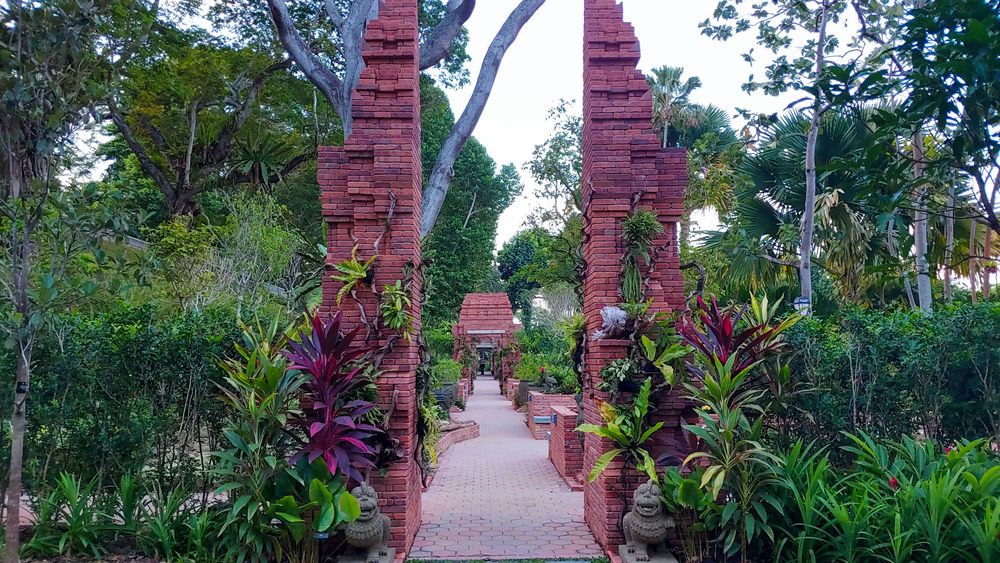
Sang Nila Utama Garden is a strong anchor because its layout gives you something to notice beyond greenery. Look at the sequence of split gates, the relationship between planted areas and the path, and the way one view opens into another. Stand aside from the main passage when photographing the gates so that other visitors can continue through.
The important historical distinction is that this is an interpretation of a palace garden, not a surviving medieval palace. NParks explains the historical gardens, including the Southeast Asian inspiration behind Sang Nila Utama and the re-created bathing-place setting of Pancur Larangan. Reading that context makes the features more interesting without confusing reconstruction with archaeological remains.
Give the plants some attention as well as the architecture. Read the labels, compare leaf shapes and notice which plants are being presented for fragrance, fruit or ornament. You do not need to identify every species. Choosing two or three details to remember is more rewarding than taking the same gate photograph at several positions.
Continue to Artisan's Garden if the archaeological story interests you. Its value is the connection between an excavated place and the people who worked on the hill. Read the interpretation before deciding that there is little to see: a dig site asks for a different kind of looking from an ornamental garden.
Add Pancur Larangan if time and energy allow, using the brochure to decide the most sensible connection. Do not assume a water feature is available for bathing or play. Follow the current signs and treat the setting as part of a historical landscape. This selection is enough for a focused first walk; all nine historical gardens do not need to become nine compulsory stops.
Use the Heritage Gallery to give the walk context
For visitors who prefer a narrative before exploring, Fort Canning Heritage Gallery is a useful starting point or midpoint. It occupies part of Fort Canning Centre, so check where it sits relative to your chosen entrance before committing to a route. Entering a gallery also changes the pace: allow time to read rather than counting it as a quick indoor shortcut.
The NParks heritage information lists the Heritage Gallery at 10:00–18:00 daily, with closure on the last Monday of the month for maintenance. The same source lists the Spice Gallery at 07:00–19:00. A park that is open all night does not provide overnight access to these displays.
Choose the Heritage Gallery for the hill's changing roles, or the Spice Gallery if plants, trade and food are your stronger interests. Visiting both is optional. On a hot day, an indoor component can be welcome, but check the actual opening arrangements before treating it as the central rest stop in your plan.
Prefer military history? Follow the colonial trail
NParks' heritage walks page describes a colonial history route of about 2 km, graded moderate, with an estimated walking time of 45 minutes. That is a route estimate, not the time needed for a leisurely visit with interpretation, photographs and pauses.
The official highlights include Fort Canning Centre, the Fort Gate, the old gunpowder magazine and a cannon, alongside replicas of communication features. Use the trail to understand how the hill's position mattered to the port and military authorities. Read labels carefully so that a replica, a surviving structure and a later adaptation do not merge into one assumed historical period.
Allow substantially more than the basic walking estimate if these features are your main reason to visit. A satisfying route might involve fewer stops and more attention at each one. If an independently operated attraction interests you, check its own tickets and operating calendar separately; a park walk is not evidence of access to every building or underground space.
Manage the hill, heat and rain
Tree cover does not remove the effort of climbing in humid conditions. Carry water, wear shoes with useful grip and start with the part you care about most. A morning visit can leave room for a slower lunch afterwards; a later visit needs attention to gallery closing times and the daylight remaining for your chosen paths.
Do not make a photograph the reason to continue when the weather deteriorates. Wet steps deserve a slower pace, and an outdoor garden is not an appropriate place to wait out a thunderstorm beneath a tree. Choose a proper indoor alternative and return when conditions suit walking.
For a wheelchair, stroller or anyone avoiding steps, inspect the current map and ask NParks about the exact connection you need. The existence of an accessible entrance does not establish a continuous step-free route between every garden. Build a shorter outing around confirmed paths and facilities rather than discovering a staircase after a long climb.
Make the final stop optional
The much-photographed spiral stairwell can be an extra if it fits your route. It should not determine the entire visit. If people are waiting, decide whether the image matters enough to use the time you could spend in a garden. Keep the passage clear and do not occupy the stairs for a lengthy photo session.
For families, the better question is how much walking everyone still wants, not whether every named feature has been reached. An early exit and a meal can be a successful ending. For history enthusiasts, an additional gallery may be worth more than another scenic detour. Make that decision before fatigue makes it for you.
If your real priority is a longer plant-focused outing, compare Fort Canning with our Singapore Botanic Gardens guide. Fort Canning offers a central hill layered with historical interpretation; the Botanic Gardens deserves its own decision about entrances, walking distance and the orchid collection. Scheduling both on one day is unnecessary unless gardens are the purpose of the day.
Cover photograph: Brick split gates amid tropical plants in Sang Nila Utama Garden, Fort Canning — ScribblingGeek, CC BY-SA 4.0.
Frequently Asked Questions
How long should I allow for Fort Canning Park?
Allow about 90 minutes for a selected garden walk or 2–3 hours with a gallery and a longer route. These are editorial estimates. Slopes, rest stops and how much interpretation you read will change the pace.
Is Fort Canning Park open at night?
NParks lists the park as open 24 hours. Galleries and other attractions have their own operating times. For an introductory history and garden walk, daylight makes signs and paths easier to follow.
Which MRT station should I use?
Fort Canning, Dhoby Ghaut and Clarke Quay are nearby options. Choose after locating your first stop and intended exit on the official map; the park has several approaches across different sides of a hill.
Are the palace gardens original medieval remains?
No. Sang Nila Utama Garden and Pancur Larangan interpret earlier settings through later landscape design. Artisan's Garden provides a different connection through an archaeological site. Read the signs to distinguish reconstructed features from surviving evidence.


Keep Exploring
Central Park: Choose a Walk That Fits Your Day
Plan a manageable Central Park walk with named landmarks, sensible exits and alternatives for closures, limited mobility or changing weather.

Chapultepec Park: Choose Your Day Out
Plan Chapultepec by geography: choose a castle-and-lake route, a museum day along Reforma or an outing farther west, without confusing park access with attraction tickets.
ANIMA Garden from Marrakech: Plan Your Visit
Plan ANIMA as a garden outing from Marrakech, with the official shuttle, ticket categories, café time and clear limits on access and onward travel.