
Queens Museum New York: Panorama and Visit Planning
Plan a Queens Museum visit: Panorama model, pay-what-you-wish entry, opening hours, subway walk, accessibility and a nearby Unisphere stop.
Choose the Queens Museum if you want to understand New York as a whole city rather than look only at Manhattan's skyline. Its Panorama turns streets, waterways, parks and boroughs into a model you can study together. Add a walk around the Unisphere and you have a focused Queens outing, without needing to fill the day with several distant museums.
The practical points are important: the museum closes on Mondays and Tuesdays, uses pay-what-you-wish admission and invites individual visitors to reserve a timed ticket. The Panorama is a collection installation; the exhibitions beside it have their own dates. Check both before making the journey.
Our New York highlights guide can help you decide what this adds to your trip. The Queens Museum is especially rewarding for maps, urban history and the relationship between the city and its infrastructure. It is a different choice from a broad survey of famous paintings or an observation-deck visit.
Hours, admission and time to allow
The following arrangements were checked against the museum's visitor information on 23 November 2026. Recheck holiday closures and dated ticket availability for your visit.
| Detail | Current planning information |
|---|---|
| Wednesday–Friday | 12:00–17:00 |
| Saturday–Sunday | 11:00–17:00 |
| Monday–Tuesday | Closed |
| Last ticketed gallery entry | 16:30 |
| Admission | Pay what you wish; suggested adult contribution $8, senior/student $6 |
| Children | Age 12 and under admitted free; under-14s must stay with an adult over 18 |
| Suggested allowance | 90 minutes–2 hours in the museum, plus travel and a park walk |
The museum allowance is an editorial estimate, not a fixed tour duration. Arriving at 16:30 leaves only a short interval before closing, so last admission is a limit rather than a good target for an unhurried Panorama visit.
Pay-what-you-wish is not the same wording as a mandatory $8 adult ticket, and it is more precise than describing the institution simply as free. Choose your contribution through the official booking process and bring the digital or printed ticket. Other free-admission categories exist, with identification required for some; check the category that actually applies to you.
What the Panorama shows
The Panorama of the City of New York is a large physical model at 1:1200 scale, originally made for the 1964–1965 World's Fair. Its detailed city includes the boroughs, streets, parks and bridges. Walking around it lets you grasp relationships that are difficult to see from a single viewpoint in the real city.
Start by finding Manhattan's outline, then look beyond it. Follow the East River, compare the land area of Queens with the density of central Manhattan, and locate the park you are standing in. After that, trace one journey you have actually made or plan to make. This approach gives the model a personal reference without requiring knowledge of every neighbourhood.
Do not treat it as a completely current three-dimensional navigation map. The museum explains the major 1992–1994 update and subsequent changes; its history describes the comprehensive version as reflecting the city at the start of 1992. A building missing from your mental picture of today's skyline does not mean you have found the wrong borough. Use labels and interpretation to understand when the model represents the city.
Give yourself time for both the overall view and particular details. A useful family exercise is to locate water, green space and a bridge before searching for a famous skyscraper. For an urban-history visit, compare the space given to roads, airports and parks. These are ways of looking, not a claim that the model explains every community's history on its own.
A model with a history, not only a miniature skyline
The museum's history explains the Panorama's renovation and the replacement of its original ride arrangement with viewing circulation around the model. That distinction matters if you have seen old World's Fair footage: you visit a museum installation today, not a surviving amusement ride you can book.
The Panorama also invites questions about who decides what a city model emphasises. Look at connections and boundaries as well as individual buildings. Where are the large open spaces? Which areas are separated by water, and which are joined by bridges? A model can make infrastructure visible while still simplifying the lived experience of a neighbourhood.
Use the museum's interpretation and digital guide to add context rather than trying to identify every object from memory. Ask the Welcome Team which associated material is available that day. If your main purpose is the Panorama, confirm its access when reserving; a permanent collection label does not override a temporary operational notice.
Permanent installation versus dated exhibitions
One current companion is Collection Spotlight: The Panorama Archives, listed for 20 June 2026 to 31 January 2027 in the Rubin Gallery. The official exhibition page describes restoration footage and material showing how the Panorama and its viewing experience developed.
It is a useful addition if model-making, conservation or urban documentation interests you. Check that its dates still cover your visit. The end of this archive display is not the announced closing date of the Panorama itself; they are separate entries and should not be confused.
Other galleries change programme. Review the museum's current exhibitions before choosing how long to stay, rather than assuming an artwork seen in a previous travel photograph is still displayed. You can give the Panorama most of your attention and add one exhibition without treating every room as compulsory.
Getting there: include the walk through the park
The museum occupies the New York City Building in Flushing Meadows Corona Park. Its visitor page describes approaches from Mets–Willets Point and 111th Street, both on the 7 train, and asks visitors to allow about 15 minutes on foot from either station. That walking allowance is in addition to the subway ride and any transfers from your accommodation.
From Mets–Willets Point, the museum directs visitors toward the park and the Unisphere; the building is just beyond the globe. From 111th Street, follow the museum's described park approach. Use the MTA's current service information before travelling, especially for weekend changes. Do not assume a journey will follow the ordinary pattern because it did on a previous trip.
The museum lists entrances facing the park and Grand Central Parkway. If you are being dropped off, identify the entrance and meeting point explicitly. Its free parking is limited, so do not make a tight appointment depend on finding a space immediately. Avoid comparing a short local ride-hailing estimate with a journey from Manhattan: your origin and current demand determine that quote.
A rainy-day museum visit still includes an exposed walk from the subway. Bring appropriate footwear and a layer, or plan an alternative arrival suited to your needs. Do not compress the museum visit because you forgot to budget for crossing the park.
Pair it with the Unisphere, not the whole borough
The obvious outdoor companion is the Unisphere. NYC Parks describes the globe as a centrepiece commissioned for the 1964–1965 World's Fair. Seen after the Panorama, it continues the theme of representing places at a different scale: the model presents New York, while the globe presents the world.
Allow a modest walk around the surrounding paths if weather and access permit. Fountains visible in photographs may not be operating during your visit; follow temporary barriers around maintenance work. A short park circuit is a complete pairing; you do not need to cross the whole park or add an attraction simply because it shares the same park name.
If you plan food in another Queens neighbourhood afterward, plot the journey separately. Flushing, Corona and Long Island City are not interchangeable locations. Make the museum and park the fixed part of the outing, then add a meal that fits your route instead of assuming everything in Queens is a short walk apart.
Families, access and bags
The admission rules distinguish free entry for children 12 and under from the supervision rule for visitors under 14. Keep that difference in mind if teenagers visit with a younger sibling: an accompanying adult must be over 18. A model-viewing challenge can keep younger visitors engaged, but galleries are shared spaces and the installation is not a hands-on play model.
The accessibility information states that the museum accommodates wheelchairs and mobility devices and offers a preparation guide for neurodiverse visitors. Large-print and Braille material can be requested at the information desk; contact the accessibility team ahead for particular support rather than assuming every accommodation is immediately available.
The museum's visit page says the public coat check is closed and asks visitors to leave large bags, including luggage, elsewhere. Its accessibility page separately mentions loan wheelchairs in the lobby/coat-check area. Do not interpret that reference as confirmation that luggage storage has reopened; ask staff about equipment availability and keep your bags out of the plan.
Build a comfortable half-day
Choose an open day and reserve a time that leaves room before closing. Start with the Panorama, add the archive display or another exhibition that interests you, then take the Unisphere walk if conditions suit. A café is listed on the visitor page, but check availability rather than relying on it for an essential meal or dietary requirement.
For a budget-focused trip, our New York free-admission guide helps distinguish free entry, suggested contributions and eligibility elsewhere. Judge this outing by its total transport and time as well as the admission contribution. The Queens Museum works best as a deliberate visit to the city in miniature, with one nearby outdoor extension.
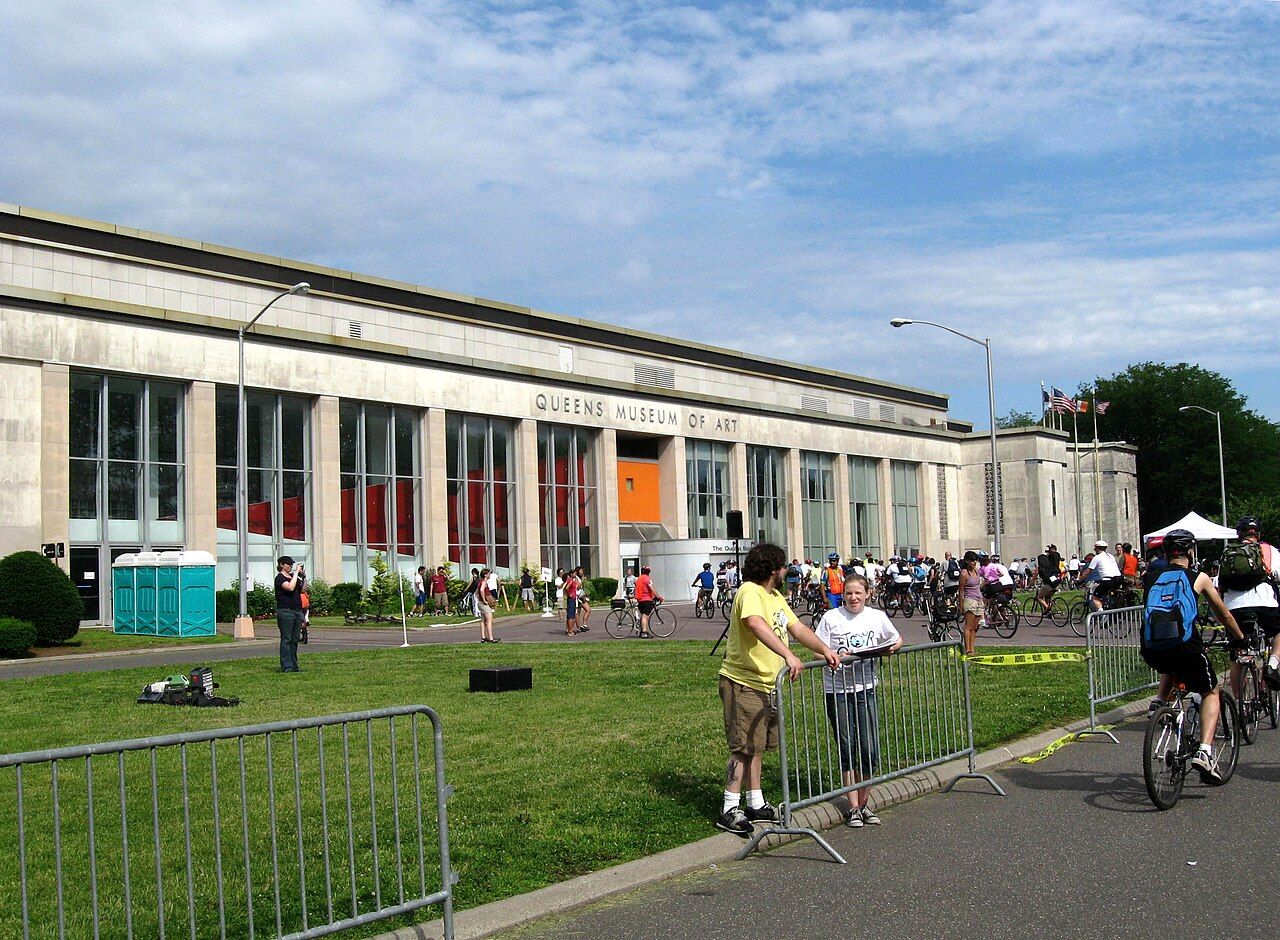
Cover photograph: Queens Museum exterior during Tour de Queens preparations, June 2008 — Queens Museum exterior during preparations for the Tour de Queens, 8 June 2008. Resized for publication. — Jim.henderson, Public domain.
Frequently Asked Questions
Is the Queens Museum free?
It uses pay-what-you-wish admission, with suggested contributions and specific free categories. That is different from a mandatory adult ticket; use the official booking process.
Do I need to book?
The museum invites individuals and families to reserve timed tickets. Organised groups must book in advance, including third-party guided groups.
Is the Panorama an exact model of New York today?
No. Its major historical update and later changes do not make it a continuously current city map. Read the interpretation for the period represented.
Can I combine it with the Unisphere?
Yes. The globe is the natural park companion, subject to weather and local access. Add time for the walk from the subway as well as time inside the museum.


Keep Exploring
Brooklyn Museum: Choose Your New York Art Visit
Plan the Brooklyn Museum with admission options, exhibition tickets, current hours, accessible routes and realistic Brooklyn combinations.

Intrepid Museum New York: Choose Your Visit
Choose the carrier, Enterprise, Growler or a Concorde tour, with access checks, digital tickets and dated closures.
Nezu Museum Tokyo: Art, Garden and Visit Planning
Plan Nezu Museum in Aoyama: exhibition dates, ticket scope, garden access, Omotesando exits and a realistic visit alongside the galleries.