
Museo Kaluz: Choose Your Mexico City Art Visit
Plan Museo Kaluz with current Mucha and Mexican Art Nouveau exhibitions, ticket choices, collection expectations and separate terrace arrangements.
Choose Museo Kaluz for the exhibition you want to see, then add the historic building and terrace as separate parts of the visit. Its collection is strongly associated with Mexican painting and landscape, but that does not mean a permanent landscape display awaits every visitor. The museum programmes temporary exhibitions, and the current ticket choices matter more than an old list of collection highlights.
As checked on 24 November 2026, two exhibitions shape the visit: Alphonse Mucha. La magia de la línea and El arte nuevo. Simbolismo y Art Nouveau en México. They offer a particularly useful pairing for anyone interested in how decorative line, illustration and design travelled between countries and media. Use our Mexico City cultural guide to decide how this fits among the capital's other museums.
The practical choices
| Detail | Planning information |
|---|---|
| Address | Avenida Hidalgo 85, beside Alameda Central |
| Ordinary opening | Wednesday–Monday, 10:00–18:00 |
| Last admission | 17:30 |
| Weekly closure | Tuesday |
| Mucha exhibition | 9 October 2026–8 February 2027 |
| El arte nuevo | 30 October 2026–8 March 2027 |
| Advertised standard prices | Mucha MX$150; El arte nuevo MX$100; combined MX$200 |
| Main decision | One exhibition, both, or a separately checked terrace visit |
Opening arrangements come from the museum's visitor page. The national cultural information register lists the three admission options. These are advertised exhibition prices, not a completed booking quote; check the chosen date, category and final charge before paying.
Do not schedule Tuesday based on older destination pages that describe a different weekly closure. The operator currently says Tuesday is closed. Likewise, 17:30 is an admission cut-off, not enough time to enjoy a substantial exhibition before the 18:00 closing time.
What the collection does—and does not—promise
The Kaluz collection overview brings together Mexican art, Spanish exile art, Japanese art and contemporary work. Landscape sits alongside portraiture, scenes of everyday life, still life and abstraction. That breadth helps explain why the museum's programme can move beyond an exclusively Mexican landscape show.
Its online catalogue includes works by artists such as Dr. Atl and Feliciano Peña, while the collection also has important material connected with José María Velasco. Treat those names as an introduction to the institution, not a checklist of paintings guaranteed to be hanging during your trip. The cultural register explicitly describes the galleries as temporary exhibition spaces.
If a particular painting is the reason you want to visit, contact the museum with the work's title before buying. An online collection entry establishes ownership or inclusion in the collection; it does not establish today's room assignment. This is especially important while the two Art Nouveau exhibitions are the featured programme.
For a first visit without a specific artist in mind, choose the current show that best matches your attention. Posters and graphic design suggest Mucha. Mexican modernity across painting, illustration, objects and architecture suggests El arte nuevo. Seeing both allows a comparison, but enjoying one carefully is more rewarding than rushing two because a combined ticket looks economical.
Mucha: posters, decorative panels and a different scale
The museum's Mucha exhibition page describes around 130 works, including posters, lithographs, illustrations, drawings and objects, presented in collaboration with the Mucha Foundation. The illustrated examples include Gismonda and Zodiac, alongside material tracing later visual influence.
Start by noticing how a figure, lettering and an ornamental border share the same image. A poster is designed to communicate, so ask where your eye goes first and how line directs it. Then look closely at hair, fabric and plantlike curves. You do not need to identify every reference to appreciate the difference between an image that reads from a distance and one that rewards close inspection.
The exhibition also includes La magia del Art Nouveau, a large-scale projection experience. Treat this as an additional interpretation, not the equivalent of examining the original printed works. If your time is limited, protect time in the galleries rather than spending the entire visit in the most immediately spectacular room.
The museum-linked ticket page estimates 90 minutes to two hours for the Mucha visit with the immersive experience. Admission is tied to the selected time. This makes it a poor fit for a tiny gap between a fixed lunch reservation and an afternoon performance elsewhere.
El arte nuevo: look for Mexican transformations
El arte nuevo explores Symbolism and Art Nouveau in Mexico through painting, drawing, illustration, publications, decorative objects and architecture. The museum names Julio Ruelas, Roberto Montenegro, Saturnino Herrán, Adolfo Best Maugard, Ángel Zárraga and Alfredo Ramos Martínez alongside international figures including Aubrey Beardsley and Edward Burne-Jones.
This is useful if you want more than a sequence of famous European posters. Look for how a visual language changes when it appears in a magazine, a painting or a building. Compare a decorative curve with a figure's outline, or a natural motif with an architectural detail. The question is not simply whether two objects look similar, but what each was made to do.
The museum also describes an interactive model locating Art Nouveau heritage across Mexico City's neighbourhoods. That offers a practical bridge between an indoor exhibition and later walking. Choose one architectural detail to notice outdoors—ironwork, an entrance or an ornamented window—rather than trying to memorise every building on the model.
The authorised El arte nuevo booking page currently advertises free admission to this exhibition on Wednesdays. Do not extend that statement automatically to Mucha or to every activity in the building. Its ticket also has different entry wording from the timed Mucha product, so read the conditions of the actual option selected.
One exhibition or the combined ticket?
Choose Mucha alone when your strongest interest is graphic art and you can give it the advertised 90–120 minutes. Choose El arte nuevo alone when Mexican cultural history, design and the city's architecture are the main draw. Choose both when comparing the international and Mexican material is something you genuinely want to spend time doing.
The combined advertised price is MX$200, against MX$250 for the two standard admissions bought separately. That saving is useful only if you have the attention and time for both. Allow a longer museum block than the Mucha estimate alone, plus any meal or terrace stop. This is an editorial planning recommendation, not a promised duration for the combined route.
Keep your ticket available while moving through the building because staff may ask to see it at different spaces. Check whether a concession requires identification and whether a selected event or tour has its own charge. A booking for one exhibition should not be treated as a pass to all programmes.
Read the building as another layer of the visit
Kaluz occupies the former Hotel de Cortés. The museum's building history traces earlier use as an Augustinian lodging house, later residential uses and conversion to a hotel in 1943. Its baroque facade was remodelled in 1780, combining tezontle and dressed stone.
Look at the facade before entering, then compare that street-facing surface with the courtyard and galleries. The building's repeated changes of use are part of its story: this was not designed from the outset as a modern exhibition box. A visit can connect the objects upstairs with the urban history outside without turning every architectural feature into an assumed original detail.
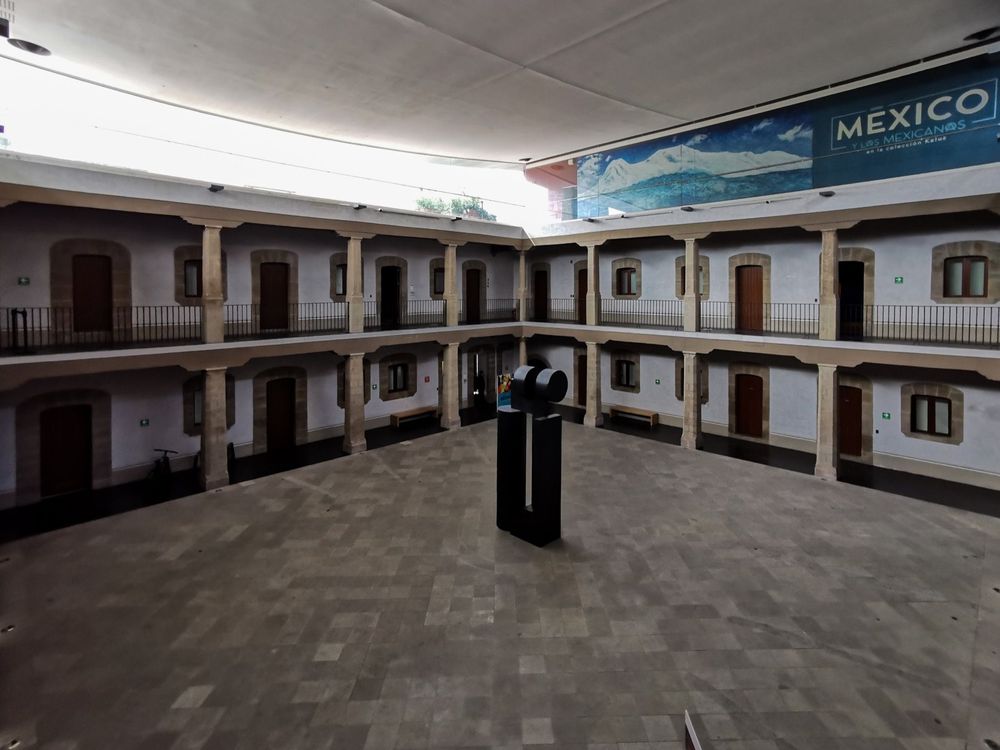
The cover photograph is archival and shows an earlier installation. It identifies the museum's courtyard; it does not show the current exhibition programme. Once inside, use current room signs and the day's visitor route rather than trying to reproduce a photograph from a previous year.
The terrace is an extra decision
The museum has a terrace and an urban-observation element, as well as food and drink facilities. Those can be an enjoyable pause, but do not confuse a table reservation, terrace event or café purchase with admission to the art galleries. Equally, buying an exhibition ticket does not promise a restaurant table or a particular view at sunset.
Current ordinary terrace-only access conditions were not clearly established in the visitor information checked for this guide. Ask the museum before planning a visit solely for that space, especially if an event is taking place. Do not rely on an older free-access claim as a guarantee.
If art is your priority, do the galleries first while you are attentive. If your main purpose is a meal with a view, confirm the food service and access arrangements directly. Keeping those two purposes clear prevents an exhibition from becoming an unexpected extra cost or a hurried interruption.
Arrival, comfort and a manageable central day
The museum recommends public transport and has no parking of its own. Its visitor directions list Hidalgo Metro on lines 2 and 3 and Bellas Artes on lines 2 and 8. Check current service before travelling; station proximity does not guarantee that every entrance or transfer is suitable for your mobility needs.
Inside, the museum confirms lifts to the galleries, accessible toilets and wheelchair loans with valid identification. Some rooms have low light, cool temperatures or changing sound and lighting. Bring a light layer and ask the visitor team for sensory details if the immersive room needs advance consideration.
Large backpacks, suitcases, umbrellas, food and drinks are restricted in the galleries. Ordinary photography is permitted without flash or tripod unless an individual work is marked otherwise. Travel lightly and check the signs rather than assuming every exhibition follows the same photography permissions.
For a second cultural stop nearby, compare our Palacio de Bellas Artes guide. Its museum, building and performances involve different choices, so avoid booking two demanding indoor visits back to back simply because they are close. Alameda Central can provide a walking break between them.
Cover photograph: Courtyard of Museo Kaluz in Mexico City with an earlier exhibition installation, photographed in 2021 — Archive photograph Image adapted for publication. — ProtoplasmaKid, CC BY-SA 4.0.
Frequently Asked Questions
Is Museo Kaluz open on Mondays?
Its current ordinary schedule is Wednesday–Monday, 10:00–18:00, with last entry at 17:30. Tuesday is the weekly closure; check holiday exceptions before travelling.
Will I always see Mexican landscape paintings?
No particular work or permanent landscape display is guaranteed. Kaluz has a substantial collection, but the galleries operate through temporary exhibitions. Check the current programme.
Is Wednesday completely free?
The authorised El arte nuevo ticket page advertises free Wednesday entry to that exhibition. Do not assume Mucha, the combined product or other events are included.
Does a terrace visit include the exhibitions?
Do not assume so. Terrace access, food service and exhibition tickets are separate arrangements that should be checked for your date.
Can wheelchair users visit the galleries?
The museum confirms lift access to all galleries and exhibitions, accessible toilets and wheelchair loans with valid identification. Ask about the route and any specific assistance needed.


Keep Exploring
Museo Franz Mayer: Plan Your Mexico City Visit
Plan Museo Franz Mayer with current general ticket prices, free Tuesday conditions, collection highlights and advice on special exhibitions.
Museo Jumex: Plan Your Mexico City Art Visit
Plan Museo Jumex with free entry, current hours, exhibitions, architecture, access and a sensible pairing with Museo Soumaya.
Museo Carrillo Gil: Plan Your Mexico City Visit
Choose a focused Museo Carrillo Gil visit through collecting and contemporary art, with current exhibition dates, admission and San Ángel planning.