
Morgan Library New York: Choose Your Visit
Visit the Morgan Library in New York: historic rooms, exhibitions, free Friday reservations, library-only hours, tickets and seasonal garden access.
Visit the Morgan Library & Museum for an intimate combination of historic rooms, rare books, drawings and changing exhibitions in Midtown Manhattan. The main decision is whether you want the historic library alone or a fuller museum visit. Those choices have different free-entry arrangements, and confusing them can leave the exhibition you wanted outside your ticket.
Allow around two hours for the historic rooms and a selected exhibition, or longer if manuscripts and drawings are a strong interest. Our New York cultural shortlist compares the city's larger experiences; this guide explains how the Morgan fits into a day without becoming another museum visited in a hurry.
Fast facts
| Detail | Planning information |
|---|---|
| Entrance | 225 Madison Avenue, between 36th and 37th Streets |
| Regular hours | Tuesday–Thursday and Saturday–Sunday 10:30–17:00; Friday 10:30–20:00 |
| Weekly closure | Monday |
| General admission | Adults US$25; age 65+ US$17; students with current ID US$13 |
| Children | Age 12 and under free with an accompanying adult |
| Free Friday | 17:00–20:00; reservation required |
| Historic-library-only free hours | Tuesday and Sunday 15:00–17:00; no reservation required; special exhibitions excluded |
| Suggested visit | About two hours, with more time for several exhibitions |
Information was checked on 19 November 2026 against the Morgan's visitor page. Online ticket sales carry service fees. The suggested duration is an editorial allowance. Prices are US dollars; a bank's conversion and charges determine the euro amount you actually pay.
Choose the experience before the admission window
The historic library is the right starting point if architecture is your main interest. Its richly decorated rooms give a concentrated sense of the private collecting world from which the institution developed. A visit focused on these interiors can be satisfying even if you do not want to read every manuscript label.
Choose a full museum visit when a particular exhibition, artistic medium or literary subject attracts you. The Morgan's identity reaches beyond its book-lined room: drawings, music and manuscript material can require slow looking and careful reading. A small object in a case may take longer to understand than a large painting.
Do not treat the Morgan as a public reading room where a sightseeing ticket lets you browse rare books. Museum viewing and research access are different activities. If your purpose is scholarly consultation, investigate the research arrangements separately rather than arriving with the expectation of taking an item from a shelf.
For a group, agree on one common priority. Architecture enthusiasts can begin with the historic rooms, while readers may want time for a temporary display. If interests differ, set a meeting point after a short independent section. That is more comfortable than making everyone read every label at the same pace.
Understand the three admission choices
A regular paid visit offers the broadest flexibility within the day's opening hours. Advance timed tickets are suggested, not required, according to the museum. Check the complete booking total because online service fees are additional to the published admission rates. A timed entry is a planning tool, not a reason to schedule a train or another attraction immediately afterwards.
Free Fridays run from 17:00 to 20:00 and require reservations. The museum releases those tickets one week in advance. If that is your preferred option, build a reminder around the release rather than assuming you can simply turn up. A free slot is useful when it fits your trip; restructuring an entire evening around an unavailable reservation is not a saving.
Tuesday and Sunday 15:00–17:00 free access covers the historic rooms only. No reservation is required for these hours, but special exhibitions are excluded. This is a strong choice for someone interested principally in the library interior. It is not interchangeable with the Friday museum offer.
For example, a Tuesday visitor whose only priority is the historic architecture can use the late-afternoon arrangement. Someone coming for a temporary drawing exhibition should choose an admission option that includes it. Read the ticket description and current programme together before deciding that a free period covers your entire plan.
Read the original rooms as a collection setting
The official historic-library introduction identifies Charles Follen McKim as the architect and 1906 as the completion year. Start with the contrast between a library built for a private collector and the public museum around it. The building communicates an idea about knowledge and prestige as well as providing storage for books.
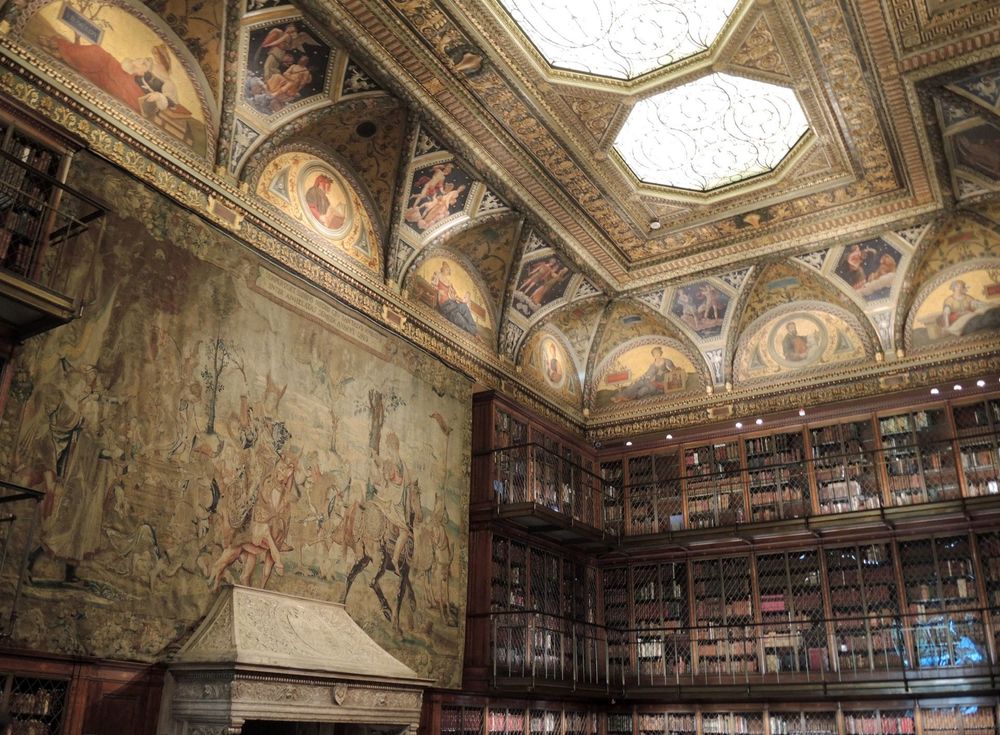
In the East Room, alternate between the overall space and individual details. Look at the relationship between shelving, upper levels, decoration and display cases. A photograph aimed only at the ceiling can miss how the room was designed to surround a visitor with books and images.
The museum's explanation of the Rotunda distinguishes the library to the east, Morgan's study to the west and the former librarian's office to the north. Use that simple layout to understand the rooms' different purposes. The office was associated with Belle da Costa Greene, whose work belongs within the institution's story, not merely as a footnote to its founder.
Move from large impressions to specific questions. Which features make a room ceremonial, and which suggest work? How does the visitor move from an entrance into a space of display? You need not identify every classical reference to notice that the decoration was designed to convey authority and continuity with earlier cultures.
Add one exhibition with enough attention
Check the current exhibition programme for your travel dates. A collection catalogue records ownership; it does not promise that a particular drawing, manuscript or book will be on display. Temporary exhibitions and rotating selections are a reason to consult the programme before buying a ticket for one specific object.
Select the exhibition whose subject you can describe in a sentence. An interest in drawing, printed books, music or literary manuscripts is more useful than a vague intention to see everything. Read an introductory panel first, then choose a few objects that illustrate the central question.
For a manuscript, look for visible changes, annotations or the relationship between text and illustration where the display allows. For a drawing, compare line and preparation with the finished image you may expect. Follow the labels rather than inventing an object's purpose from its appearance. These are viewing suggestions, not a promise about any specific item currently exhibited.
If you are travelling with children, ask them to compare an image and a written page, or choose one detail they would explain to another person. A shorter, engaged visit works better than prolonged reading fatigue. Finish while the group still has attention for the historic rooms or the walk afterwards.
Notice how the modern campus changes the visit
The institutional history describes the transformation into a public institution in 1924 and Renzo Piano's major expansion completed in 2006. The modern spaces connect historic buildings and help explain why the visitor experience is larger than a single old library.
Give yourself a pause between the decorated rooms and another gallery. The change in light and materials provides a useful architectural comparison. You do not need to convert that pause into a separate attraction or buy something to justify sitting out part of the museum pace.
The café and shop do not require museum admission, according to the visitor page. Their accessibility without a ticket does not grant access to galleries. If you are meeting someone who is not visiting the museum, confirm the practical meeting point and the café's own hours; food service does not necessarily last until museum closing.
Plan correctly for the season and holidays
The Morgan Garden's published 2026 season was 1 May–1 November, on Fridays, Saturdays and Sundays. That season had ended by the 19 November check date. Do not build a winter visit around garden access, and do not carry the 2026 dates forward as a promise for another year.
The museum closes on Thanksgiving Day, Christmas Day and New Year's Day. It lists an early close at 16:00 on Christmas Eve and 17:00 on New Year's Eve. These exceptions matter more than the ordinary weekly table when planning a holiday trip. Confirm your actual calendar date before arranging a non-refundable activity around the visit.
A rainy day can make the Morgan an appealing indoor choice, but the walk from transport and any entry wait still require weather planning. Bring only what you comfortably need, check the museum's current bag and photography rules, and ask staff before using equipment in a gallery.
Fit the Morgan into Midtown
The address is Madison Avenue at the block between 36th and 37th Streets. The museum's directions identify the 6 train at 33rd Street and several services at Grand Central as arrival options. Choose the route from your actual starting point and check current service changes rather than memorising a fixed journey time.
A selective Morgan visit pairs naturally with a Midtown walk. Grand Central or Bryant Park can offer a different kind of experience before or after the galleries, but add the walking and any separate entry arrangements. The nearby New York Public Library is a different institution; its visitor rules and reading-room access do not carry over to the Morgan.
Our three-day New York itinerary helps place the museum within a larger trip. Replace another overlapping indoor stop if necessary. Two museums can be rewarding for an art-focused day, but not when both become rushed introductions followed by a cross-city transfer.
If step-free access, seating or a particular sensory accommodation matters, ask the museum about the complete route for your intended galleries. A lift symbol on a map is useful information, but a conversation about the actual sequence of rooms and current equipment is more helpful. Leave a buffer before your next fixed commitment so access arrangements do not turn into time pressure.
Cover photograph: Decorated ceiling, tapestry and bookcases inside the Morgan Library — Photographed in October 2015; current displays may differ. — Pingthing, CC BY-SA 4.0.
Frequently Asked Questions
When is the Morgan Library & Museum free?
Friday 17:00–20:00 is free with a required reservation, released one week ahead. Tuesday and Sunday 15:00–17:00 offer free access to the historic rooms without reservation, but exclude special exhibitions. These are different offers.
How long should a visit take?
Around two hours is a useful editorial allowance for the historic rooms and one selected exhibition. Readers and drawing enthusiasts may want longer. A library-only visit can be shorter, depending on attention and entry conditions.
Is the Morgan Garden open in November?
The published 2026 garden season ended on 1 November. At the 19 November check date, it was outside that season. Consult the current visitor page for future opening dates rather than assuming year-round access.
Is the Morgan the same as the New York Public Library?
No. The Morgan is a separate museum and independent research library at 225 Madison Avenue. A museum ticket is for visiting displays and rooms, not permission to consult rare collection materials as a researcher.


Keep Exploring
Brooklyn Museum: Choose Your New York Art Visit
Plan the Brooklyn Museum with admission options, exhibition tickets, current hours, accessible routes and realistic Brooklyn combinations.
New York Public Library: Plan Your Schwarzman Visit
Choose exhibitions, architecture or an official tour at NYPL’s Schwarzman Building, with reading-room access and practical arrival advice.

Intrepid Museum New York: Choose Your Visit
Choose the carrier, Enterprise, Growler or a Concorde tour, with access checks, digital tickets and dated closures.