
Basilica of Guadalupe: Plan Your Mexico City Visit
Choose the new and old basilicas, museum or Tepeyac hill, with respectful visiting advice and separate opening and guided-tour arrangements.
The Basilica of Guadalupe is best planned as a visit to an active religious complex, with a clear choice between worship, architecture and a longer exploration of its museum and hill. The new basilica, old basilica and Capilla del Cerrito are different places, not interchangeable names for one church. Giving each its proper role makes the visit easier to understand and more respectful of people who have come to pray.
For a first cultural visit, allow roughly 2 hours for the main basilica and a selective look around the complex. Add time if you want the museum, the hill or a service. This is an editorial estimate, not a promise about queues. Use our Mexico City guide to decide where this northern outing fits, rather than attaching it to every other attraction on your list.
Decide which visit you want
| Priority | Focus | Main planning issue |
|---|---|---|
| Pilgrimage or prayer | New basilica and the image of Our Lady of Guadalupe | Service times and worship take precedence over sightseeing |
| Architectural contrast | New basilica, old basilica and the open precinct | Each interior has its own access arrangements |
| Religious art | Museum of the Basilica | Separate opening and admission need confirmation |
| Hill and wider setting | Capilla del Cerrito and Tepeyac | Extra walking and steps; not the default accessible route |
| Guided interpretation | Sanctuary-organised tour | Advance reservation, donation and language confirmation |
Operational pages were checked on 13 November 2026. Some sanctuary pages retain older notices, and the cultural ministry's museum listing was last updated in 2022. Treat the published information as a starting point and confirm any service that determines your trip.
Start with the new basilica
The sanctuary's official hours page identifies the new basilica as the place where the image on Juan Diego's tilma is kept and displayed. It gives ordinary opening as daily, 06:00–21:00. Those are building hours, not an invitation to wander through every part of the church throughout the day.
Enter with the expectation that prayer and liturgy may already be taking place. Pause to understand the visitor flow and follow staff directions for approaching the image. A worshipper's time in front of a sacred image is not a photographic obstacle to be hurried aside. If you are there mainly for architecture, observe from an appropriate position and let religious activity determine where you can stand.
For someone unfamiliar with Catholic practice, the visit can still be meaningful. Look at how the building accommodates a shared focus and how groups arrive, gather and disperse. You do not need to imitate devotional gestures to behave respectfully. Quiet attention, space for others and restrained photography are enough to begin with.
If attending Mass is the purpose, choose the specific service from the current sanctuary programme before settling on transport. A broad opening window is not a Mass reservation, and a listed service is not a guarantee of seating. Keep the rest of the day flexible enough that the service does not become something you have to leave halfway through.
Understand the old basilica as a separate church
The older building is now called Templo Expiatorio a Cristo Rey. The sanctuary dates its opening to 1709 and explains that it held the image before the new basilica became the principal home in 1976. These dates help make the architectural contrast legible without requiring a specialist history lesson.
Compare the old church's façade and proportions with the newer building across the precinct. The point is not to decide which is more beautiful, but to notice how different periods conceived a major place of worship. If an interior is not open for visitors, the exterior comparison remains useful; do not assume that an advertised Mass time establishes continuous tourist access.
This distinction matters when a tour description promises “the basilica”. Ask which buildings the proposed route includes and whether any interior depends on services or local restrictions. A guide can explain a closed building from outside, but that is different from a confirmed interior visit. The answer should be clear before you pay or organise a tightly timed day.
Add the museum for art, not just another doorway
The city's museum description places the Museo de la Basílica beside the old basilica and describes paintings, sculpture, liturgical objects and other material associated with devotion to Guadalupe. This is the stronger addition if your main interest is the visual culture surrounding the shrine.
Give the museum its own block of attention. Compare the purpose of an object used in worship with the purpose of an image offered in thanks. Read who commissioned or made a work and the context in which it was used. Those questions keep the art connected to the living sanctuary instead of treating it as an unrelated collection.
The Secretaría de Cultura listing publishes Tuesday–Sunday, 10:00–17:00, but its displayed update date is 11 July 2022. This guide therefore does not present that listing's old admission prices as a current quote. Confirm museum opening, ticket cost and any restrictions directly before making it the non-negotiable reason for your journey.
Do not infer that early basilica opening means early museum access, or that a Monday church visit includes the museum. If confirmation is unavailable, build a satisfying main-basilica and precinct visit first and treat the museum as conditional. That keeps uncertainty visible without turning an unverified service into an itinerary promise.
Make the Cerrito an optional extension
The sanctuary lists Capilla del Cerrito separately, with ordinary hours of 07:00–18:00. The hill belongs to the wider devotional setting, but the climb is a different physical commitment from entering the main basilica. Choose it because you want that setting, not because a map makes every point look close.
Before ascending, consider the heat, your energy and the time still available. Use comfortable shoes, carry water for the outdoor portions and take pauses without blocking circulation. With children or a group of mixed walking abilities, decide on a clear meeting place if some people stay below. A vague agreement to “meet by the basilica” is unhelpful in a complex containing several prominent buildings.
Visitors needing a route without steps should ask the sanctuary for current access guidance for each intended space. Do not extrapolate from the main church to the hill, museum or smaller chapels. The practical question is whether the route you actually want is manageable, including toilets and return travel, rather than whether the complex is described broadly as accessible.
Guided visits and respectful behaviour
The sanctuary's guided-visit page advertises Spanish tours Monday–Saturday at 11:00 and 15:00, lasting 1 hour 30 minutes–2 hours, with limited places, advance reservation and a donation required. English visits are subject to enquiry, not a guaranteed departure. Request confirmation through the official contact before relying on a specific language or time.
The tour is especially useful if you want interpretation linking the buildings to the sanctuary's religious history. Ask whether the museum and hill are included, how much walking is involved and where you must meet. Do not assume that a published tour description reserves a place, or that a commercial city excursion follows the same route and conditions.
Dress for a religious venue: choose clothing covering shoulders and knees and remove headwear where required. Follow current signs and staff instructions, including any health measures. The official hours page retains older pandemic-era wording, so this guide does not claim that every historical notice is actively enforced today.
Keep conversations quiet, silence your phone and avoid photographing people in vulnerable or intimate moments of prayer. Where photography is permitted, take a brief picture without obstructing an aisle or staging a prolonged pose. Donations, purchases and privately booked guide services are separate decisions; do not confuse them with a requirement to buy a package simply to approach the sanctuary.
Plan the journey and the rest of the day
The Metro's official Line 6 page lists La Villa/Basílica station. Use it as a transport reference, then check the actual route from your accommodation and current service conditions. Metro and Metrobús are different systems; a line number on its own is not enough to identify the right journey.
With a taxi or ride service, confirm an appropriate drop-off and return meeting point. Large religious gatherings can change pedestrian and vehicle access. A theoretical driving time does not account for an event or the last part of the walk, so avoid booking a distant timed attraction immediately afterward.
Coyoacán offers a very different southern neighbourhood outing. Our Coyoacán and Frida Kahlo guide is useful for choosing that on another part of the trip, not as an automatic same-day pairing. One thoughtful sanctuary visit and a flexible meal can be a better use of the day than crossing the city to collect another admission.
Before leaving, check that everyone in your party has seen the space that mattered most to them. Someone attending for faith may value quiet time more than the complete architectural circuit; someone interested in art may prefer the museum to the hill. A good shared plan makes room for those differences instead of giving every building equal priority.
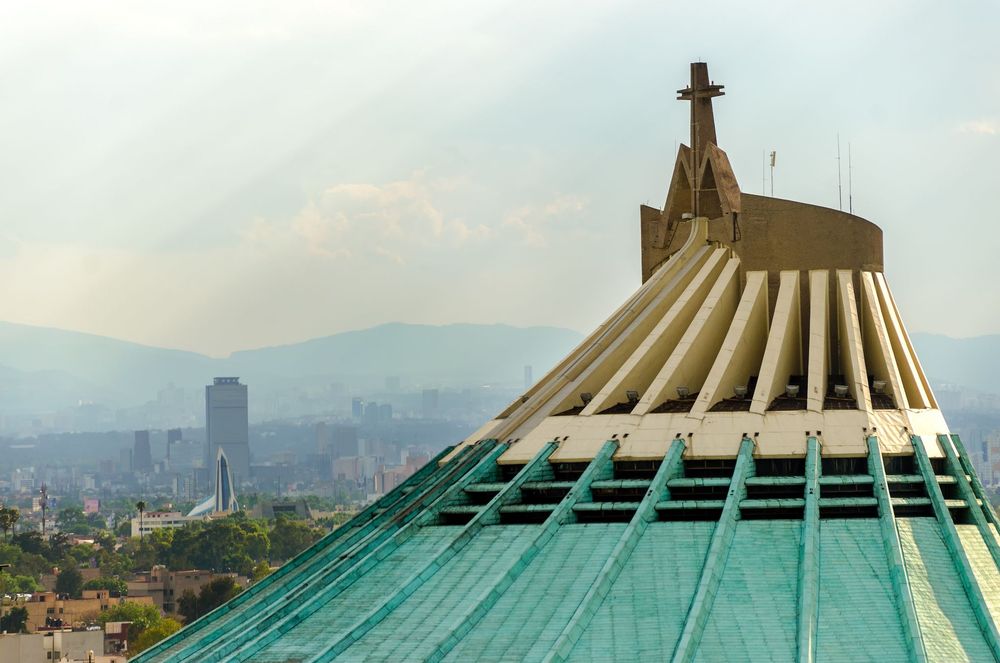
Cover photograph: Green roof and cross of the new Basilica of Guadalupe — Lidia Lopez, CC BY 2.0.
Frequently Asked Questions
Are the old and new basilicas the same building?
No. The new basilica houses the image of Our Lady of Guadalupe. The old basilica is now the Templo Expiatorio a Cristo Rey, with separate worship and access arrangements.
Does the basilica's opening time include the museum?
No. The main basilica publishes daily 06:00–21:00 opening, while the museum has separate arrangements. Confirm the museum directly; the ministry listing retains a 2022 update date.
Can I join a guided visit in English?
The sanctuary asks visitors to enquire about English availability. Spanish departures are advertised Monday–Saturday at 11:00 and 15:00, with advance reservation and a required donation; a place is not guaranteed by the timetable alone.
Do I have to climb Tepeyac hill to visit the basilica?
No. The Capilla del Cerrito is an optional extension with additional walking and steps. Visitors with mobility needs should confirm the route for each intended space rather than assume access is identical throughout the complex.


Keep Exploring
MUNAL Mexico City: Plan Your Art Visit
Plan a selective MUNAL visit with Mexican art, palace architecture, current admission rules and a focused historic-centre pairing.
Museo Franz Mayer: Plan Your Mexico City Visit
Plan Museo Franz Mayer with current general ticket prices, free Tuesday conditions, collection highlights and advice on special exhibitions.
Museo Jumex: Plan Your Mexico City Art Visit
Plan Museo Jumex with free entry, current hours, exhibitions, architecture, access and a sensible pairing with Museo Soumaya.