
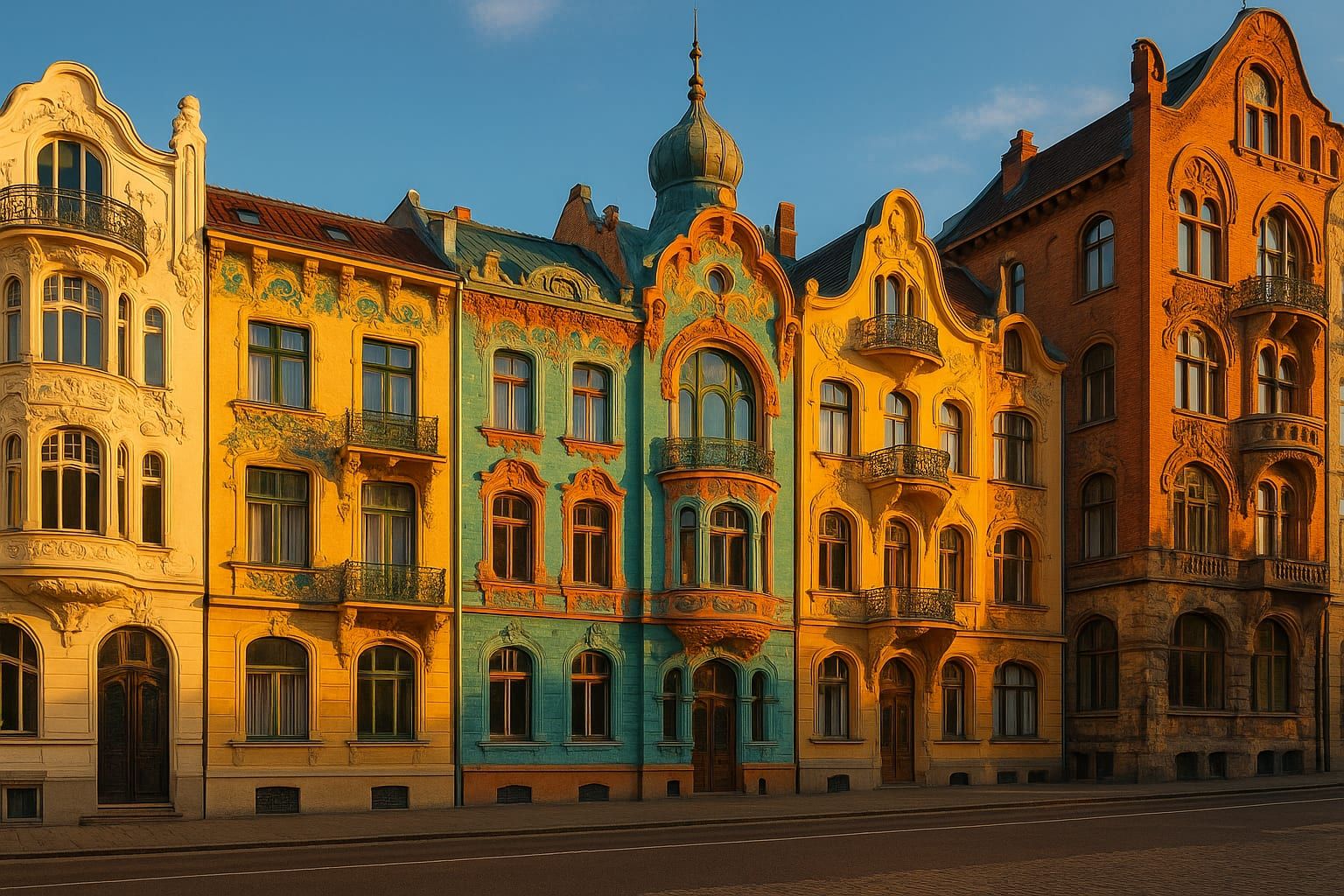
Discover Europe's finest Art Nouveau and Modernisme — from Riga's ornate façades to Gaudí's Barcelona masterpieces. A practical guide to must-see buildings, walking routes and local tips.
The Art Nouveau Trail: Europe's Most Beautiful Buildings
Art Nouveau — with its sinuous lines, flowering motifs and lavish use of new materials — swept across Europe around the turn of the 20th century. Though it bore different names and regional flavours (Modernisme in Catalonia, Jugendstil in German-speaking lands, Sezession in Austria), the movement left a continent-wide legacy of buildings that feel both of their time and utterly modern.
This guide takes you on an Art Nouveau trail across Europe: the key cities, the buildings you cannot miss, practical tips for visiting, and local insights to help you experience the style like a native.
Why follow the Art Nouveau Trail?
Art Nouveau was a reaction to historicism and industrial mass production. Architects and designers sought to harmonize art, craft and architecture: façades became sculptural canvases, interiors were total works of art, and everyday objects were elevated with ornament. The result is one of the most photogenic and human-scale styles in European architecture.
Whether you’re a photographer, architecture student, or just love decorative detail, these cities offer concentrated clusters of Art Nouveau buildings — perfect for a long weekend or an extended road trip.
Top Art Nouveau cities and must-see buildings
Below are the canonical stops for any trail. For each city I list a handful of highlights, what to expect, and a local tip.
Riga, Latvia — The Art Nouveau capital
- Must-sees: Alberta iela and Elizabetes iela (the high-density Art Nouveau district), the Riga Art Nouveau Museum.
- Why go: Riga boasts one of the largest ensembles of Art Nouveau architecture in the world. The façades brim with masks, floral cartouches and whimsical figures.
- Local tip: Head to Alberta iela early (before 10am) to avoid tour groups and capture morning light. For a short city-focused itinerary see our guide: 3 Days in Riga.
Brussels, Belgium — Horta and the decorative daring
- Must-sees: Victor Horta’s Hôtel Tassel, Maison Saint-Cyr, the Victor Horta Museum, and the UNESCO-listed Stoclet Palace (an opulent Gesamtkunstwerk).
- Why go: Victor Horta’s work is often considered the epitome of Art Nouveau architecture — graceful ironwork, fluid staircases and integrated interiors.
- Local tip: Buy a combined Victor Horta Museum ticket and time your visit for late afternoon when the light plays across the museum’s iron balustrades. Finish with a hot chocolate in one of Brussels’ genteel cafés.
Barcelona, Spain — Catalan Modernisme (Gaudí and beyond)
- Must-sees: Casa Batlló, Casa Milà (La Pedrera), Palau Güell, and the winding Park Güell.
- Why go: Catalan Modernisme is a regional take on Art Nouveau with spectacular sculptural façades, mosaics and inventive structural solutions.
- Local tip: Pre-book tickets for Casa Batlló and La Pedrera; visit Casa Batlló after sunset when its façade is lit. Combine architecture with tapas in the Eixample district.
Vienna, Austria — The Sezession and civic expression
- Must-sees: The Secession Building (Beethoven Frieze), Otto Wagner’s Postal Savings Bank, and elegant apartment fronts in the Ringstrasse area.
- Why go: Vienna’s Art Nouveau (Sezessionstil) is more restrained and geometric, with refined ornament integrated into civic buildings and private houses.
- Local tip: The Secession often hosts contemporary exhibitions; combine with a coffee at a traditional Viennese café.
Prague, Czech Republic — Bohemian flourish
- Must-sees: The Municipal House (Obecní dům), Hotel Paris, and a scattering of Art Nouveau apartment buildings in Lesser Town and the Old Town.
- Why go: Prague blends Gothic and Baroque backdrops with early 20th-century decorative exuberance — the Municipal House is a show-stopper.
- Local tip: The Municipal House hosts classical concerts; check the schedule and attend an evening concert to see the interior lit and alive. Pair your cultural stop with a stroll across the Lesser Town.
Budapest, Hungary — Thermal grandeur and ornament
- Must-sees: Gresham Palace (now a luxury hotel), the Gellért Hotel & Baths, and the charming residential façades along Andrássy Avenue.
- Why go: Budapest’s Art Nouveau interweaves with the city’s love of grand public baths and palatial hotels.
- Local tip: Combine sightseeing with a soak — the Gellért or Széchenyi Baths make for a restorative and atmospheric post-walk stop. For more on combining baths with a city stay see 3 Days in Budapest.
Bucharest, Romania — Eastern elegance
- Must-sees: Cantacuzino Palace (home to the George Enescu Museum), elegant turn-of-the-century villas around Calea Victoriei.
- Why go: Romania mixed French Beaux-Arts and Art Nouveau elements to create richly decorated palaces and townhouses with luxuriant interiors.
- Local tip: The George Enescu Museum is a jewel — check opening days and guided tour options for the best appreciation of the interiors.
Nancy & the École de Nancy, France — the artisanship hub
- Must-sees: Musée de l'École de Nancy, Maison Bergeret and numerous private villas and workshops.
- Why go: École de Nancy promoted applied arts — glass, furniture, metalwork — resulting in high-quality decorative work that complements regional architecture.
- Local tip: The museum often runs workshops and thematic tours focusing on glasswork and furniture design — perfect if you care about the craft behind the style.
A sample Art Nouveau weekend: 3 itineraries
Riga (48–72 hours): Day 1 — Alberta iela, Art Nouveau Museum, and the central market; Day 2 — walking tour of Elizabetes iela and the brewery quarter; Day 3 — free morning for museums or a short train trip to Jūrmala.
Brussels (48 hours): Day 1 — Victor Horta Museum, Saint-Cyr houses, Tram 92 loop for Art Nouveau façades; Day 2 — Stoclet Palace neighbourhood (advance tour) and an evening in the Sablon antique quarter.
Budapest (48–72 hours): Day 1 — Andrássy Avenue façades and Dohany Street Synagogue; Day 2 — Gellért Baths and Gresham Palace photo stop; Day 3 — explore lesser-known Art Nouveau apartment buildings in the city’s residential districts.
Practical tips for following the Trail
Best time to visit
- Spring (April–June) and autumn (September–October) offer mild light and fewer crowds. Summer can be hot and busy, while winter offers atmospheric, low-light photos but shorter opening hours.
How to see more in less time
- Walking is the best way to appreciate details. Pick one neighbourhood per half-day rather than trying to ‘collect’ buildings across town.
- City transport passes often include museum discounts. Plan ahead and check combined tickets for museum clusters.
Photography tips
- Early morning or late afternoon delivers warm, angled light that accentuates relief and ornament.
- Use a wide-angle lens for façades and a 35–50mm for interior details. Respect private properties — many Art Nouveau buildings are lived-in apartments.
Accessibility and entry
- Some Art Nouveau gems are private or inhabited; admire façades respectfully. Museums and landmark houses usually have guided tours — many require advance booking and limited group sizes.
- If mobility is a concern, research building accessibility ahead of time; older buildings may have narrow staircases and limited lifts.
Local etiquette and safety
- Ask before photographing residents or private courtyards. Many countries are sensitive about privacy and image use.
- Standard city caution applies — pickpockets operate in tourist areas; keep valuables secure on busy trams and squares.
Where to eat, drink and linger
- Riga: Try specialty coffee shops and a bakery near Alberta iela after your walk. The city’s café culture pairs well with architectural exploration.
- Brussels: Sample waffles or a light lunch in the Sablon area — many cafés sit in historic buildings where you can keep soaking up the décor.
- Barcelona: A late lunch of tapas on the Eixample promises a perfect contrast to Gaudí’s exuberance.
- Budapest: After a morning of façades, unwind with a spa session and then a riverside meal with views of the Danube.
Conservation, restoration and local crafts
Many Art Nouveau buildings are the result of careful restoration. Look for plaques noting restoration projects or join a conservation tour if available — you’ll learn about the craftsmen who restored stained glass, mosaics and ornamental ironwork.
In cities like Nancy and Riga, you can find workshops and museums dedicated to decorative arts. If you love craft detail, build time into your itinerary to visit those spaces.
Final tips and inspiration
- Don’t rush: Art Nouveau rewards slow looking. Spend time on a single façade and you’ll discover layers of detail — sculpted masks, hidden symbols and playful ironwork motifs.
- Mix big names and local gems: While Gaudí and Horta are essential, some of the trail’s greatest pleasures are the quiet apartment buildings, little cafés and restored storefronts.
- Combine with nearby experiences: If you’re visiting Budapest, include a thermal bath visit; in Riga, stroll the central market; in Prague, pair the Municipal House with a concert evening.
If you want a concentrated city plan, explore our detailed local itineraries: the Riga Art Nouveau route is a ready-made three-day plan 3 Days in Riga, and for a city that pairs architecture with relaxing baths see 3 Days in Budapest. For a detour into Eastern Europe’s overlooked cultural riches, consider a stop in Plovdiv to combine regional history with surprising architectural details: Plovdiv: Europe’s Best-Kept Secret.
Art Nouveau is a celebration of line, colour and craftsmanship: follow the trail and you’ll return home with a new eye for the decorative stories that make cities memorable.
Related
Keep Exploring
Understanding the Balkans: History & Culture
A traveler's guide to the Balkans that untangles history, explains cultural diversity, and gives practical tips — from food and festivals to routes and local etiquette.
La Tomatina & Spain's Craziest Festivals
From Buñol’s tomato-soaked streets to bull runs and firework-soaked plazas, explore La Tomatina and Spain’s wildest festivals with practical tips, history, and local insights.
Carnival in Venice: Complete Guide
Everything you need to know to experience Venice Carnival: history, key events, costume tips, where to watch, budgets, and smart planning for an unforgettable Carnevale in Venice.