
Choose the right Melbourne base: central sightseeing, riverside evenings, inner-north neighbourhoods or the bay, with clear transport trade-offs.
For a first visit focused on central sightseeing, stay in Melbourne's CBD. Choose Southbank if riverside evenings are a priority, Carlton for meals and museum days, or Fitzroy and Collingwood when the neighbourhoods are the main reason for coming. St Kilda makes sense when you want to spend real time beside the bay, rather than commute from it every morning.
The best choice depends less on a neighbourhood's reputation than on where you will finish your days. A room near dinner, a performance or your evening walk can be more useful than one beside an attraction you visit only once. Start with that pattern, then compare individual properties.
Choose your base at a glance
| Base | Choose it for | Look closely at | Main compromise |
|---|---|---|---|
| CBD | A short first visit and varied city plans | Southern Cross, the central grid or the eastern end | Your preferred neighbourhood evenings may require travel |
| Southbank | River walks and an arts-focused stay | The actual bridge and street route from the entrance | Outside the Free Tram Zone |
| Carlton | Lygon Street meals and Melbourne Museum | Southern Carlton versus addresses farther north | More effort for repeated trips south of the river |
| Fitzroy / Collingwood | Cafes, independent shops, dinner and music | Distance from the venues you will actually use | A separate journey for central sightseeing |
| St Kilda | Foreshore time and a bay-focused routine | Beach access and the correct tram stop | Longer city journeys; weather matters more |
| Melbourne Airport | A flight-led overnight stop | Correct airport, terminal and hotel transfer | Poor fit for a city sightseeing base |
These are editorial recommendations, not hotel-quality or price rankings. Transport information was checked on 13 October 2026; check the linked official guidance for your travel dates.
The Free Tram Zone: useful, but smaller than your trip
The official tram map shows the central zone running along Flinders Street to the south and Spring Street to the east, with La Trobe Street forming much of its northern edge. It extends around Queen Victoria Market and west into Docklands. The boundary follows particular streets and stops; it is not a circle around every attraction labelled central Melbourne.
Southbank, NGV International, Melbourne Museum, Fitzroy and St Kilda are outside it. Being close to a boundary does not make the entire journey free. For example, a tram ride from the CBD across the river to the arts precinct leaves the zone, even though the destination feels central.
According to Transport Victoria's visitor guidance, do not tap on or off when your tram journey stays entirely inside the zone. Tap on for a journey that extends beyond it. The free zone applies to trams, not an automatic free journey on trains or buses serving the same area.
A hotel outside the zone can still be a good choice if you enjoy the walk into it. Compare the actual entrance and boarding stop before booking, especially with luggage or limited walking tolerance. Saving a fare is less valuable if reaching the free stop makes every outing awkward.
CBD: the most flexible first-visit base
The CBD works well when your plans span different parts of Melbourne. You can start with the laneways, return between outings and change direction without having committed your whole stay to one neighbourhood. It is our default for a short city break, particularly when arrival and departure reduce your available sightseeing time.
Choose within the grid deliberately. The western side around Southern Cross is useful if you will use the airport coach. SkyBus Melbourne City Express connects Melbourne Tullamarine Airport with Southern Cross Station. Check the walking route from its coach terminal to the property, rather than assuming every hotel advertised as near the station is equally convenient.
The central grid is a useful compromise when you want different directions each day. The southern end suits repeated walks towards Federation Square and the river. The eastern end around Spring Street is worth considering if your booked evenings are nearby; inspect the specific theatre or restaurant address rather than treating the whole centre as one doorstep.
For planning, allow roughly 20–35 minutes to walk between opposite parts of the main grid, before lengthy stops. This is an editorial allowance, not a measured hotel transfer; crossings, your endpoints and your pace matter. Being in the CBD does not mean every attraction is a short walk away.
If you want a concrete test of the location, plot the first and last stops from our Melbourne itinerary for 3 days. A property that makes those journeys straightforward is more useful than a claim to be close to everything.
Southbank: river evenings, with an address check
Choose Southbank when coming back to the Yarra is part of the holiday you want. The official Southbank and South Wharf guide distinguishes the riverside dining stretch from the convention-centre end farther west. Those are different starting points for your daily routes.
An address near Southgate and the crossings towards Flinders Street is a different proposition from an apartment deeper inland or towards South Wharf. A river view does not tell you where the building entrance is, which bridge you need, or how far you will walk before reaching transport. Trace the route at street level.
Southbank can suit a gallery-led break and evenings on the promenade. It is less compelling if most of your restaurant and music plans are in Fitzroy or Carlton: you would repeatedly cross the centre to return. Compare that recurring journey with the pleasure you expect from staying by the water.
Do not pay extra for a view without checking the booked room category. Likewise, an apartment photograph does not establish whether reception, luggage storage or after-hours assistance is available. These are property-level questions, especially if you arrive before check-in and want to begin exploring.
Carlton: meals, books and museum days
Carlton suits travellers who want a neighbourhood routine built around a meal and a cultural visit. Visit Melbourne's Carlton guide highlights Lygon Street dining, Readings, Cinema Nova, Melbourne Museum and Carlton Gardens. That combination gives you useful reasons to spend evenings as well as daytime here.
Focus on the address rather than the suburb name. Southern Carlton, closer to the city edge and gardens, is the more practical search area if you still expect frequent central outings. A property farther north may suit your chosen restaurants but changes the walking calculation. Map both the museum entrance and your likely dinner address.
Compared with Fitzroy, Carlton is the stronger choice when books, films and museum time shape the trip; Fitzroy is the stronger choice when independent shops and music dominate your evenings. This is a difference in priorities, not a promise that every Carlton room is quiet or every Fitzroy street is noisy.
For families or a longer stay, compare usable room space, laundry and kitchen facilities with the distance to transport. A kitchen matters only if you intend to shop and cook. A large apartment with an inconvenient entrance or difficult late check-in can create more work than it saves.
Fitzroy and Collingwood: stay where you will go out
Choose this part of the inner north when breakfast, shopping and dinner are central to your Melbourne plans. The official Fitzroy guide identifies Brunswick, Gertrude, Smith and Johnston Streets for cafes, retail, pubs and music. Use those streets to narrow your search, then place the actual venues on a map.
Fitzroy and Collingwood are useful to compare together, but a broad search area is not a single location. Staying near the places you expect to revisit is the point. A listing labelled Collingwood may put you on a different side of the neighbourhood from your Fitzroy dinner plans.
Allow an editorial planning buffer of 25–45 minutes for a door-to-door trip between an inner-north property and a central appointment, including walking and waiting. This is not a tram timetable or a guarantee; check the journey planner with the actual addresses. Repeating the trip for sightseeing, a room break and dinner can consume a noticeable part of the day.
If live music is your reason to stay, confirm the performance before booking around a venue. Ask the property about room position, nearby late-opening businesses and sound insulation if sleep matters. Do not assume a whole neighbourhood provides the same night-time experience. Also keep the names straight: Brunswick Street is in Fitzroy; Fitzroy Street is in St Kilda.
St Kilda: choose the bay as part of your daily life
St Kilda is worthwhile as a base when you want foreshore walks to be an everyday pleasure. The official St Kilda guide brings together the beachside setting, dining and performance venues. Choose it for that combination rather than because a booking site makes the room look close to Melbourne generally.
Check the distance to the foreshore and to the stop serving your city journeys. Being in St Kilda does not guarantee that either is directly outside. St Kilda Road is also a long corridor: a hotel carrying that address is not automatically a beach hotel or a property in St Kilda itself.
As an editorial allowance, budget 40–60 minutes door to door for a St Kilda–CBD journey, including getting to the stop and waiting. Your particular route may take less or more; use the live planner before a fixed booking. If you expect to go into the city, return to change and go back for dinner, the cumulative travel is a strong argument for staying centrally instead.
The bay choice also deserves a weather test. If a wet or windy day would send you straight back to central museums, consider whether a CBD base with a separate St Kilda outing would serve you better. If you would still enjoy nearby meals and a booked performance, the neighbourhood may remain the right fit. A waterfront address is not a promise of swimming conditions or wildlife sightings.
Airport hotels: solve the flight problem only
An airport hotel makes sense for a very early departure, a late arrival before onward travel or an overnight connection. Use Melbourne Airport's accommodation map to distinguish properties in the terminal precinct from nearby hotels that need a transfer.
Check the airport on your booking first: Melbourne Tullamarine and Avalon are different airports. Then verify the route to your terminal, any shuttle operating hours and the process for late check-in. The word airport in a hotel name is not evidence that you can walk there with bags.
For an ordinary city visit, the airport is a transfer problem to solve at the beginning and end, rather than the best place to sleep throughout. If only the final flight needs an airport night, weigh that move against packing, checkout and an extra check-in. Do not split a short stay merely to experience another hotel.
Compare rooms after you choose the area
Shortlist properties using the complete stay cost, cancellation terms, bedding, room position and arrival arrangements. Add any required parking or transfers before comparing totals. No district is reliably cheapest across all travel dates and room types.
If you are bringing a car for a regional trip, ask about parking access and charges rather than assuming accommodation includes it. For city days, judge the location by your walking and public transport routes. A parking space does not make driving the easiest way to reach every appointment.
For the next decision, our guide to things to do in Melbourne compares the cultural visits and neighbourhood outings that can anchor your stay. Choose those anchors before paying for an address whose main advantage you may never use.
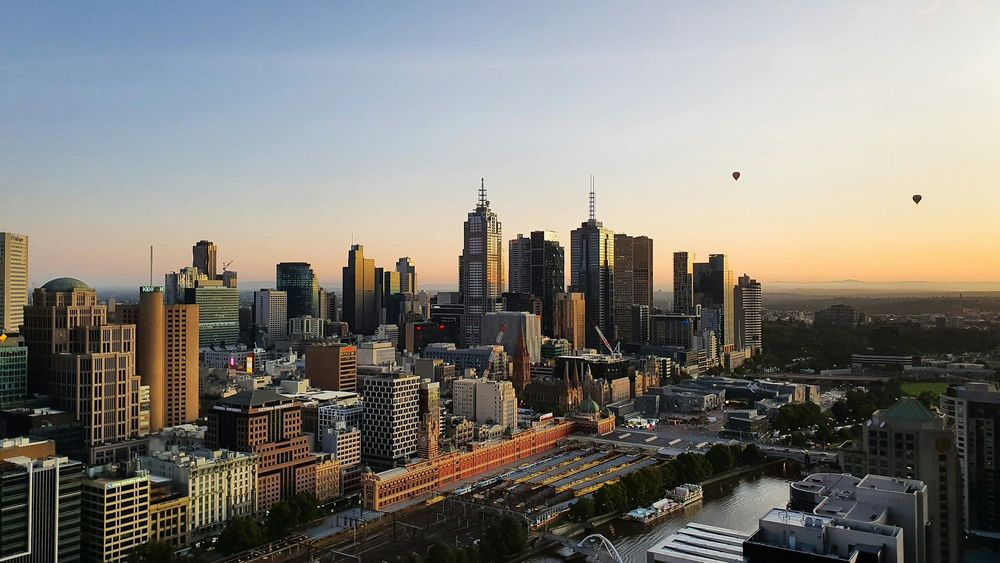
Cover photograph: Melbourne skyline in warm light with hot-air balloons overhead. Photo by Urlaubstracker on Unsplash.
Frequently Asked Questions
Where should I stay in Melbourne for a first visit?
The CBD is the most flexible choice for a short visit with varied sightseeing. Southbank works if riverside evenings matter more, while Carlton or Fitzroy can be better when you want to spend several evenings in the inner north.
Is Southbank inside the Free Tram Zone?
No. Southbank is outside the zone, even though you can walk across the river into the CBD. A tram journey crossing the boundary requires payment; only tram journeys entirely within the zone are free.
Is St Kilda a good base for sightseeing in Melbourne?
Yes, if bay time is a substantial part of the trip and you accept the separate city journeys. For a stay dominated by central museums and inner-north evenings, choose a more central base and visit St Kilda as an outing.
Should I book an airport hotel for my Melbourne stay?
Usually only when flight timing or an overnight connection makes it useful. Verify the correct airport, terminal and transfer arrangements. For several days exploring Melbourne, a city or neighbourhood base is more practical.

Keep Exploring
Where to Stay in Sydney: Choose Your Base
Choose a Sydney base by the journeys you will repeat: harbour sightseeing, dinner out, coastal mornings or an early flight. Compare each area before choosing a room.

Where to Stay in Oaxaca: Choose Your Neighbourhood
Choose your Oaxaca City base by the streets you will use most: markets near the Zócalo, Santo Domingo's cultural sights, Jalatlaco or Xochimilco.

Where to Stay in Los Angeles: Choosing Your Base
Choose your Los Angeles base by the journeys you will repeat: compare Downtown, Hollywood, West Hollywood, Santa Monica, Venice and airport stays.