
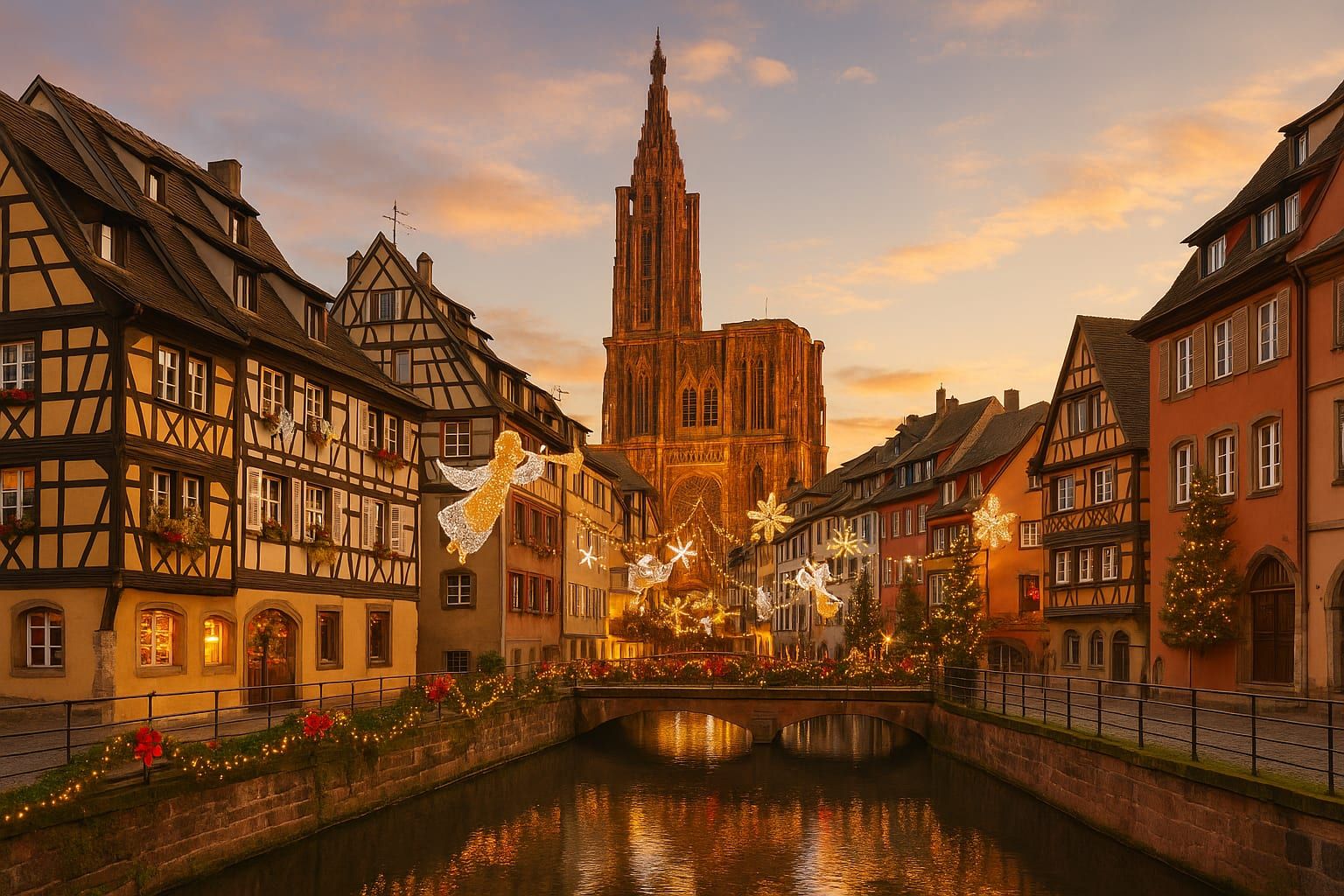
Strasbourg transforms into Europe’s Christmas capital each winter — a fairytale of timbered houses, centuries-old markets, lights, mulled wine and Alsatian traditions.
Strasbourg: Capital of Christmas
Strasbourg doesn't just celebrate Christmas — it becomes a winter legend. Nicknamed the “Capital of Christmas,” the city on the Franco-German border dresses in thousands of lights, centuries-old traditions return to its squares, and the scent of cinnamon, roasted chestnuts and vin chaud fills the air. With origins dating back to 1570, Strasbourg’s Christkindelsmärik is one of Europe’s oldest and most atmospheric holiday markets.
Below is a complete guide to experiencing Christmas in Strasbourg: the must-see markets and neighborhoods, where to eat and shop, insider tips to avoid crowds, practical travel advice, and how to pair Strasbourg with nearby Alsatian treasures like Colmar.
Why Strasbourg feels like the Capital of Christmas
- Historical roots: The Strasbourg Christmas market traces its modern lineage to the 16th century (commonly cited as 1570). Over generations the market and the city’s holiday rituals have layered tradition on top of tradition.
- The setting: Strasbourg’s Grande Île — a UNESCO World Heritage island — with its timber-framed houses, Gothic cathedral and winding canals, forms the perfect medieval backdrop for festive lights and wooden chalets.
- Scale and variety: The market isn’t a single place but a constellation of themed markets across the city (crafts, gastronomy, children’s village, and more), so the festive atmosphere is everywhere.
- Cultural mix: Alsace’s Franco-German heritage shows in the food, names, and crafts — making Strasbourg a unique crossroads for Christmas culture.
Main markets & festive spots (what not to miss)
Place Kléber — The Great Tree
At the heart of Strasbourg stands the massive Christmas tree at Place Kléber. It’s the city’s iconic seasonal landmark and an essential photo op. The lighting ceremony draws crowds, so arrive early if you want a close view.
Christkindelsmärik — Place Broglie
Often referred to as the “original” market, the Christkindelsmärik at Place Broglie is where many of the oldest stalls and traditions are concentrated. Here you’ll find artisan gifts, wooden toys, and local foods.
Cathedral Square & Place du Château
The square in front of Strasbourg Cathedral hosts stalls with handcrafted ornaments and nativity scenes. While you’re here, step into the cathedral — the illuminated façade against the winter sky is spectacular.
Petite France and Quai des Bateliers
This postcard-perfect neighborhood, with its canals and half-timbered houses, becomes especially magical at night when lights reflect in the water. Smaller markets and boutique stalls are tucked into side streets.
Place Gutenberg & Place Saint-Thomas
These squares host themed markets, from local gastronomy and regional wines to artisan workshops and live music.
Children’s markets and special events
Strasbourg runs a dedicated children’s market and a program of concerts, puppet shows and light projections. Keep an eye on the official program for family-friendly events and opening times.
Food and drink: eat like an Alsatian
Part of Strasbourg’s holiday charm is culinary. Try these local specialties at market stalls and winstubs (traditional Alsatian taverns):
- Vin chaud (mulled wine): Often served in collectible ceramic or reusable cups — bring a reusable cup or be prepared to pay a small deposit.
- Bretzel: Warm soft pretzels, sometimes filled or topped.
- Tarte flambée (flammekueche): Paper-thin crust with crème fraîche, onions and lardons — a must-try.
- Fournée / kougelhopf: A brioche-like pastry, frequently sold in markets.
- Bredele: Seasonal Alsatian biscuits that make excellent gifts.
- Roasted chestnuts, sausages and raclette-style cheese stands: comfort food for cold nights.
Pro tip: step into a winstub for a proper meal and a cozy atmosphere. These local spots are perfect for warming up between market visits.
Shopping: what to buy and where
Strasbourg is a great place to hunt for handcrafted presents: carved wooden toys, blown-glass ornaments, woolen goods, and local preserves (mustard, jams and eaux-de-vie). The artisan stalls near Place Broglie and the Cathedral concentrate the best handmade goods.
Look for authentic Alsatian artisans rather than factory-produced souvenirs — small workshops and cooperatives will often show you how items are made.
Practical tips — getting there and getting around
- When to go: The market season typically runs from late November through December (many stalls close on December 24 or 25, though some remain open through the end of the month). Check the official dates before you travel.
- How to get there: Strasbourg is well connected by rail. TGV trains from Paris take around 1.5–2 hours. There are also regular connections from Germany, Switzerland and other French cities. If arriving by air, Strasbourg Airport links to the city by tram.
- Getting around: The city is compact and very walkable. Strasbourg’s efficient tram network is the easiest way to move farther afield — trams run frequently and are an easy way to reach hotels outside the historic center. Consider buying single tickets or a day pass.
- Accommodation: Book early — hotels in and around the Grande Île fill up fast during market season. If you want the most atmospheric stay, look for rooms in Petite France; for better value, search just outside the island but near a tram stop.
Best times, crowd strategy and money-saving tips
- Beat the crowds: Weekday mornings are the quietest. If you can, visit Madrid during the week and arrive early for the markets. Evenings are magical but most crowded.
- Blue hour photography: The best light for photos is during blue hour (just after sunset) when the sky is deep and lights pop — but expect more people. If you want photos with fewer people, try early morning.
- Bring cash and a card: Most stalls accept cards, but small vendors and food stalls may prefer cash. ATMs are widely available, and the currency is the euro.
- Reusable cup programs: To cut single-use waste, many markets use reusable cups for vin chaud. Bring a travel mug or be prepared to pay a deposit when buying your drink.
Accessibility & family tips
- Accessibility: The major squares are generally accessible, but cobblestones and packed crowds can make navigation tricky with strollers or mobility aids. If you require assistance, plan ahead and use the tram network to reduce walking.
- Families: The children’s market and puppet shows are designed for families. Bring warm layers for kids and plan indoor stops for meals and warming up.
Sustainability & local initiatives
Strasbourg has taken steps to reduce the environmental impact of its markets: reusable cups, eco-friendly lighting choices and partnerships with local producers. Respect local signage about recycling and deposit systems, and support artisans who source materials locally.
Sample 2- or 3-day itinerary
Day 1 — Arrival & first impressions
- Afternoon: Check into your hotel on or near the Grande Île. Walk through Petite France to get the first festive glimpses.
- Evening: Watch the lights come up at Place Kléber and visit the stalls at Place Broglie. Sip vin chaud and sample a tarte flambée in a nearby winstub.
Day 2 — Markets, cathedral & boat tour
- Morning: Explore the Christkindelsmärik around Place Broglie and Place de la Cathédrale. Visit the Strasbourg Cathedral and, if operating, the astronomical clock.
- Afternoon: Take a Batorama boat tour on the River Ill for a different perspective of the illuminated façades and canals.
- Evening: Head to Place Gutenberg and Place Saint-Thomas for local crafts and live music.
Day 3 — Day trip option
- Option A: Head to nearby Colmar for a fairytale Alsatian market experience — the town is a short train ride away and well worth a half- or full-day trip. See more on Colmar’s markets in our guide: /en/seasonal-travel/colmar-christmas-markets-fairytale-alsace
- Option B: Combine Strasbourg with other European market highlights via our roundup: /en/seasonal-travel/best-christmas-markets-europe-complete-guide
Local insights you won’t find in every guide
- Hidden warming spots: For a less touristy break, duck into the libraries or small churches near Place Saint-Étienne — they’re quiet and beautifully decorated.
- Seek out infantile traditions: Some neighborhoods still practice local nativity rituals and small community concerts—ask stall vendors for the schedule or consult local bulletin boards.
- Market pacing: Treat the market as a sampler — eat little and often, and buy small items from different stalls. If you see something truly unique, buy it; popular items can sell out early.
- Language and friendliness: French is the main language, but many vendors in Strasbourg speak German or English due to tourism and the region’s history. A few words in French (bonjour, merci) always help.
Safety & etiquette
- Pickpockets: As with any crowded tourist spot, watch your belongings in peak hours.
- Waste: Use recycling bins and respect deposit systems for cups.
- Tipping: Tipping is not mandatory in France; rounding up for good service is common in cafés and restaurants.
Pairing Strasbourg with other winter destinations
Strasbourg is the perfect base for exploring Alsace. A day trip to Colmar’s fairytale markets is an easy addition (/en/seasonal-travel/colmar-christmas-markets-fairytale-alsace), and if you’re building a broader Christmas-market itinerary, consult our Europe guide for other top markets to visit: /en/seasonal-travel/best-christmas-markets-europe-complete-guide. If you’re curious how other Central European cities celebrate, our Budapest Christmas piece highlights thermal baths and markets for a contrasting winter escape: /en/seasonal-travel/budapest-christmas-thermal-baths-markets
Photography tips
- Blue hour and night: Bring a fast lens and a stabilizing grip — tripods are sometimes impractical in crowds.
- Capture details: Zoom in on craft stalls, ornaments, and food for intimate shots that tell the story.
- Motion & light: Use slower shutter speeds for light trails from tramlines if you have a steady hand or small travel tripod.
Final thoughts
Strasbourg’s claim as the Capital of Christmas is more than marketing — it’s earned through centuries of tradition, thoughtful civic planning, and a festive atmosphere that spills into every neighborhood. Whether you come for the towering tree at Place Kléber, the centuries-old Christkindelsmärik, the smells of Alsatian cuisine, or simply the charm of Petite France lit up at night, Strasbourg delivers a Christmas experience that feels both authentic and enchanting.
Plan ahead, bundle up, and let the city’s lights guide you from one magical square to the next — Strasbourg rewards curious travelers with memories (and perfect gifts) that last well beyond the holiday season.
Practical checklist
- When to go: late November–December (check official dates)
- Must-see: Place Kléber (tree), Christkindelsmärik at Place Broglie, Strasbourg Cathedral, Petite France
- Eat: tarte flambée, vin chaud, bretzels, kougelhopf, bredele
- Bring: warm layers, comfortable boots, reusable cup, cash for small stalls
- Nearby: day-trip to Colmar (/en/seasonal-travel/colmar-christmas-markets-fairytale-alsace)
Happy travels — and joyeux Noël from Strasbourg!
Related
Keep Exploring
Greek Islands: Which One Is Right for You?
From party islands and luxury escapes to quiet villages and family-friendly beaches, this guide helps you match your travel style to the perfect Greek island — with practical tips and sample itiner...
Summer in Scandinavia: Midnight Sun Magic
Experience Scandinavia’s Midnight Sun: where and when to go, best activities from hiking to whale-watching, local festivals, photography tips, packing advice and safety notes.
Cherry Blossoms in Europe: Best Spots
A practical guide to Europe's top cherry blossom spots — when to go, where to find the best tunnels and parks, local tips, and photo-perfect viewpoints from Bonn to Stockholm.