
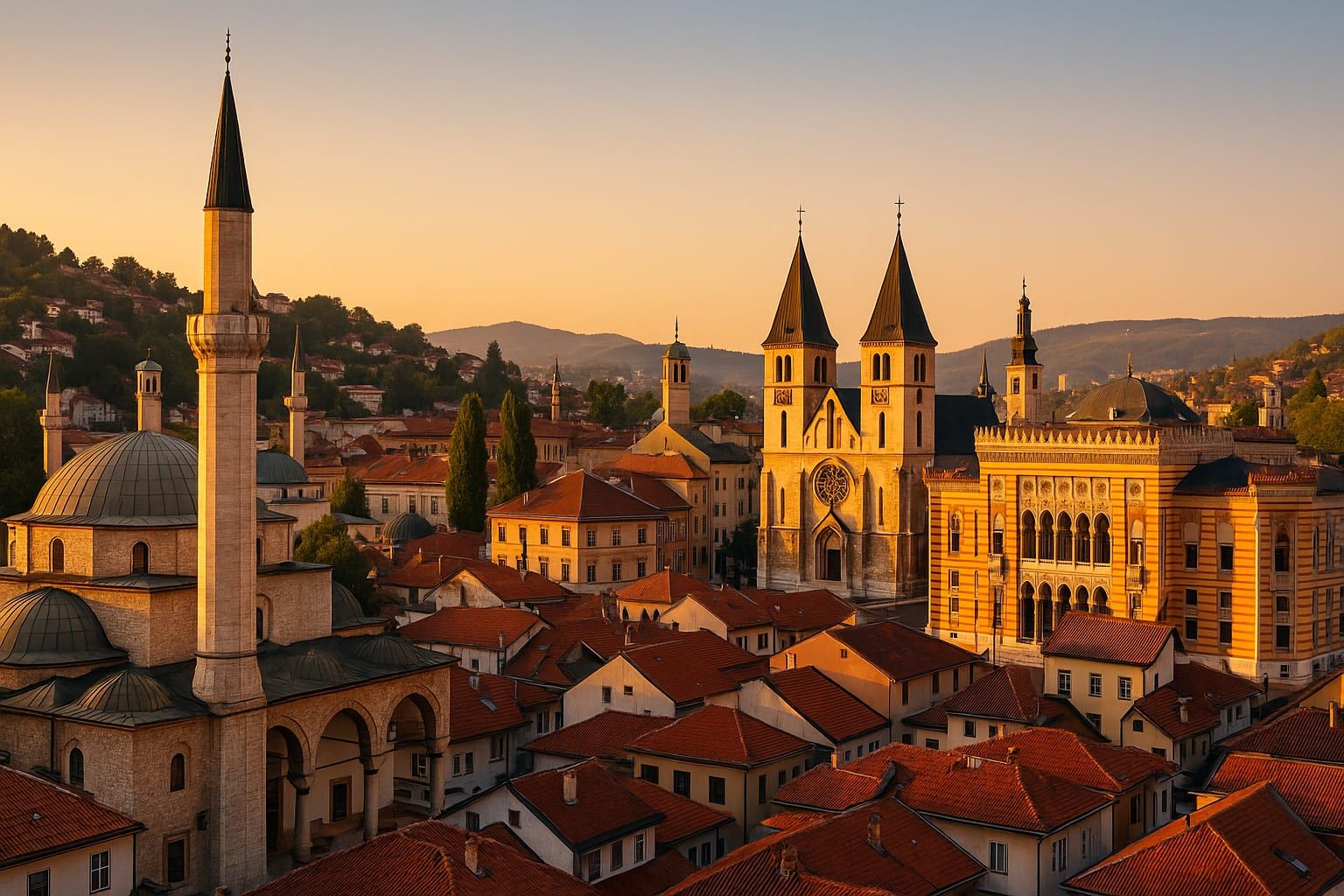
Discover Sarajevo — a compact, soulful capital where mosques, churches and synagogues stand within earshot, Ottoman bazaars meet Austro-Hungarian boulevards, and history hums in every street.
Sarajevo: The Jerusalem of Europe You've Never Visited
Sarajevo is a city of close-up contrasts: the call to prayer mixing with church bells, Ottoman lanes opening onto Austro-Hungarian boulevards, and an unmistakable warmth beneath a complicated past. Often called the "Jerusalem of Europe," Sarajevo wears that nickname like a challenge and an invitation. It asks you to look beyond headlines and discover a place where history, faith and daily life coexist in a way that’s quietly spectacular.
Why Sarajevo is called Europe’s Jerusalem
The nickname comes from Sarajevo’s extraordinary religious diversity and its role as a crossroads of empires. For centuries the city has sheltered mosques, Orthodox churches, Catholic cathedrals and a historic Sephardic synagogue within a compact city center. Where else in Europe can you walk a few streets and see all four traditions literally in sight of one another?
This interwoven identity is the result of Ottoman rule (15th–19th century), followed by Austro-Hungarian influence (late 19th–early 20th century), and Sarajevo’s long role as a regional trading and cultural hub. That blend shaped the city's architecture, cuisine, music and public life.
Where to begin: Neighborhoods and must-see sites
Baščaršija — the Ottoman heart
Start in Baščaršija, Sarajevo’s old bazaar. Cobbled alleys brim with artisan shops selling copperware, wooden souvenirs and hand-painted ceramics. Stop at the Sebilj — the signature Ottoman fountain — and wander to the Gazi Husrev-beg Mosque, one of Bosnia’s most important Islamic sites. Sample a Bosnian coffee in a tiny kafana (traditional café) and watch life unfold.
Why linger: Baščaršija is a sensory intro — the scents of grilled meat, the clink of hammered brass, and locals playing backgammon in the afternoon light.
The Latin Bridge and Austro-Hungarian Sarajevo
A short walk from the bazaar takes you across the Miljacka River to the Latin Bridge, the site near which Archduke Franz Ferdinand was assassinated in 1914 — an event that sparked World War I. Nearby Austro-Hungarian streets show a very different architectural language: wide avenues, ornate façades and cafés where you might linger over a slice of baklava.
Sacred Heart Cathedral and the Jewish Quarter
Explore the Sacred Heart Cathedral (a neo-Gothic landmark) and the Old Orthodox Church to see the religious diversity that defines the city. Visit the Old Temple (the Ashkenazi synagogue) and the Jewish Museum to learn about Sarajevo’s Jewish community and the famed Sarajevo Haggadah — an illuminated 14th-century manuscript that symbolizes the city’s layered heritage.
War heritage with dignity: Tunnel Museum & War Childhood Museum
Sarajevo’s recent past is painful but important. The Tunnel of Hope (Tunnel Museum) and the War Childhood Museum offer dignified, human-focused perspectives on the siege of Sarajevo (1992–1996). These sites are not tourist spectacles; they are living testimonies to survival and resilience. Allow time and emotional space for these visits.
Panoramas and green lungs: Trebević and Yellow Fortress
For sweeping views, take the cable car up Trebević Mountain (or hike if you prefer). The Yellow Fortress, above the old town, is a favorite at sunset — bring a camera and a picnic.
Eat, drink and linger: Sarajevo’s culinary crossroads
Food is a perfect teacher here. Sarajevo’s cuisine is an intersection of Ottoman, Mediterranean and Central European influences.
- Try ćevapi (grilled minced-meat sausages) with somun (flatbread) — classic places include popular local ćevabdžinicas across the city.
- Burek and pita pastries are breakfast staples; pair with yogurt or ayran.
- Bosanski lonac is a slow-cooked stew that embodies home cooking.
- Sweets: baklava, tufahija (poached apple stuffed with walnuts) and kadaif.
- Don’t miss Bosnian coffee served in a džezva — a ritual meant to be savored slowly.
Cafe culture in Sarajevo is intimate and unhurried. Spend an hour at a street café and you’ll feel how coffee anchors social life.
Festivals, arts and the modern pulse
Sarajevo Film Festival (August) is the city’s cultural highlight, drawing international filmmakers and a lively crowd. The city also has thriving music and theatre scenes, galleries, and public events that celebrate both traditional music and contemporary art.
Local artists and musicians often engage with the city’s past — producing work that reflects memory, identity and rebuilding.
Day trips and regional routes
Sarajevo is also a great base for exploring the Balkans. Mostar, with its Ottoman-era Stari Most (Old Bridge), is the classic day trip (a 2–3 hour drive). For a longer adventure, consider the Ultimate Balkans Road Trip: a two-week itinerary threading through neighboring capitals, coastlines and mountains (/en/itineraries/ultimate-balkans-road-trip-2-weeks-itinerary).
If you’re traveling on a budget, the region is surprisingly affordable — see a practical budget route for the Balkans here (/en/budget-travel/budget-balkans-2-weeks-1000-euro).
Practical travel tips
Getting there and getting around
- Flights: Sarajevo International Airport (SJJ) connects with many European hubs seasonally. Low-cost and legacy carriers both operate routes.
- Buses and trains: long-distance buses link Sarajevo with Zagreb, Belgrade, Mostar and coastal Croatia. Trains are less extensive but scenic where available.
- In the city: Sarajevo is eminently walkable, especially the center. For hills and viewpoints, use the cable car, local buses, or taxis. Rideshare apps like Bolt operate in Bosnia and can be convenient; confirm prices before you ride.
Best time to visit
- Spring (April–June) and early autumn (September–October) offer mild weather, fewer crowds and vivid colors on Trebević.
- Summer can be hot in the valley but lively with festivals; winter brings a charming snow-dusted city and nearby skiing opportunities.
Currency, tipping and budgets
- Currency: Bosnian Convertible Mark (BAM). ATMs are widely available; credit cards accepted in many places but carry cash for markets and small cafés.
- Tipping: 10% is customary in restaurants if service isn’t included.
- Budget: Sarajevo can be very affordable compared with Western Europe. For budget itineraries and two-week Balkan routes, see our guide (/en/budget-travel/budget-balkans-2-weeks-1000-euro).
Language and etiquette
- Languages: Bosnian, Serbian and Croatian are mutually intelligible. English is widely understood in tourist areas, younger generations and hospitality staff.
- Polite phrases: “Zdravo” or “Dobar dan” (hello), “Hvala” (thank you), and “Molim” (please/you’re welcome). Learning a few basics is appreciated.
- Dress: casual is fine. When visiting mosques, dress modestly (cover shoulders and knees); women should carry a scarf to cover their hair.
Safety and respectful travel
Sarajevo is safe for tourists by European standards; petty theft is occasional, so keep usual travel precautions. More importantly, be mindful when discussing the 1990s war. Locals will often be candid about their experiences — listen respectfully. Avoid sensationalizing recent suffering; instead, seek to understand history through museums, memorials and conversations.
Insider tips and local quirks
- Coffee is social capital: expect an invitation to sit and talk. Never rush a coffee with a Sarajevan — it's a time to connect.
- Afternoon pastry crawl: work your way through bakeries for burek, sirnica (cheese pie) and pite (savory pies). Locals often grab these on the go.
- Shop for copperware and filigree jewelry in Baščaršija — bargaining is part of the fun but keep it friendly.
- When visiting viewpoints at sunrise or sunset (Yellow Fortress is popular), arrive early to avoid crowds and to see the city in the best light.
- Sarajevo Roses: you’ll notice red resin markings on the pavement where mortar craters once were — memorials to the siege. Treat them with quiet reverence.
Sample 48-hour Sarajevo itinerary
Day 1
- Morning: Start at Baščaršija; coffee and burek.
- Midday: Gazi Husrev-beg Mosque and a walk along the Miljacka River.
- Afternoon: Latin Bridge and the Museum of Sarajevo (assassination exhibits). Lunch of ćevapi.
- Evening: Sunset at Yellow Fortress; dinner in the old town.
Day 2
- Morning: Tunnel of Hope Museum; reflect and learn.
- Midday: Visit the National Museum and see local exhibits. Stroll to the Sacred Heart Cathedral and the Old Orthodox Church.
- Afternoon: Cable car to Trebević or a short drive to Vrelo Bosne (spring of the Bosna River) if you’d like green space.
- Evening: Try local nightlife — small bars and concerts; if visiting in August, catch the Sarajevo Film Festival.
Responsible travel notes
- Support local businesses: choose family-run guesthouses, artisan shops and cafés.
- Learn before you go: understanding the Balkans’ complex history adds depth to your visit. Our primer on the region helps provide context (/en/local-culture/understanding-the-balkans-history-culture).
- Be mindful at memorials: photography rules may vary; when in doubt, ask.
Why Sarajevo stays with visitors
Sarajevo doesn’t try to be polished. Its appeal is honest: a city rebuilt around community, where histories collide and coexist, and where small moments — a shared coffee, a rooftop view, a marketplace bargain — become memorable. If you’re after a European city that combines compact walkability with deep cultural layers, Sarajevo will surprise you.
Whether you come for history, food, music, or simply for a few days of slow wandering, Sarajevo rewards curiosity. It’s a city that asks you to notice the small, human details — and to leave having seen how faiths, cultures and stories can hold a city together.
Plan well, travel respectfully, and give Sarajevo time: it’s a place best understood slowly, cup by cup.
Keep Exploring
Siracusa: Sicily's Most Beautiful Ancient City
Siracusa is Sicily’s most beautiful ancient city: Greek theatres, Baroque Ortigia, seafood markets and sun-drenched alleys. This guide covers highlights, food, itineraries and practical tips.
Ohrid: Europe's Hidden Lake Paradise
Discover Ohrid, North Macedonia — a UNESCO lakeside jewel. From crystal-clear Lake Ohrid and ancient churches to hidden beaches and local food, this practical guide covers what to see, do and how t...
Lecce, Italy — The Florence of the South
Discover Lecce — Salento’s honey‑coloured Baroque gem. This guide covers must‑see architecture, food, day trips, local tips and practical advice for exploring the ‘Florence of the South.’