
Escursioni in Provenza: Le Migliori Gite da Aix e Marsiglia
Campi di lavanda, calanques costiere e villaggi arroccati. La tua guida completa per esplorare la Provenza dalle sue due grandi città.
Provence Day Trips: The Best Excursions from Aix and Marseille
Lavender fields, coastal calanques, and perched villages. Your complete guide to exploring Provence from its two great cities.
Provence is too vast, too varied, and too beautiful to experience from a single base. But two cities—Aix-en-Provence and Marseille—put most of the region's treasures within easy reach. Stay in one (or both), and the best of Provence unfolds around you.
This is a land of contrasts: elegant Aix versus gritty Marseille; ochre cliffs versus turquoise calanques; lavender fields versus fishing ports. The day trips here don't just show you pretty places—they reveal Provence's remarkable diversity.
The Calanques: France's Most Dramatic Coastline
Distance from Marseille: 30-45 minutes | Difficulty: Easy to challenging
The Calanques are narrow inlets carved into the limestone cliffs between Marseille and Cassis—a stunning national park where white rock meets impossibly turquoise water. This is the French Riviera as it once was: wild, undeveloped, and achingly beautiful.
How to Experience Them
By boat: The easiest option. Boats leave regularly from Marseille's Vieux Port and from Cassis, offering views of calanques inaccessible by land. A half-day excursion covers the main inlets.
On foot: For the full experience, hike. The classic route from Marseille to Cassis is the GR 98, taking 6-8 hours through spectacular scenery. Shorter hikes access individual calanques—Sugiton (2.5 hours round trip) and En-Vau (4 hours) are favorites.
By kayak: Paddle into the calanques for close-up exploration. Rentals are available in Cassis and at La Ciotat.
Practical Tips
- In summer, access to some calanques is restricted due to fire risk. Check conditions at the national park website.
- Bring water, sun protection, and sturdy shoes if hiking.
- The water is cold even in summer—but the swimming is spectacular.
Cassis: The Perfect Fishing Port
Distance from Marseille: 30 minutes | From Aix: 45 minutes
Nestled between the Calanques and the Cap Canaille (Europe's highest sea cliff), Cassis is a pastel-colored fishing village that's managed to stay charming despite its popularity.
The harbor is picture-perfect—fishing boats bobbing, outdoor restaurants serving bouillabaisse, cliffs rising dramatically behind. The local white wine (Cassis AOC) is dry and mineral, perfect with seafood.
What to Do
- Walk the harbor and old town
- Take a boat trip to the Calanques (departures from the port)
- Swim at Plage de la Grande Mer or the smaller coves nearby
- Drive (carefully) up to the Cap Canaille viewpoint
- Taste wine at Clos Sainte Magdeleine or other local domaines
Best For
Seafood lovers, casual hikers, wine enthusiasts, anyone seeking a quintessential Provençal port experience.
The Luberon: Lavender and Perched Villages
Distance from Aix: 1 hour | From Marseille: 1.5 hours
The Luberon is the Provence of postcards: hilltop villages in honey-colored stone, lavender fields stretching to the horizon, olive groves and vineyards carpeting the valleys. This is Peter Mayle territory, made famous by A Year in Provence.
The Essential Villages
Gordes: The most dramatic of the perched villages, built into a cliff face with a Renaissance château at its summit. Touristy but spectacular—come early or late to avoid crowds.
Roussillon: Famous for its ochre cliffs, which give the village an otherworldly palette of reds, oranges, and yellows. Walk the Sentier des Ocres through the quarries.
Bonnieux: Less crowded than Gordes, equally beautiful, with views across to neighboring Lacoste (where the Marquis de Sade once held court).
Ménerbes: Quiet and elegant, made famous by Peter Mayle. The Maison de la Truffe et du Vin is worth a stop.
Lourmarin: The Luberon's most livable village, with excellent restaurants, weekly markets, and a café culture that rivals Aix.
The Lavender
Lavender season peaks in late June to early August. The most photogenic fields are around:
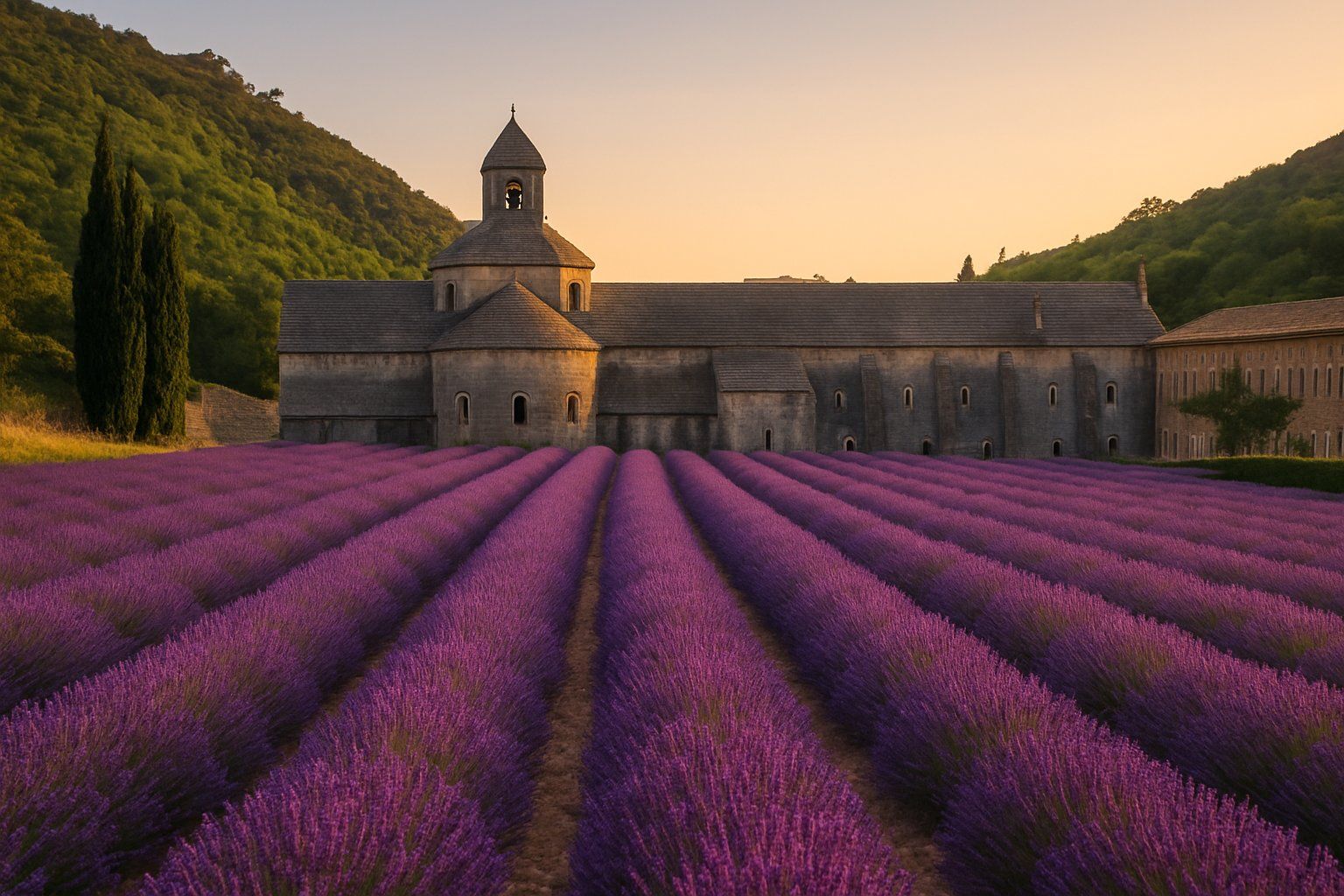
- Sénanque Abbey: The iconic image of Provence—a 12th-century Cistercian abbey surrounded by lavender rows
- Plateau de Valensole: Vast commercial fields, stunning at dawn or dusk
- Sault: A lavender town with annual festival in mid-August
Practical Tips
- The Luberon requires a car. Public transport is limited.
- Visit on market days: Gordes (Tuesday), Lourmarin (Friday), Bonnieux (Friday)
- Book restaurants in advance during summer—the villages are small.
Mont Sainte-Victoire: In Cézanne's Footsteps
Distance from Aix: 15 minutes to trailheads
The mountain that obsessed Paul Cézanne rises 1,011 meters east of Aix-en-Provence. He painted it over 80 times, and hiking its trails reveals why: the light changes constantly, the rock shifts from white to pink to grey, and the views stretch from the Alps to the Mediterranean.
Hiking Options
Croix de Provence (5 hours round trip): The classic hike, summiting at the distinctive iron cross. Start from the Parking des Venturiers or Le Tholonet.
Terrain des Peintres loop (1 hour): Easy walk to Cézanne's painting spots, with panels showing his views.
Bibémus Quarries (guided tour only): Explore the ochre quarries where Cézanne worked, now preserved as a cultural site.
Practical Tips
- Trails can be closed in summer due to fire risk—check before hiking.
- Start early in warm weather; there's little shade on upper slopes.
- The Maison Sainte-Victoire near the trailhead has maps and information.
Les Baux-de-Provence: Medieval Drama
Distance from Aix: 45 minutes | From Marseille: 1 hour
Les Baux is a medieval citadel perched on a rocky spur in the Alpilles, with ruined walls and the skeleton of a once-mighty fortress. It's undeniably touristy—but the setting is genuinely spectacular.
What to See
The Château des Baux: The ruined castle complex, with siege weapons reconstructed for demonstrations. Views stretch across the Alpilles and toward the Camargue.
Carrières de Lumières: The former quarries now host immersive art projections—massive images projected onto the cave walls, accompanied by music. The annual exhibitions change themes.
The Village: Narrow streets lined with artisan shops and restaurants, best explored early morning or evening when day-trippers have left.
Combine With
- Saint-Rémy-de-Provence: A lovely market town (Van Gogh's asylum is nearby), 20 minutes away
- Alpilles wine tasting: The surrounding appellation produces excellent rosé and red
Arles: Roman Provence
Distance from Aix: 1 hour | From Marseille: 1 hour
Arles was the capital of Roman Gaul, and its monuments remain remarkable: a massive amphitheater (still hosting bullfights and concerts), a nearly intact Roman theater, and the remnants of baths, forums, and cemeteries.
But Arles is also Vincent van Gogh's city—he painted over 300 works here, including "Café Terrace at Night" and "The Yellow House." The Fondation Vincent van Gogh explores his legacy, while plaques around town mark his painting locations.
More recently, the Luma Arles complex has made the city a contemporary art destination. Its striking Frank Gehry-designed tower dominates the former railway yards, now a sprawling cultural campus.
What to Do
- Walk the Roman monuments (a combined ticket covers all sites)
- Visit the Musée Départemental Arles Antique for Roman sculptures and mosaics
- Explore Luma Arles and its exhibitions
- Wander the old town, comparing Van Gogh's painting sites to modern reality
- Attend a concert or event in the amphitheater (summer schedule is excellent)
Market Day
Saturday brings one of Provence's best markets, sprawling along the Boulevard des Lices.
The Camargue: Wild Wetlands
Distance from Arles: 30 minutes | From Marseille: 1.5 hours
The Camargue is Europe's largest river delta—a strange, flat landscape of salt marshes, lagoons, and rice paddies, famous for white horses, black bulls, and pink flamingos.
It's not conventionally beautiful, but it's haunting and utterly unlike anywhere else in France.
How to Explore
Parc Ornithologique du Pont de Gau: The best place to see flamingos up close, with boardwalks through the marshes.
Saintes-Maries-de-la-Mer: The Camargue's main town, a pilgrimage site for the Roma community and a base for horseback riding.
By bike: Flat terrain makes cycling ideal. Rent bikes in Arles or Saintes-Maries.
By horseback: The traditional way to explore—many ranches offer half-day rides.
Planning Your Day Trips
From Aix-en-Provence
| Destination | Time | Best For |
|---|---|---|
| Mont Sainte-Victoire | 15 min | Hiking, Cézanne |
| Marseille | 30 min | Urban contrast, food |
| Cassis & Calanques | 45 min | Coast, swimming |
| Luberon villages | 1 hour | Beauty, markets |
| Les Baux | 45 min | Medieval drama |
| Arles | 1 hour | Roman history, Van Gogh |
From Marseille
| Destination | Time | Best For |
|---|---|---|
| Calanques | 30-45 min | Hiking, swimming |
| Cassis | 30 min | Seafood, wine |
| Aix-en-Provence | 30 min | Elegance, markets |
| Les Baux | 1 hour | Medieval drama |
| Arles | 1 hour | Roman history |
| Camargue | 1.5 hours | Wildlife, atmosphere |
The Verdict
Provence rewards exploration. The obvious attractions—lavender fields, perched villages, coastal calanques—are obvious for a reason: they're genuinely spectacular. But the region's magic lies in its contrasts: aristocratic Aix and working-class Marseille; cultivated Luberon and wild Camargue; Roman Arles and modernist Luma.
Base yourself in Aix for elegance and easy access to the Luberon. Choose Marseille for energy, food, and the coast. Better yet, spend time in both—they're only 30 minutes apart, and together they unlock all of Provence.
Planning your Provence adventure? Our detailed guides to Aix-en-Provence and Marseille cover everything you need for a perfect visit.
Related
Continua a esplorare
48 ore a Dublino: pub, letteratura e georgiana
Due giorni a Dublino: scopri luoghi letterari, pub vivaci e piazze georgiane. Un piano rilassato e percorribile a piedi con consigli locali, info sui trasporti e dove mangiare.
48 ore a Bruxelles: cioccolato, birra e Art Nouveau
Due giorni a Bruxelles: assaggia cioccolato d'eccellenza, gusta birre belghe iconiche e segui un itinerario Art Nouveau tra quartieri eleganti. Piano pratico e passeggiabile in 48 ore.
3 Giorni a Edimburgo: Castello, Vicoli e Whisky
Itinerario pratico di tre giorni a Edimburgo che bilancia Castello e Royal Mile con vicoli nascosti, degustazioni di whisky e consigli locali per una fuga indimenticabile.